If the Holy of Holies was easy to get into, it wouldn’t be holy: A review (of sorts) of L. Michael Morales’ “Who Shall Ascend the Mountain of the Lord?”
Contrary to popular misconception, the Bible is not a book. It’s not even a library of books.
The Bible is, in actuality, a civilization. It is the encapsulation of an entire people and culture and way of life.
Of course, that Book is the medium through which the record of that civilization is preserved and conveyed to us, but it is a profound error to think of it in terms, therefore, of being a mere collection of literature among other works of literature – as if the fact that it can be bound between two covers and occupy shelf space alongside, say, a cookbook or an adventure novel, it exists on the same level.
And, it’s worth noting that this is not me speaking as a believer. All of this is true, regardless of any given person’s theology. Of course, as a believer, I know it is far more, even, than what I have described here so far, but what I have described here is the very least of what the Bible is. This is just the ground floor. Skeptics will often dole out facile dismissals of Christian belief along the lines of, “You only believe that because you read it in some book,” as if it’s a dunk; but no – it’s a personal advertisement of both profound ignorance and towering arrogance, because it’s not “just some book,” even on the most hardened naturalistic terms.
This, among other ruminations, has been percolating since I read “Who Shall Ascend the Mountain of the Lord?” by L. Michael Morales.
I read it about a year ago, but I’ve been possessed by it – in the best possible way – ever since.
Outside of the Bible, it is the single most profound and life-changing book I have ever read.
And I don’t mean, “The most profound theological book.” I mean, of all books.
It has utterly transformed my understanding of the Atonement in particular, and therefore my spiritual life in general, and therefore my life in its entirety.
‘Just Bottom-Line It For Me’
As I’ve struggled to explain to people why that is and why this book is so profound and important, there are no words that I can offer to truly communicate it. All of my words about it – as far as I can tell, at least (and I’ve been pretty careful) – are true. But mere words are dismally inadequate to convey it.
This is due in large part to the transcendent nature of the Truth I have been fumbling around to communicate.
But there is an additional barrier to understanding in the form of the basic assumptions that Christians commonly bring to the discussion.
In a lot of ways, Christians aren’t much different than that aforementioned unbeliever who rejects the Bible as “just some book.” They don’t get there by the same smug contempt for religion, but by a path of reverential acceptance of various institutional conventions, they wind up in a very similar place.
Christians hardly have a monopoly on this, but like everyone else, we tend to want the path of least resistance, which lends itself to the minimalist/legalist mindset so often mistaken for righteousness yet condemned throughout the Bible. You can see this in the Gospels, in many of the questions that people brought to Jesus that amounted, essentially, to, “What’s the bare minimum I have to do to placate God? What’s the lowest bar I have to meet to get God off my back, so I can stop worrying about religion and what happens when I die? How much sin can I get away with?”
And the answer, of course – according to the terms of the question – always amounted to, “Be perfect or be damned. The Father will tolerate nothing less than absolute sinless moral perfection.”
If you try to be justified by observance of the Law, nothing less than absolute compliance will do.
Today, we understand the gospel in terms of “salvation by grace through faith.”
We cannot be justified by our obedience to the Law. We can only be justified by faith.
And, this – as stated – is what the Bible plainly teaches.
Except, by filtering this through that minimalist/legalist mindset, we often supply wildly mistaken definitions to each of those terms, winding up with a hollow and destructive “gospel” that saves no one.
I once had a two-or-three-hour, heated debate with a so-called “Jehovah’s Witness” who insisted – according to the standard JW dogma – that Jesus was not crucified on a t-shaped cross, but on a vertical “torture stake.” (They are not witnesses to “Jehovah,” and that’s not His Name, hence the quotation marks.) He argued this with a vehemence and verve that suggested that this should be the most shocking and life-changing revelation imaginable, while the whole time, I refused to engage with the historical claim at all, because I just absolutely did not care. My only interest was in getting him to explain why any of this mattered – which he kept deflecting in his efforts to force-feed me the information about the historical claim, on the apparent belief that this would open my eyes and convert me, if only he could get me to ingest the data to compel the change.
After six hours of this (I wasn’t keeping track, but that’s what it felt like), he finally answered, “Well, we’re saved through faith, aren’t we?”
“Sure. Of course,” I shrugged.
“So shouldn’t we make absolutely sure we believe the right things?!” he exclaimed as an intended verbal slap to the face to awaken me to the stakes (no pun intended).
Further probing revealed that he believed wholeheartedly that a person’s standing before God hinges entirely upon holding all of the correct beliefs. If someone went through life believing Jesus died on a cross rather than a vertical stake, God will reject him as an unbeliever on the Day of Judgment.
JWs are very peculiar about the makeup of those “correct beliefs” and extreme in the granularity of that makeup, but the overall assumption is generally consistent with that of mainstream Christianity: the “faith” that supposedly saves us is typically defined – albeit implicitly, most often – as “holding the correct doctrines about God and Jesus.”
Christians are often, therefore, highly preoccupied with concerns of “What are the minimal beliefs a Christian must affirm in order to be saved?”
And by “saved,” they mean a change in forensic status, according to which they are bound for heaven in death instead of hell. Everything else (such as the ontological change that constitutes actual salvation, which is supposed to follow the status change) is largely an afterthought.
So, it’s not unusual for Christians to take to the Bible as a catalogue of doctrines, mining it for proof-texts to support their particular theological system or institutional traditions, so they can draw the right boundaries by which to determine who is in and who is out, and they guard those boundaries with the same stridency with which my acquaintance argued about the shape of the wood on which Jesus was crucified. They might draw those boundaries with a broad brush instead of the scalpel my friend was using, but it’s with the same basic set of assumptions.
And so, the “faith” that the New Testament writers set out as a corrective to justification under the Law becomes just another law – not of ritual performance and outward behavior, but of doctrinal affirmation.
‘There is a Difference Between Knowing the Path … and Walking the Path’
With regard to the Atonement, I happen to agree wholeheartedly with the doctrine of Penal Substitutionary Atonement that most Protestants glean from the Bible.
But, until I read Morales’ book, I did not truly understand it. I could articulate the doctrine well enough and I believed it with full sincerity, but I didn’t really know it – what it means and why it means it and how it maps to reality in practical, concrete terms. It was abstract. It was a doctrine.
And so, I was not transformed by it to anything close to the extent to which I am now. It did not inform the way that I relate, moment-by-moment, to God and to the world. My faith was real, and so my relationship to God was real; but it was a clumsy, immature, partially blind faith, by comparison.
“Who Shall Ascend the Mountain of the Lord?” is about the theology of the book of Leviticus.
And, I’m chuckling right now as I type this, because of the reaction I typically get whenever I have this conversation in-person, which I imagine now on the part of the reader.
To most people – especially to Christians, who are the people most likely to have attempted to read it – the word “Leviticus” is synonymous with tedious, unrelenting boredom undertaken as a religious chore. And to outsiders, it’s the book that the Alphabet activists like to wield as a cudgel against Bible-believers for its seemingly primitive, backward and nonsensical prohibitions against bacon, mixed fabrics and sodomy.
So, it is the single most assiduously neglected book of the Bible.
It is also the single most important book of the Bible.
And that’s not according to me, nor even Morales. That’s according to the Bible.
As Morales explains in his book, the Torah – the Five Books of Moses that are the foundation of the rest of the Bible – is arranged in a chiasm. Named for the X-shaped Greek letter “chi,” a chiastic literary structure is arranged around a central point for emphasis, with the outer points mirroring one another and pointing inward to that central point. A chiastic structure positively screams at the reader, “This – right here in the center – is what this entire work is all about.”
The Torah is arranged A-B-C-B-A. Genesis and Deuteronomy – the As – mirror one another in their theme of the identity and character of God’s covenant people. Exodus and Numbers – the Bs – narrate the Israelites’ wilderness wanderings under God’s and Moses’ guidance. Everything in Genesis and Exodus anticipates Leviticus, and everything in Numbers and Deuteronomy is in hindsight of it. According to that structure, Leviticus is the central axis around which the Torah, and therefore the rest of the Bible, revolves.
(As an interesting aside, this is reinforced in the Gospel of Matthew, which is often referred to as “the Miniature Torah” for its chiastic arrangement around five distinct discourses, each of which corresponds in theme and emphasis to its respective book of the Torah. Which means, if you don’t know the Torah, you cannot understand the first book of the New Testament; and if you don’t understand Leviticus, you have not understood the Torah. Leviticus is the literary lynchpin of the entire Bible.)
And, Leviticus – the C of the Torah’s chiasm – is itself internally arranged as a chiasm centered upon the Day of Atonement, Yom Kippur, as the central focus. So, everything from Genesis 1:1 and on is buildup to that event, and everything that follows is in consequence to that event.
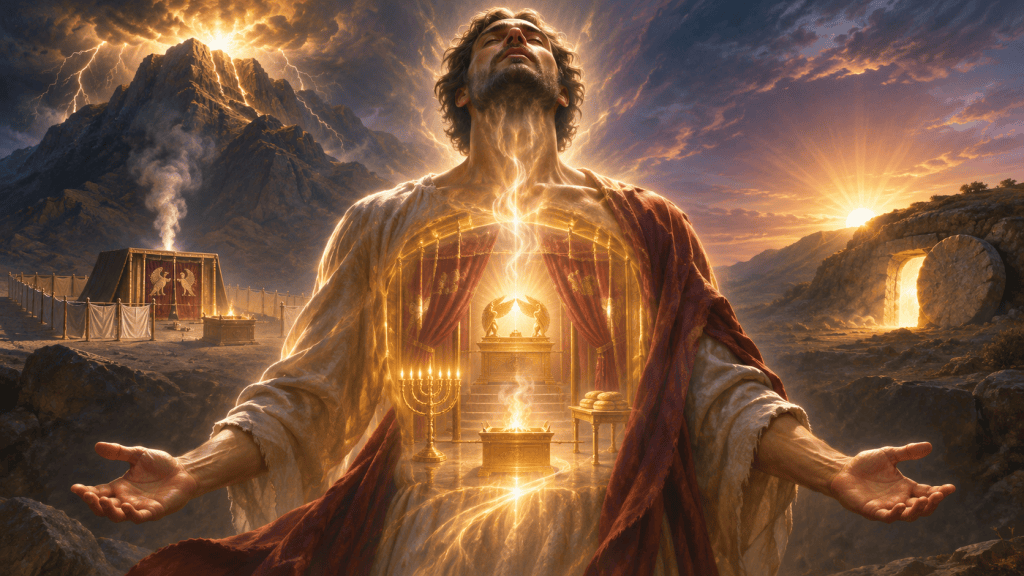
The Day of Atonement is the one day of the year in which the high priest entered into the Presence of God in the Holy of Holies within the tabernacle (later, the temple), where the Ark of the Covenant resided.
As Morales explains, the tabernacle was a portable Mount Sinai – the holy mountain on which God revealed Himself to Israel after leaving Egypt. But, more fundamentally, it was an architectural recreation of the Garden of Eden – the original “temple” where God dwelled with Man on earth, and of which all other temples, high places and sacred spaces in history have been attempts to imitate and restore in some form or another.
The high priest was the representative of all of Israel, and the nation of Israel was itself the priestly nation taken as the first fruits representative of all of humanity.
So, this was the annual Day when humanity – representatively speaking – was reconciled to God and admitted into His Presence.
The fact that Leviticus is simultaneously the most neglected and the most important book of the Bible is not a contradiction or a paradox. These are different facets of the same quality.
It is the Holy of Holies of the Bible.
Just as only the high priest can enter the Holy of Holies – and that only at the appointed time and with the prescribed sacrifices correctly offered, casual readers simply looking to mine it for proof-texts are not admitted entrance into the Holy of Holies of the Bible.
It is supposed to be prohibitively boring. It is supposed to repel those who do not approach with the requisite reverence, humility and commitment that only a sincere faith can motivate. It is supposed to grate against incompatible sensibilities. Because only those who are justified by faith and thereby purified of sin can enter to obtain the blessings that are to be found exclusively therein.
And that barrier to entry is in large part due to the fact that the book of Leviticus is not, per se, a work of literature intended be gratifying for its own sake or to study and thereby obtain information to shape religious beliefs. That’s not what it was to the Israelites, at least.
Rather, it was an operating manual for the temple – for how to live in God’s Presence. They didn’t read about the Day of Atonement and the rest of the sacrificial rituals. They lived it, every year and every day that the temple stood. And every day of exile in which the temple was in ruins, their life was defined by mourning its absence.
The temple was the center of their existence – culturally, institutionally, morally, philosophically, etc. Their entire way of life grew out of that center.
The concepts and themes that permeate Leviticus are about how sin separates us from God, which is why the world is corrupted, why God is absent and humans are savage and bestial. God Himself is the Source of light and life and blessing, but sin cannot exist in His Presence without being destroyed. Cleansing the temple and expiating sin so as to maintain their fitness for God’s Presence resulted in life and blessing for the nation, manifesting in health, beauty, justice, righteousness, prosperity, fertility and security. Anything that renders them unfit to be in His Presence, therefore, is ugly, diseased, decaying and deadly.
Of course, this is all basic information for all Christians, without necessarily reading Leviticus. I’m not offering any new information here. This is a matter of settled doctrine for any basically-biblically-literate Christian.
But, what has been striking to me as I followed Dr. Morales’ high-priestly (so to speak) guidance through Leviticus is that God did not reveal any of this to the Israelites as a matter of mere doctrine. He prescribed this as a way of life, so that the Israelites would know all of this in their very bones. He knows our proclivity for minimalism/legalism, and so He built an entire civilization around these truths. Living this out every single day for centuries would have ingrained in them a deep and abiding sense of disgust for sin, and an association with holiness of beauty and joy and glory, a sense of dread at the thought of offending God, and a deep experiential sense of what it takes for fallen mortals to overcome the separation from Him that our sin requires.
Insofar as they lived out the prescriptions and prohibitions of Leviticus (and we know that they weren’t always consistent), they lived their lives on a razor’s edge between two extremes: on the one side, holy terror at the prospect of offending the One Who dwelled among them, and on the other, joy and glory and blessing from living by His grace.
The Fulfillment of the Ages
So, when faithful Jews learned about the death of Jesus of Nazareth, and it was reported to them that, at the moment of his death, the world itself shook and the curtain in the temple was torn in two … For us, the significance of that confluence of events must be explained, and then we can understand it on an intellectual level, in the abstract. But for them, they knew immediately, intuitively, in their very bones … everything is different now. Just as we can see – in terms of narrative structure – how everything turned on the Day of Atonement within the Torah, they understood that, with the death of Jesus, history itself has taken a turn, the cosmic, supernatural significance of which cannot be overstated.
The resurrection of Jesus confirmed that meaning: with purification for sins made once for all, the Life of God now dwells within humanity. Each of us who live within the meaning of that sacrifice is now a “portable Mount Sinai.” We are the temple. We are God’s very Presence on earth.
And, again – as a matter of doctrine, this is all old hat to any garden-variety churchgoer. The profound joy, the transformation of consciousness and outlook … and more than that – the ontological transformation, the new self that this Truth brings about, tempt me to keep writing, to try to plumb the unfathomable depths and astonishing heights of everything this means, but … they’re just words, and words only go so far.
Salvation is no mere doctrine to believe, but a Reality to live out.
But, words have their place, and L. Michael Morales’ words in “Who Shall Ascend the Mountain of the Lord?” have had a profound impact on me. I cannot recommend it enough.


Leave a Reply