The stronghold we must demolish is our own.
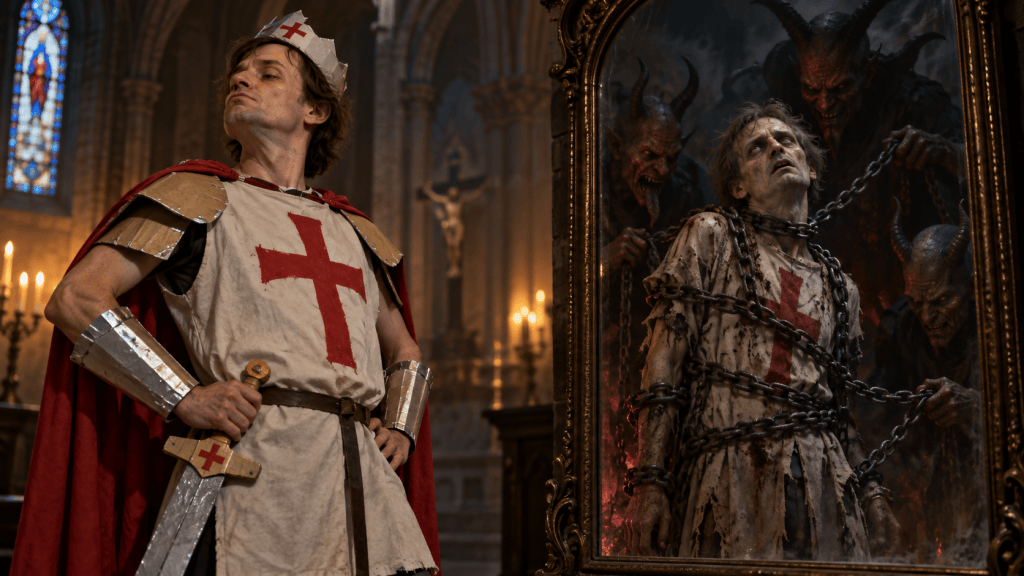
There is an exercise that, at every opportunity that presents itself, I implore each Christian to undertake:
Set apart a few hours on some rainy weekend to sit down with the Bible and a notepad, and write down “Column A” and “Column B.”
Open the Bible to Genesis 1:1 and just start scanning, line-by-line, passage-by-passage, book-by-book.
In Column A, note down the scriptural address of every verse, phrase or passage that explicitly, plainly and unambiguously conveys this “dying and going to heaven as a disembodied soul/spirit”-idea that we all take for granted as the meaning of “salvation.” And, of course, you’ll want to pay especially close attention to the very first mention of this concept – underline it, highlight it, put a big circle around it with an asterisk or five, bookmark your Bible in that spot – because that will be the most important example and the one to which all subsequent examples refer back and build upon. That one’s a keeper. That’s a verse to prioritize in your Bible-verse-memorization queue – maybe put it on a plaque to hang up in your library.
In Column B, note down all of the scripture verses from which this idea can merely be inferred … if we start out already “knowing” that’s what the Bible is about and we are looking to confirm our bias.
(Of course, if you don’t have the time or inclination for any of this, there is always the option of plugging these instructions in as a prompt for your favorite chatbot. But, you will need to adjust for the fact that they are generally programmed to tell you what you want to hear, and be commensurately skeptical and intellectually honest in your pushback.)
By Revelation 22:21, you’ll have a solid dozen or so examples for Column B, depending on how hermeneutically creative you (or your preferred chatbot) are.
But you will have precisely zero examples for Column A. None. Not one single solitary verse. You’ll have nothing for that plaque, nothing to memorize or highlight and underline or bookmark, because that verse does not exist.
Every example in Column B, if it’s read in context and properly understood, will turn out to be about something else entirely that will fit much more naturally with the writer’s broader train of thought than “dying and going to heaven” does – bodily resurrection at Christ’s return, the messianic kingdom, the renewal of creation, the present indwelling of the Spirit, our status before God by our being identified with Christ, etc. None will actually be about an afterlife in some other world as immaterial, disembodied beings.
There is not a single genuine example of anyone going to heaven in death as a disembodied soul or spirit. It is never described as happening, God never promises it, no one ever asks for it, prays for it or hopes for it. God makes a lot of promises throughout the Bible, and people ask Him for a great many things, but that is never once among them. It just isn’t there as a concept in the Bible.
And if I am wrong about this, it should be super easy to shut me up and make me stop bringing this up all the time: Just find even one solitary example for Column A. Just one. That’s all it would take, and you’d be doing me a huge favor, because if I’m being honest, this isn’t any fun for me. I don’t actually like being the lone, grating voice of dissent at every Christian gathering, denouncing everyone’s most cherished beliefs when everyone would prefer to just get along and be accommodated in those beliefs. I know how I come across, and it’s not a good time for me any more than it is for everyone else. Only a sociopath would enjoy that, and I’m a lot of things, but not a sociopath (I might be kind of a jerk, but I’ve never been diagnosed with anything). I would much prefer to be popular and for people to be happy about me being there.
But that verse doesn’t exist, and I refuse to lie about it – implicitly or otherwise – by not making this an issue, and I will not go away or let this go as long as there is breath in my body (or until I am refuted).
The Church Is Made for War, Not Comfort and Recreation
What should be far less controversial, though, is that the biblical narrative frames human history as one big, long spiritual war. The Devil exists, and he hates mankind and makes war upon us by attacking what is most precious to our existence: our relationship to God. The war began in the Garden when the Serpent first mutilated God’s word and undermined humanity’s trust in His character and promises, alienating us from Him and stealing our birthright as God’s appointed rulers of creation.
We know how the War ends. That has been predetermined by God and so is as absolute and inevitable as tomorrow’s sunrise.
But we do not know how long it will take, and we won’t see it coming when it happens.
Jesus was very emphatic on this point. His coming will be “like a thief in the night.”
Because we don’t know, he told us to be ready at all times by staying watchful and awake and persevering in faithfulness to our mission and duties.
And, in fact, our being faithful to that mission is directly tied to the timing of his return:
“This gospel of the kingdom must be preached to all nations, and then the end will come,” he said.
As in, the Church exists to fight that War – by preaching the gospel and demolishing strongholds, tearing down every argument and pretension that sets itself up against the knowledge of God.
The outcome of the War is inevitable, but how long it takes to get there and how much of the world is ready for it when it happens depends on us. We have to be diligent and faithful and effective at preaching the gospel of the kingdom to all nations, and the end will not come before we do. And if we don’t do it, it will not be done.
Clearly, “preaching the gospel” does not mean the mere communication of a set of doctrines. Jesus did not send the Church out to win converts. We are tasked to make disciples of all nations, teaching them to obey everything he taught. A disciple is not the same as a convert.
If we are not hard at work doing that, then we are asleep at our posts. We are not ready.
And, indeed, we are not.
The Church persistently commits what is known as the “Texas Sharpshooter fallacy”: the illustration is of a person firing off shots and then painting bullseyes around the bullet holes to create the illusion of being an expert marksman.
The Church does not preach the gospel. We do not make disciples. We do not function as the Church is supposed to function.
What we do is apply biblical labels like “discipleship” and “evangelism” and “unity” and “fellowship” and “mission” and the like to the activities that the Church is doing, so we can satisfy ourselves that we’re faithful, but the activities the Church is doing are not what we see in the New Testament.
This is most obvious in the supposed “gospel” we preach, and that error corrupts everything else about how Christians view salvation and our relationship to God and our understanding of what He values and wants us to value, and how we relate to our own bodies and to creation and how we understand our mission as the Church and how that mission relates to His promises.
Consequently, we are losing the War. Our civilization – indeed, our churches, even – are overrun with enemy strongholds. The so-called “gospel” we preach is just one such stronghold among many.
The Unsubverted Gospel
The implications of our collective error are far-reaching. Most significantly, our institutional confirmation bias blinds us to what the Bible actually does teach about salvation and the Church’s mission. It inoculates us to the truth, and that truth is far better news – a far greater gospel – than what we suppose. Christians are often discouraged to learn that their most cherished beliefs are not actually found in the Bible, but what God has promised instead is so much greater than what we ever dare imagine. Our Enemy has done a masterful job of making God appear stingy toward us by this phony “soul migration to a spiritual afterlife” scheme.
I have written a three-part series to explain what the gospel actually is and what the Church is supposed to be doing.
In part 1, “The Unsubverted Gospel,” I explain why it matters that we dispense with this insipid “pie in the sky when we die” nonsense, and what is offered instead. The Bible communicates a vastly different cosmology and anthropology than what commonly passes as the “Christian” or “biblical worldview,” and in this chapter I detail the true biblical worldview.
In part 2, “From Appetite to Immortality,” I explain the human condition resulting from the Fall, and what “salvation” from that condition means, in practical terms.
In part 3, “The Forge of Saints,” I lay out a step-by-step blueprint for a faithful, effective and operational Church, offering actual biblical discipleship. Then, there are two appendices in which I address the two most common objections. The first, “Where Did the Church Go Wrong?”, documents the historical path of the early Church from faithfulness to apostasy. In the second, “If God is in Control, Why is Christianity Dying?”, I explain the theological reasons, and the ongoing consequences of our apostasy.
And, of course, there are the common objections that the Bible indeed does teach “dying and going to heaven,” which I address in an older article: “Setting the Record Straight on Eternal Life.”


Leave a Reply