Uncategorized

  • Why I’m not a Young Earth Creationist… and Jesus isn’t either. (1/3)

    UPDATE: I disavow much (not all) of this. My views on the Book of Genesis and its relationship to science have changed considerably since I wrote this many years ago, and if I’m being honest, I’m somewhat embarrassed by much of what I’ve written here. I feel like it would be dishonest of me to remove it, however, and also — as embarrassed as I am about how I used to think — keeping it up for posterity might be helpful and instructive, if only to convey that it’s Ok to change your views in light of new information, even if you have to eat a little crow along the way. 

    Maybe I’ll get around someday soon to finally writing Part 3 of this, in which I’ll explain how and why my views have changed. For now, though, feel free to bask in my humiliation. 

    This little tractate started out as a Facebook comment the other day by which I’d intended to explain why I so emphatically reject the notion that Jesus was a Six-Day, Young Earth Creationist. I got a little carried away, though, and the discussion moved on before I could finish this and post it. Since I find myself having this conversation so often anyway, though, and since I created this blog precisely so I could collect all of these mini-lectures I find myself inflicting upon people, I thought I may as well post it here, so when it comes up in conversation again I can just say, “I wrote a blog entry about that,” and spare the person a lengthy impromptu sermon, while still providing an option to read about it at their leisure at a later time.

    Again, the discussion was about Christianity’s relationship to modern science, and why I’m so emphatic that Young Earth Creationism isn’t actually taught in the Bible, and that the Theory of Evolution is, not only a more-or-less indisputable and proven scientific fact, but the most biblically-correct model of biology on the market.

    I should further qualify my use of the word “indisputable,” though. I use it, of course, as a relative term, because any and all scientific theories exist for the purpose of being disputed. That said, I know there are flaws, gaps, and as-yet unexplained inconsistencies within the Theory of Evolution, and the work of scientists is to either figure out how to reconcile those apparent discrepancies with the broader principle on which the theoretical model is built, or to come up with a better scientific (not philosopical, but scientific) model to account for them– a model that provides more consistent and accurate predictability with regard to the phenomena under study than the  current model.

    It does no good, then, for YECs to point out apparent problems with the Theory of Evolution, any more than it would be worthwhile to point out that Isaac Newton’s Laws of Motion don’t apply to questions of electromagnetism, or that the Theory of General Relativity doesn’t agree with Quantum Mechanics. The real scientists already know all that, and that’s why the search for a single, comprehensive model of the universe has dominated the study of physics for the past 100 or so years.

    In the field of biology, there is no significant controversy over the Theory of Evolution, because there is no other theory on the market to compete with it. Intelligent Design, while true, does not qualify, because it’s not a scientific theory. There is no way to make a testable hypothesis on the basis of Intelligent Design, because it can’t be used to make any kind of predictions whatsoever about what it purports to explain. It can’t be used to develop better drugs or preserve endangered species or anything else for which a sound theory of biology is used.

    But, that’s all beside the point where Young Earth Creationists are concerned. I’ve heard plenty of people quote Phillip Johnson books, Darwin’s Black Box and other works of evangelical propaganda packaged as shrewd and sober scientific challenges to the prevailing model of biology, but it’s specious (and a bit pretentious) for Christians to claim that they dispute the Theory of Evolution on its scientific merits. Never mind the fact that most evolutionary skeptics aren’t even remotely qualified (any more than I am) to step foot in that arena, because if it weren’t for our religious commitment to uphold the Bible, most of us would never have any reason to question or comment upon the Theory’s scientific validity.

    But… here’s the main issue at work here: a great many churchgoers spend the first few years of their lives being told by others what the Bible teaches, long before they’re in any position to read it for themselves with any meaningful comprehension. Their understanding of God and the universe and the origin of man is absorbed in early childhood and shaped in large part by cartoon depictions found in coloring books and children’s Sunday school literature. Having been told so often by well-meaning but thoroughly indoctrinated Sunday school teachers what the Bible supposedly teaches, the typical churchgoer is conditioned to hold a certain collection of preconceptions long before he or she ever learns to read. In general, they learn that God is an elderly Caucasian man with a flowing white beard who, about six-thousand years ago, rolled up the sleeves on His white robe before He reached into the mud with His two five-fingered hands to sculpt each individual species of animal life, two-by-two, in the precise form in which they exist today, as an add-on to a brief, week-long project of constructing the universe by much the same hands-on method. jesus_dinosaur  This nursery-inculcated worldview is packed with colorful ideas about talking animals as commonplace features of the original state of creation, biblical figures coexisting with dinosaurs, and prehistoric man believing and worshiping on much the same terms as a modern American evangelical.
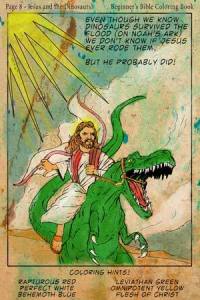
    So, when they’re old enough to then read the Bible for themselves, they wind up projecting many of these notions onto the text and feeding them back to themselves, convinced that what they’re walking away with afterward is “biblical teaching,” when it’s not.  (That is, if they actually do wind up reading it for themselves, because, let’s face it: most people filling church pews today—or even teaching Sunday school classes, for that matter—couldn’t answer basic questions about the wanderings of the Patriarchs, the Babylonian exile, or even basics about messianic prophecy, along with a host of other key concepts that collectively comprise “Christianity,” much less be able to answer questions about where the Bible came from and why it’s this particular book they uphold rather than others. None of that would be so bad, though, if we weren’t so insistent that everyone else run our shared public institutions according to our poorly-explored understanding of what constitutes Christianity. But, I digress…)

    If we take the Scriptures on their own terms, though, without projecting our own ideas in-between the lines, they’re actually much more supportive—and, even, suggestive—of the Big Bang Theory, the relativity of space/time, and, even, progressive biological evolution.

    I find it simultaneously exasperating and amusing when I encounter Christians who turn their noses up at the Big Bang Theory because they understand it only as an attack on the biblical teaching they purport to uphold. The physics community initially turned their noses up at it as well when George Lemaitre first proposed it, and for precisely the opposite reason: the notion of creatio ex nihilo (“creation out of nothing”) was, at the time, regarded as a purely theological idea– a superstition, really– so when this Catholic priest/physics professor became the first to propose it as the logical consequence of Einstein’s new General Theory of Relativity, commonly-held anti-religious snobbery led them to  assume he must have been advancing a religious agenda under a flimsy guise of scientific respectability (given some our aforementioned tendencies to dress religious indoctrination up in a nice tuxedo, it’s easy to understand why they’d think that, though).

    Lemaitre hypothesized the idea of an expanding universe suddenly appearing from an infinitely hot, dense singularity (or a “primeval atom,” as he termed it) one-third the size of a proton, which emerged inexplicably out of the darkness and void before it exploded in an immense flash of light that resolved itself into the matter and energy that comprise the universe in its entirety. The “Big Bang” Theory (a label originally meant as a pejorative before it stuck) has since been confirmed to be true several times over, but at the time, they dismissed it as nothing but a mathematical apologia for the scriptural passage reading, “In the beginning God created the heavens and the earth… And God said, ‘Let there be light,’ and there was light. God saw that the light was good, and he separated the light from the darkness. God called the light ‘day,’ and the darkness he called ‘night.’ And there was evening, and there was morning—the first day.”

    At the time, conventional wisdom among physicists had it that the universe was eternal and static, and the idea of a cosmic beginning was regarded as a quaint religious myth. A curious reversal has occurred in the intervening century in that what was once regarded as a superstition to be derided by the intellectual elite is now axiomatic to scientists’ understanding of the universe, and so is often derided instead by the religious elite.

    Of course, the final verse quoted is often taken to mean all of this happened within the span of a literal, 24-hour day… which would be a plain and obvious, albeit superficial and mistaken reading.

    If light = “day” and darkness = “night,” and this was the first such occurrence of day and night, then of course it’s a literal 24-day, right?

    Except, light and darkness on planet Earth are the consequence of rotating in and out of the illumination of the sun—something that wasn’t possible until the Fourth Day, when God set the sun, the moon, and the stars in the skyward view of the Earth. And, we read, He didn’t do it just to provide light, but to “serve as signs to mark times and days and years.” It reads that “God set them in the vault of the sky to give light on the earth, to govern the day and the night, and to separate light from darkness.”

    Yet, God had already separated light from darkness before, thereby creating the day and night that marked the First Day. Two more days then elapsed according to the standard of time established on the First Day. But, it wasn’t until the Fourth Day that He “separated light from darkness” on earth, thereby creating the night and day that mark a “day” as we experience them.

    So, whatever else the passage means, that original, primeval scale of time established on the First Day could not have been a literal 24-hour day as we experience them, but a different measurement of time entirely. It was the broader, cosmic framework of time by which the general stages of creation progressed, but not a “day” as we know them, and the Creation account was written in such a manner as to make that distinction explicit.

    Of course, when it’s read under a universally-held assumption that “a day” is just a day, and can only mean a day—because time is known to be static and linear and absolute and non-negotiable—the error is understandable. It ignores an explicit distinction within the text, but it’s still an understandable error, given the limits of our common perception of time. In the age after Einstein, though, we know better, and so, evidently, did the author of the Creation account. We know now that time is relative to the observer’s frame of reference, and that variables like mass and gravity and the curvature of space will affect the rate at which time flows, just like a boulder in a river will affect the flow of water around it. A person standing inside something as massive as the Great Pyramid of Giza will be subject to time at a slightly slower pace than a person standing in the open, but much faster than someone who might be standing on the surface of a planet the size of, say, Jupiter (I know, I know—Jupiter doesn’t have a surface, but use your imagination). If a person were unfortunate enough to be caught at the event horizon of a black hole, observers in the distance would see the cascade of events play out practically instantaneously, but to the person himself, the episode would take hundreds of years to play out, and it would appear to the person that he was frozen in place at the black hole’s edge, because time itself would slow to a crawl in the midst of its immense gravity.

    What we needed Albert Einstein and Stephen Hawking and others to teach us about time, other biblical writers were able to figure out on their own somehow: time is relative to the observer’s frame of reference, so an observer from, say, God’s frame of reference could experience a day to be as long as a thousand years, or a thousand years to go by as quickly as one day. God created time, and so He stands outside of it, beyond it, so millions of years to Him are as brief as the moments between the tick of a clock, and the moments between a clock tick are as long as the age of a universe. We don’t know exactly how long, from our frame of reference, the Six Days of Creation were (nor is that the point), but a plain comparison of Genesis 1:17,18  with vs. 3-5 should tell us that it’s not a literal 24-hour day in view when the six stages of creation are referred to as “days.”

    The days of creation, then, couldn’t have been the brief, comparatively instantaneous episodes we understand them to have been from our childhood indoctrination, but would have been cosmic epochs in which the progress of creation gradually came into place.

    And I say “came into place” because, we read (contrary to the depictions of our childhood), at no stage of creation did God ever directly intervene. Rather, He expressed His will, and creation carried it out. He said, “Let there be…” and then it was. He commanded, and creation obeyed. He issued the command, the law, the principle, the pattern, by which the universe would operate, and He issued it in a specific orderly, progressive manner.

    Nowhere is this more pronounced than on the Sixth Day, when He created animal life; or, rather, when He commanded that the earth create animal life:

    “And God said, ‘Let the land produce living creatures according to their kinds: the livestock, the creatures that move along the ground, and the wild animals, each according to its kind.’ And it was so.”

    According to the Scripture itself, God did not reach into the mud and shape each species with His own two five-fingered hands. Rather, He merely commanded, and the earth brought it forth, of itself, according to His will, according to natural laws dictated by God. The earth—which previously was not “alive” in any biological sense—produced life of itself, and it emerged from the planet “according to its kind.”

    So, if life emerged from the earth according to the natural processes set in place by the Creator, it stands to reason (and fossil record observation) that it was more like the material already present in the earth when it started out, so it emerged in a simple, basic form, then reproduced with degrees of variation and complexity in successive generations “according to its kind,” i.e., its taxonomy, eventually separating into phyla, classes, orders, families, genii, species, subspecies, etc.

    Eventually, near the conclusion of the epoch known as “the Sixth Day,” a completely unique and unprecedented species of life arose—a species unlike any previous “kind”—a species made uniquely “in the Image of God.” It was a species with a power like that of God: the power to speak—to think and communicate in symbolic terms, and to thereby create with that speech.

    Clearly, Man could not create ex nihilo as could God, but he could create systems of symbols by which God’s creation could be organized, understood, and subdued: Man’s first work was to name the animals, and so he participated, in a fashion, in God’s process of creation (Genesis 2:19, 20).

    Of course, an obvious objection to this line of reasoning is that the Scripture reads, “God formed man from the dust of the earth,” so (some reason), Man could not have evolved as “just another animal,” but was specially created by God.

    Specially created we were, for sure, but there is no elaboration in Scripture of the specific process by which God made us. The only specific mention is of the material used: the dust of the earth, which is the same material of which the rest of the animal world is composed, having been “brought forth from the earth” on the Sixth Day. The Scripture says nothing about how many degrees of removal Adam was from the earth, nor the specific process by which his physical material was transformed from mere dust into the cells of his body.

    There is a strong suggestion of the general process, though: Mankind emerged at the end of the Sixth Day, which began with God’s command that the earth bring forth living creatures. The creation of man began with the emergence of that first single-celled, self-replicating organism, which fed on the nutrients of the earth and reproduced itself over trillions of generations for millions of years, gradually transforming through mutation and natural selection, taking on new powers of movement and awareness and communication, and the ability to manipulate its environment to its advantage.

    The eventual result was the vast complexity of life we see around us today—something the earth produced of itself,  according to natural laws of chemistry and physics decreed by God, as we read in scripture.

    Of course, it doesn’t say that in so many words. It reads only that “God said, ‘Let there be…’ …and it was.” It isn’t much of a leap, though, to read it to mean that, implied in the command “Let there be…” were the instructions “Let the natural laws of chemistry and physics be such that this outcome occurs.” In fact, there is no material difference between these two wordings—they are different ways of saying the exact same thing.

    Naturally, though, such an explicit description would have been lost on a Bronze Age readership, as would an explicit description of creatio ex nihilo.

    After all, it never reads “creation out of nothing” in so many words either. In fact, the only explicit mention in scripture of God creating the universe “out of nothing” is found in the Apocrypha (2 Maccabees 7:28), written centuries after the Genesis account.

    That concept might have been a bit advanced and alien for its time as well—as alien as describing the development of life in terms of the laws of thermodynamics, genetic variation, and natural selection. The number zero wouldn’t be invented for another few centuries, and most cultures at the time believed that the gods had fashioned the world out of some pre-existent material (usually the carcass of a giant dragon or sea monster, or on the back of a giant tortoise, which stood on the back of another, larger giant tortoise standing on the back of a stiller larger tortoise, ad infinitum). The account in Genesis seems to play to that expectation, even as it undercuts it: “Now the earth was formless and empty, darkness was over the surface of the deep, and the Spirit of God was hovering over the waters.”

    All language is based on symbols, and symbols have to be recognizable– they have to be based on objects and experiences common enough to be easily referenced and recalled by the people who share the language; otherwise they’re just gibberish. And, Bronze Age Hebrews had a much less varied range of common experiences to reference than modern English speakers. Consequently, there are fewer than 9,000 unique words in the Old Testament, which speaks to an ancient Hebrew vocabulary that was much more limited than the more than one million words we have in the English language today.

    Yet, the writer of Genesis had to somehow describe something that happened beyond and prior to any human experience– something for which no human being had ever had to come up with language to describe before, using only the limited range of shared experience represented in those 9,000 words. 

    All things considered, one can only admire the unrivaled genius at work in the economy of language found in the book of Genesis, as well as the prescience in describing realities we take for granted today, yet were inconceivable to anyone living at the time.

    They had no concept at the time, and therefore no words– no direct symbols for “zero” or “nothing” or for the vacuum of space. So, the sea—with its dark, unknowable depths and unpredictable, turbulent motions—was typically employed as a descriptor in pagan creation mythology for the primeval chaos of the universe prior to the formation of the earth. Genesis seems to use that expectation as its starting point, but qualifies it by describing the earth as being, in Hebrew, tohu—without form or shape, and bohu—without substance or content, and covered in darkness—the absence of light or appearance. In a culture with no number zero and no concept of “nothing,” this was as close as the writer, in near eastern Bronze Age terms, could get to saying, “there was nothing prior to creation.” But, the writer of 2 Maccabees and others at the time seemed to catch on, and creatio ex nihilo became the standard interpretation of Genesis 1:1-5, long before there was any scientific justification to believe the universe had a beginning in time, prior to which there was nothing.

    Likewise, it doesn’t read in so many words that God created life by saying, “Let the laws of chemistry and physics and biology be such that complex animal life emerges from the planet,” but I think we can safely infer that from what is written. That reading, at least, depends far less upon our preconceptions than the cartoonish, anthropomorphized version offered by children’s Sunday school literature.

    As life proliferated and adapted and struggled and took on new powers and forms, the evolutionary Great Leap Forward finally happened late in the epoch referred to in scripture as the Sixth Day: a single specimen of primate was born, which appeared in all respects to be like every other member of its species. It was mostly hairless, could walk erect, had opposable thumbs—just like all the others of its kind. But, it understood things in a way others couldn’t, and tried to communicate what it understood, but to no avail: it was isolated in its understanding, for it alone carried the mutation that made the crucial difference between anatomically modern humans and behaviorally modern humans. It had inherited its large cranium from its forebears, which they developed by having learned the magic of fire, which enabled them to cook and digest meat in order to fulfill the massive requirements of protein demanded by their larger brains. But, this new specimen could do much more than conjure fire with dry wood or with flint and brush. It could develop a vast array of symbols in the form of sounds, which it could use to try to communicate with others of his kind… if only there were any others of its kind.

    This capacity for symbolic thought and communication amounted to the capacity to think in abstract terms, beyond just the grunts and gestures that meant “danger” or “food” or “let’s mate.” This capacity for abstract thought gave it the capacity—gave him the capacity, rather, to understand the existence of his Creator, and to worship Him.

    Adam was made from the dust of the earth, but not directly—not by God’s direct contact with the dirt. He was made from the dust of the earth in the same way we all are: we’re conceived in our mothers’ wombs and then we grow from the material provided through the food they eat, which is made of nutrients from the earth, delivered by way of plants, or by the meat of animals that ate the plants. Adam was born of a mother and a father, but he was born with a particular mutation that made him unique in all the world: he was the first of his kind, made in the image of God.

    This would explain, of course, where Cain got his wife, and it explains who all those people were of whom Cain was so terrified when God banished him to Nod: humanity—or, at least, proto-humanity—existed prior to the arrival of Adam. The writer of Genesis seemed to take it for granted that the human race existed in some capacity prior to God’s creation of Adam and Eve, and seemed to expect readers to understand that as well. No explanation was offered for who these people were who populated the city built by Cain, nor who it was that posed a threat to him in his banishment. Yet, every time a descendent of Adam was conceived and born, the writer was explicit about his origins: “Cain went in to his wife and she became pregnant…,” etc.

    These earlier specimens of humanity were superficially and anatomically identical to Adam and his descendents, but they lacked the mutation gained in the Great Leap Forward—a mutation that gave them the power of abstract, symbolic thought by which they created systems of zoology and morality through which they were able to assign qualitative value to animals and objects and relationships and people. They were able to recognize beauty and truth and goodness beyond mere sensory input and gratification of appetite, which is how they, and they alone in all the world, were able to relate to their Creator, and to experience guilt and shame over immorality and betrayal.

    The ancients understood the significance of this distinction. The relationship between speech and creation and it’s centrality in the condition of man as the unique bearer of God’s image was a major avenue of exploration in Jewish mysticism, long before evolutionary biologists and anthropologists came up with terms like “Great Leap Forward” and “behavioral modernity” to explain the same truth. Kabbalists expressed it through mantras like Abracadabra, which is Aramaic for “As I speak, I create.”

    They, and the Greek philosophers with whom they exchanged ideas, understood humanity’s symbol-based rationality to be of the same quality as the Divine Mind that created the universe. The quality was the same, but the degree was but a miniscule fraction of the infinite Supreme Consciousness.

    This basic understanding—that human rationality is of the same kind of Intelligence as the Divine Mind—laid the foundation for what would become the scientific revolution.

    Of course, this cuts sharply against the narrative we typically invoke in Western society, which has it that the Age of Reason represented a shuffling off of the supernaturalism and superstition imposed on civilization by the forces of Christianity: we learned that bad weather and illness aren’t the result, necessarily, of witchcraft or demons or the wrath of God, but low-pressure fronts and germs. If someone falls prey to illness or natural disaster, we don’t consult an oracle or a priest to find out how to expiate their sin, we consult a medical doctor or a meteorologist.

    But, that kind of supernaturalism and irrationality wasn’t actually indigenous to Judeo-Christian tradition. It was something that crept in from the paganism of our ancestors.

    I might be getting ahead of myself, though. By now, I expect that there are some pretty loud objections to what I’ve written so far. There are, after all, more than a few problems with my effort to reconcile the teachings of Scripture with those of modern science.

    They’re not insurmountable problems, but they do require the scope of another blog entry. So… to be continued.

  • This.

    Ben Irwin's avatarBen Irwin

    Fifteen years ago, I landed my dream job. Well, OK… my dream internship, anyway. I was working for a conservative Christian lobbying group in DC. We were located just eight blocks from the White House, and we were on the front lines of the culture war.

    When I arrived in May of that year, I was assigned to work in what they called the Cultural Studies department. As I soon learned, there was only one culture we studied: the gay rights movement. And we didn’t “study” it so much as fight it tooth and nail.

    A few weeks into the job, I attended a strategy summit of like-minded lobbying groups. On the agenda: figuring out how to discredit one particular one group we all despised. The stakeholders around the table took turns proposing various tactics, most of which involved some effort to publicly humiliate or otherwise embarrass an important official associated with this group.

    View original post 921 more words

  • Fortune Cookies and Altars of Hewn Stone

    I went to church this morning. It was the first time in a long time because, well…

    Well, I don’t really want to get into that.

    Or, I do, but getting into that is the broader purpose of this blog, and the “because” should be obvious enough soon enough if it’s not already from other entries.

    Anyway, I’d made up my mind not to be critical or judgy, but to just go, take in what I could, benefit from what I could, see if I could find a place for myself there, and remember that none of these people should care what I think of their church service, because nobody needs to clear it with me before they play a worship song or preach a sermon. Clearly.

    That, and being critical and disapproving is just plain exhausting.

    I find that when I do it, it’s because—as a follower of Jesus Christ, I feel somewhat responsible for how he’s represented, for the work done in his Name, for the messages spoken in his Name, the causes undertaken in his Name, etc. As a Christian, the things said, done, condoned or condemned in his Name are, in a sense, being done in my name, and that of anyone and everyone else who identifies with Jesus Christ. I don’t have more claim on the name of Christ than anyone else, but to do have some claim, and I have an obligation to try to set the record straight when he’s being misrepresented.

    And, there’s that whole “Great Commission”-thing: as a follower of Christ, I’m commanded to go out and tell people about him, to the effect of making disciples. So, you can’t be a Christian without taking some responsibility for how Christ is known and perceived in the world.

    But, it’s not like God is my own personal intellectual property. I have no licensing rights, no authority to go from church-to-church as the Theological Police. Nor do I want to. Like I said—it’s exhausting, and it doesn’t make me very popular when I find myself doing it.

    So, I went into this with the best of intentions. Or the laziest of intentions. Whatever. In either case, I didn’t want to be critical. I wanted to be nice and friendly and likeable and be able to sincerely tell the people I met there how much I enjoyed the service and how much I looked forward to coming back and how much I’d love to take them up on their offer for lunch, etc. I really just wanted to rejoin the human race by being a part of a community of like-minded people. I wanted to be part of a church again.

    Anyone still reading this has probably gathered by now that my intentions didn’t quite play out…

    My sense of alienation started with the worship service, but that’s pretty routine anyway. When I see lyrics projected on the screen about “giving my everything for Your kingdom cause” and about how we’re “set free through the blood of Christ” and how we’re supposed to be “people of selfless faith,” etc., I can’t help but wonder, “Are we all really singing about the same thing?” What does that mean to these people—that we’re set free through the blood of Christ? If you ask some Christians, it means we don’t have to eat kosher or be circumcised anymore… something that never would have applied to us or our predominantly European ancestors anyway. Some will say it means we’re “set free from sin,” but in what sense are we “free from sin”? Some think it just means we can do whatever we want and presume on God’s forgiveness and a trouble-free afterlife… “Is that what everybody’s so excited about this morning?”

    But, that’s a tangent. Those are the considerations that come to mind in any worship service at any church I’m visiting for the first (or second, third, or hundredth) time, based on past experience and common observations about denominational differences and doctrinal divisions. The ambiguity makes it hard to take the collective emotion seriously, so I find myself fighting an increasing feeling of silliness about so much enthusiasm attached to so many vague abstractions and potentially misguided theology.

    I fully realize how weird, and how cripplingly dysfunctional it is to let myself become so morbidly preoccupied with these considerations during worship service. I mean, the point of doing it together, in a group, is that we’re all on the same page—that it should be fellowship as well as worship, and that only really works if there is a common foundation to our collective enthusiasm, so we can feed off of and reinforce each other in our common faith.

    But, there’s only so much I can control, and having some worship and fellowship is better than none at all, so I try to bury all these distractions and just go with it.

    Then came the sermon.

    The text was the Book of Esther, and the message was about how “God can take something ordinary and use it for something extraordinary” (never mind that Esther would have had to have been extraordinarily hot to get noticed in the first place, and never mind that the preacher apparently thought it was the Persians, not the Babylonians, who carried the Jews into captivity, but that’s just quibbling on my part).

    The point to which the sermon led was that the congregation needs to give extraordinarily to pay for the ongoing church building project.

    That wasn’t the only point, though. It was just an example to illustrate the general message that, even though you might just be an ordinary (insert occupation here… schoolteacher, construction worker, office drone, corporate manager, etc.), God can still use you for something extraordinary, because that’s what He did with Esther.

    A couple of people shouted “Amen, brother!”

    Then there was an altar-call, in case anyone had been so moved by the sermon that they wanted to publicly commit or recommit their lives to Jesus.

    Now, I don’t dispute that God can use ordinary people or objects to extraordinary effect, or that that’s what He did with Esther.

    I also don’t dispute that churches need money for building projects and payrolls and utility bills and other operating expenses, and so people need to tithe, and if there are legitimate but extraordinary expenses, they need to give extraordinarily… if they want those expenses met.

    And my point isn’t just to criticize the sermon for not being very good or original.

    Because, let’s face it—we’ve all heard this sermon a hundred times. Not exactly this one, but something along those lines: “Look what God did with this loser in biblical times! Even hookers and slaves got to be used by God. Think of what He can do in your life!”

    But, again—the quality of the sermon, or lack thereof, is not my point.

    As a journalist, I know what it’s like to put something out there for public consumption and criticism, and I know that every article I write isn’t a Pulitzer-prize winning work (to date, none of them have been). Heck, I know a lot of it isn’t even very good by my own meager standards, and so I’m wide-open to criticism.

    But, if I didn’t know the difference between writing news and writing my own opinions or speculations, I’d get fired pretty quickly, and rightly so.

    Likewise, a school teacher who doesn’t know the difference between educating children and indoctrinating them should not be employed as a teacher.

    A police officer who doesn’t know the difference between using force to uphold the law and using force to get his own way should not be employed as a police officer, and should probably be in jail.

    In the case of preachers…

    As I was sitting in church this morning and wrestling with my reasons for being so put off by this sermon, a certain law from the Old Testament kept coming to mind: there were recurring prohibitions in the Law of Moses against idolatry, but along with them were some peculiar and seemingly arbitrary instructions about the construction of altars.

    “The Lord said to Moses, ‘Tell the Israelites this: “You have seen for yourselves that I have spoken to you from heaven: Do not make any gods to be alongside Me; do not make for yourselves gods of silver or gods of gold.

    Make an altar of earth for Me and sacrifice on it your burnt offerings and fellowship offerings, your sheep and goats and your cattle. Wherever I cause My Name to be honored, I will come to you and bless you. If you make an altar of stones for me, do not build it with dressed stones, for you will defile it if you use a tool on it.’”

    When they made an altar, it was to be made of, well… it was just supposed to be a pile of dirt, basically. Or, if they wanted something more substantial and sturdy, they could use a pile of rocks, but they weren’t supposed to be anything special—no fancy, hewn rocks, because any use of a tool on the stones would defile them.

    That didn’t apply, of course, to the altars in the Temple—the Altar of Incense and the Altar of Burnt Offering. They had horns and were made of precisely-measured wood and decorated with bronze and gold, so they had to use tools for that.

    But, they were made according to a strict, God-given pattern by specifically-chosen, Spirit-filled people.

    The point was that God didn’t want any kind of human creativity to enter into the equation. He didn’t want to be worshiped on an altar fashioned through human skill or imagination.

    Even if it was a particularly gifted human who was completely and genuinely devoted to God, who just wanted to please God by using his or her talents to His glory, it was nonetheless forbidden.

    The reason for that, I believe, was that if they were going to worship God, He wanted them to worship God.

    If an altar was adorned with man-made artistry, that pattern of artistry would have been associated with the worship of God, then eventually institutionalized as a part of that worship, and it would only be a matter of time before that pattern came to represent God—if only for the group of people who used that style of altar.

    But, God can’t be represented by any image or pattern of human design: “You saw no form of any kind the day the Lord spoke to you at Horeb out of the fire. Therefore watch yourselves very carefully, so that you do not become corrupt and make for yourselves an idol, an image of any shape, whether formed like a man or a woman, or like any animal on earth or any bird that flies in the air…do not be enticed into bowing down to them and worshiping things the Lord your God has apportioned to all the nations under heaven.”

    The destruction caused by idolatry is twofold: first, and worst of all, it confines “God” within human understanding. He is infinitely more than we can ever imagine Him to be, but we effectively cut ourselves off from Him when we cling to a man-made concept of God instead of God Himself.

    Therefore, all theological systems should be merely provisional—they should always be open to revision and growth. A great many churchgoers cling dogmatically to certain doctrinal positions like security blankets, refusing to relinquish them, even in the face of clear, compelling evidence that they’re wrong. They think they’re being faithful to God by doing so, but they’re all too often only being faithful to a particular concept of God, because it’s the one in which they’ve invested their reputations and identity, and on which they’ve settled.

    Secondly, it limits us by raising up natural forces and concepts as gods, setting them above ourselves.

    For instance, most ancient people in the West and in the Near East worshipped the goddess Ishtar, or Easter (Ashtoreth or Asherah in the Old Testament),  or Aphrodite/Venus as she was known to the Greeks and Romans.

    Ishtar was the personification of female sexuality. Worship of her was usually coupled with worship of her consort Baal, the storm god, through temple prostitution.

    The thinking behind this system was that when it rained, that was supposedly Baal having sex with Ishtar, the earth-goddess. Baal was worshipped as a means to an end: to bring the rain to water the crops. So, in order to bring this about, Baal and Ishtar had to be aroused by ritual sex acts in their temple.

    Now, contrary to a few long-standing Christian traditions, the Bible doesn’t teach that sex is in any way bad. It’s good. God invented it. Our sexuality is a part of our humanity—it’s an aspect of having been created in God’s Image, even.

    However, it has to be controlled. Christian or not, for just plain old social and legal reasons, we all have to learn to control our sexual impulses, to some degree. Like all of our other appetites, once mastered, it becomes an indispensable servant. But, it must be mastered.

    In fact, mastery of our appetites is an essential aspect of our salvation. Our salvation consists in our “participation in the divine nature” and “escaping the corruption of the world caused by human appetite,” or “epithumia,” as it reads in the original Greek. Salvation amounts to being given the New Nature, but to participate in our New Nature, we have to become greater than our appetites.

    When our sexuality is exalted to the status of godhood, though, it becomes the master. The belief system arising out of idolatry tells us that our sexuality is a god to be worshiped and obeyed. Mastering it is out of the question, and appeasing it is a religious obligation, no matter the cost. Sacrifices must be made in service to it.

    Archeologists have discovered innumerable artifacts from that religious system in Israel: mass infant graves where the aborted fetuses and murdered newborns of temple prostitutes were disposed of.

    Ishtar/Aphrodite worship gave them an outlet to let their sexuality master them, and routine horrors followed.

    Or, if a personification of female sexuality didn’t put them in a worshipful mood, there were male prostitutes at the temple of Apollo.

    And then there was Mars, the god of war, to whom all sacrifices were justified, by virtue of his divinity.

    But, there were also more domestic and mundane gods and goddesses: Hestia, goddess of the hearth and home; Minerva, goddess of learning and of commerce; etc.

    All aspects of nature, civilization, and human experience were personified and deified and worshiped. According to this thinking, none of these forces were subject to man, but mankind was subject to them all. They weren’t just institutions that had been set in place by natural forces now understandable through psychology and sociology: they were gods and goddesses. Social structures were set in stone, so to speak, because they had been set in place by the gods. If you were born a slave, it was because the gods wanted it that way, and to oppose the institution of slavery was to oppose the divine order. The status quo was validated and protected as the will of the gods, and anyone who questioned it was likely to be tried and executed as a corrupting influence. And if you had impulses for sex and violence, those could be denied no more than an impulse for music and poetry and justice. These were all gods to be worshiped, and their whims were to be obeyed.

    The sin in that was that it made man subject to what God had apportioned to all the nations under heaven. Contrary to a great many ideas entertained by fundamentalist religion, it has always been God’s plan that humanity learn to conquer and control nature. We were meant to walk on the moon, understand natural processes of meteorology and biology, and even split the atom. Idolatrous worship held us back from that, and it took the advent of Christianity put us on that track by inspiring the innovations of God-seeking men like Isaac Newton and Gregor Mendel and others whose devotion to God and understanding of monotheistic cosmology taught them that the universe must be naturally-ordered and subject to intelligent observation and prediction.

    It was also sin—again, because it equated natural forces and human appetites with Ultimate Reality, thereby exalting the status quo as the Divine Plan.

    In contrast, the prophets and apostles taught that this world is fallen and corrupt, but God has promised to fix it—to redeem and transform it—through the Messiah. Following the Messiah, then, means joining his cause to redeem the world. We don’t just sit back and wait for it, though—we work to bring it about. That’s what the Great Commission is about. That’s what the Church is for. We are God’s instrument and agency for bringing about the Messianic Age.

    I’ve written at length in other entries about how to do that, and how what we’re calling “evangelism” and “discipleship” aren’t really, so I won’t rehash all that here, except to say that, at the very least, it means we have to be willing to relinquish the safety of existing institutions and beliefs. “Whoever tries to save his life will lose it, whoever loses his life for my sake will find it,” the Lord said.

    So, when I hear a sermon about how “God can take something ordinary and use it for something extraordinary,” with no actual reference to how Esther fit into God’s larger redemptive plan, and no practical instruction for how that applies to us (other than to tithe more), I can’t help but be critical, despite intentions otherwise.

    And I’m not being critical because it wasn’t a very good sermon. I’m being critical because it was idolatrous.

    If that “extraordinariness” to which he called us was in any way related to the overall message of the gospel, or even a clumsy admonition to seek the face of God, I wouldn’t have been moved to write this. But, it wasn’t. It was nothing but a validation of the status quo: “You’re fine being an ordinary (insert occupation here), because God will use you for something extraordinary. It’s all a part of his plan. You don’t have to do anything differently. Just accept the warm, gooey, sugary sentiment we’re feeding you, and you’ll go to heaven. Oh, and give us money.”

    Sure, he made reference to Scripture, but was that really the message of Scripture? Or was that just something he projected onto it to give an appearance of being “scriptural”?

    Jesus called people to leave everything to follow him, and said that if we love our families more than we love him, we can’t really follow him.

    With that in view… does anyone really think God’s purpose for the Book of Esther was to tell us to be content with our day jobs?

    Maybe God wants us to be content in our day jobs, but you can’t really get that from the Book of Esther, and you can get the opposite message from plenty of other passages, if you want to.

    The fact is, it didn’t really matter what the Book of Esther actually teaches, because that preacher just wanted to dial-in a sermon that told everyone they were Ok, and that they should feel good about themselves and where they are in life, because that’s where God wants them.

    I get that he and the countless other preachers who routinely do the same thing are trying to be “relevant” and all that.  But, the Bible is already relevant, if they’d just let it speak for itself.

    Instead, they’re projecting their own ideas onto it and feeding them back to themselves, repackaged in biblical rhetoric. And you can make the Bible say whatever you want when you do that.

    But, that reduces the Bible to a fortune cookie, or a daily horoscope. It reduces the gospel to a gooey, sentimental affirmation of the status quo, and it offers a “word of God” completely devoid of God.

    Using it that way is the equivalent of worshiping God on an altar of over-decorated stones, and then worshiping our own artistry as God, and then using that worship as a validation of whatever else we want to chisel upon the altar.

    That’s why there are a million different little versions of “Christianity” out there who can’t agree on what the Bible actually teaches, apart from a few broad, toothless generalities.

    And that, my friends, is why I always feel like such an alien in church, and why I hate going. I just don’t see the point. I feel like I’d be better off getting some fortune cookies, and hanging out in a bar.

  • The Untold Story of the Resurrection Revealed! What REALLY happened 2,000 years ago… finally unearthed!

    Ok, not really.

    Well, kinda.’

    Promises of shocking revelations and untold stories of well-known events get people to buy books and read gossip magazines, so if you’re reading this, the same trick got you to read my blog and feed my constant need for attention… So, mission accomplished.

    But, it’s not entirely a trick… just a slight exaggeration.

    Anyway, let me explain—

    I didn’t have a home church to go to last year on Easter and I didn’t feel like trying out a new church amid the crowded influx of nominal Christians making their yearly check-in, so I stayed home to reflect on the resurrection on my own by reading through each of the Gospel accounts, flipping back-and-forth between them in an attempt to get the full picture.

    I just so happened to have recently been reading John Shelby Spong’s abominable work of liberal theological propaganda Resurrection: Myth or Reality?, in which, among other lines of argument, he accounts for the supposedly irreconcilable differences and discrepancies between the four accounts (well… five, if we count Paul’s account from 1 Corinthians 15) by reiterating the standard position of modern biblical higher criticism, which is that that the New Testament accounts of Jesus, particularly of his resurrection, represent various stages of legendary tradition layered over a few small kernels of truth in the form of scant authentic memories of the actual Jesus of history.

    My reasons for rejecting that argument and for accepting the New Testament accounts as reliable accounts of history were explained at length in my last three entries, but it still gave me a hankering (yes, I had a hankering) to see a single “official” version of events, without the apparent discrepancies between the four Gospels. I wanted to know what really happened—not just several witnesses’ separate versions of what happened.

    Just to clarify—Spong and his fellows have a few valid points…

    For instance, Matthew, Mark, and John all mention a trip to Galilee, where they saw the risen Jesus, yet Luke has Jesus explicitly telling them to stay in Jerusalem until the events of Pentecost. That at least seems to be a pretty major contradiction.

    Also, one version has the women seeing a single angel outside the tomb after an earthquake, another has the angel inside the tomb with no mention of an earthquake, another has it as two angels, and another has no angels—just an empty, unguarded tomb discovered by Mary Magdalene before she runs to the disciples. That version has her encountering the risen Jesus later by herself, while another version has him appearing first to all of the women as a group. Paul said Peter alone was the first witness to the risen Jesus, yet the Gospel accounts seemingly have Peter seeing Jesus alive again for the first time with most of the other apostles with him.

    And so on and so forth….

    If we already know it’s all just legend and magical nonsense from the get-go, there’s no great mystery here: they just made up different stories about the resurrection. Case closed.

    Except… (as discussed in my last few entries) that explanation just doesn’t account for the known and incontrovertible facts about the origins of Christianity.

    There is every possible indication that the original Christians thought of the resurrection as an actual event of history. And not just an actual event in history, but an event they experienced.

    They didn’t have our “progressive,” postmodern understanding of religion as a man-made convention made up of interchangeable, subjective narratives (at least, not as it related to their own religion). Deliberately making stuff up about God just wasn’t, well… kosher. We think of religion today almost as a form of art—as a form of collective, cultural self-expression. Whatever validity there may or may not be to that understanding, that isn’t how the apostles and early Christians, as Jews (or Gentile converts), understood their own religion. They saw it more as a rigid science, and its laws and traditions were immutable, authoritative, and non-negotiable—you just didn’t mess around with what God commanded. In fact, one of Jesus’ biggest problems with the religious leaders of his day was that they tended to mistake their own traditions for God’s. So, when the first Christians offered their different accounts of the resurrection, they weren’t offering “their own interpretation of an emerging tradition,” but their own remembered experiences, or in the case of Luke, other people’s remembered experiences:

    “Many have undertaken to draw up an account of the things that have been fulfilled among us, just as they were handed down to us by those who from the first were eyewitnesses and servants of the word. With this in mind, since I myself have carefully investigated everything from the beginning, I too decided to write an orderly account for you, most excellent Beloved of God, so that you may know the certainty of the things you have been taught.”

    The fact that there are differences and, even, discrepancies between the four Gospels doesn’t in any way undermine their credibility as historical witnesses. If anything, that bolsters their credibility—it shows that they didn’t conspire together to get their stories straight. Remembering events differently just means they were remembering, not fabricating.

    Obviously, there are nuances to this beyond what I’ve addressed here, and I don’t want to get too far into a critique of modern biblical higher criticism, rehash what I’ve written about it in previous entries, or get into another lengthy apologetic treatment of the resurrection. I only bring it up to say that I had some of these considerations in mind last Easter as I began to read the Gospel accounts, and it made me want to resolve them into a single, comprehensive account.

    So, being the reclusive nerd that I am—and not knowing at the time that somebody else already beat me to the punch a couple thousand years ago, I commenced to spend the rest of the day combining the different resurrection accounts into a single narrative, arranged according to the general chronology provided by Paul.

    And I have to say, despite unknowingly reinventing the wheel, it was a pretty worthwhile and edifying exercise.

    For one thing, I resolved (to my own satisfaction, at least) most of the seeming contradictions… at least, those that could be resolved. The discrepancies that couldn’t be resolved, though, don’t really matter. Granted, they frustrate modern conventional ideas of “biblical inerrancy,” but apart from that consideration, they’re inconsequential, and from an historical standpoint, they actually strengthen the Gospels’ credibility as authentic memories.

    More importantly, though, it cast the resurrection in a new light for me.

    Not to say that the individual accounts are inadequate or lacking in themselves, but (to me, at least) that single combined narrative is of greater value than the mere sum of its parts. Each individual account is like a different number in a coordinate, and combining them offers a more textured and nuanced, multi-dimensional picture of what happened and of the people involved.

    If you’ve seen the movie Contact, a good analogy (perhaps ironically) for what I’m getting at would be when they finally figured out to look at the blueprints for the alien construct as a single three-dimensional diagram instead of as individual two-dimensional images. Themes and conflicts emerged that I hadn’t seen before, and the reality of it sank-in in ways it hadn’t quite previously.

    I don’t want to ruin it by getting into specifics, in case people want to read it for themselves. It’s just been sitting on my computer all year since then, and since Easter is coming up, and since I just finished explaining why I believe the resurrection to be a knowable, provable fact of history, it seemed appropriate to put this out there for anyone inclined to read it.

    I would have just pasted it directly into a blog template, but I color-coded the text to show the seams between its constituent parts and their respective source. I thought it was important to preserve that, but I couldn’t figure out how to do that within the blog template, so I’ve just attached it as a Word document here.

    Resurrection SINGLE NARRATIVE