Uncategorized

  • What Did Jesus Actually Teach?

    This article is a follow-up to a recent episode of the Mount Hermeneutics podcast in which we tackled the question of “What Did Jesus Teach?”

    On the show, we frequently critique and correct what we regard to be the many errors of the mainstream Church, such as the persistent misconception that the objective of Jesus’ teachings is to get us into heaven as disembodied spirits when we die, and that he plainly taught, “I’m God; believe in me in order to get there.”

    Our longstanding contrarianism naturally invites questions like, “Well, then, what did he teach?”, hence the subject of our episode.

    The Kingdom of God Has Come Near

    To prepare for the discussion, I reviewed each of the four Gospels with attention to that specific question.

    Jesus’ teachings can be summed up as:

    “The time has come. The kingdom of God has come near. Repent and believe the good news!”

    Of course, all of those terms require definition, because modern readers tend to approach the text with the aforementioned confirmation bias that “kingdom of God” or “kingdom of heaven” refers to the afterlife.

    It’s important to bear in mind that Jesus was a Jewish rabbi, teaching Judaism to Jews, and all of these terms and concepts were already well defined and firmly established within Judaism centuries before Jesus was born.

    When Jesus (and John the Baptist before him) spoke of “the kingdom of God,” his listeners would have understood that to mean the concept as it is defined throughout the Hebrew Scriptures, i.e., the Old Testament.

    If you open the Psalms at random, you’re likely to land on a passage like Psalm 98, in which the songwriter calls on nature itself to cry out for joy and praise of God, “for He comes to judge the earth; He will judge the world with righteousness and the peoples with equity.”

    The Psalms were the musical catalogue sung in the temple, and throughout these songs, there is an almost constant view to this expected future in which the God of this one tiny Mediterranean nation called “Israel” will rule visibly on earth as King, with all the Gentile nations abandoning their false gods and basking in the light of His glory, shining from Jerusalem as the capital city of the world. When He assumes His throne, He will recompense the righteous and the wicked, cast down the proud and exalt the meek and humble, fulfill all of His promises to Abraham and vindicate His faithful. Men will beat their swords into plowshares and there will be peace between all nations, and God’s glory will fill the earth as the water covers the seas, and death itself will be defeated.

    In some psalms, this future kingdom is the explicit focus, but in others, it’s in the background to provide perspective and hope amid suffering and affliction and national calamity. Sometimes it is pictured as a present reality, with God’s ongoing faithfulness and justice understood as a preview to the age to come – or, at least, the promise of the age to come is a sufficient compensation for the suffering of their time. The concept itself is almost always there, at some level of attention, in most of the Psalms.

    We tend to miss most of this, though, because we read the Psalms (and the rest of the Bible) with that aforementioned confirmation bias, so we gloss these passages over as abstractions or as references to some vague, pie-in-the-sky afterlife in another world. But, no – their focus is squarely on this world, when God Himself reigns visibly.

    As time went on and the prophets wrote and taught and added to the corpus of Scripture, the revelation of this coming kingdom progressed and the figure of the promised Messiah – God’s Chosen One who would be His agent to bring all this about – came into clearer and clearer focus.

    In the second book of 1 Enoch, the “Book of the Parables” (chs. 37-71), many of the various features and elements of the Messiah and his reign that had been revealed in the Torah, the Prophets and the Writings were compiled in one place and synthesized into a composite vision of what the Jewish people collectively understood would be the ultimate fulfillment of all of God’s promises to Israel: the figure envisioned by the prophet Daniel, the “One Like a Son of Man,” would appear at the end of the age, coming in the glory of God on the clouds of heaven, with all of God’s angels at his command, and he would sit on a throne of glory in Jerusalem to judge the nations, raise the dead and rule over a renewed and restored creation.

    So, when John the Baptist arrived on the scene, and Jesus after him, declaring, “The time is fulfilled. The kingdom of God is at hand,” this is how the Jewish people to whom they preached would have understood it.

    As in, when it reads that Jesus “taught them about the kingdom of God,” he was not introducing them to the concept, and he certainly wasn’t overturning the concept they had in mind in favor of another concept — that of an afterlife in another world as disembodied spirits, which was totally alien to anything found in the Scriptures, but totally consistent with the pagan beliefs constantly condemned in those Scriptures. Everything he taught presupposed the truth of that concept of “the kingdom of God” as they understood it from the Old Testament, and built upon that understanding.

    The Messianic Secret

    The same is true of all of Jesus’ mentions of “the Son of Man.”  

    Before Jesus was born, and as we can see from the aforementioned portions of 1 Enoch, the phrase “Son of Man” simply meant “the Messiah” in the hearing of any 1st-century Jew.

    We tend to read the Gospels with the omniscience of hindsight (because we know that he is “Jesus Christ,” i.e., “Jesus the Messiah”) and so we suppose that he was speaking of himself directly in the third person every time he mentioned “the Son of Man,” never stopping to reflect on how bizarre that would have been, regardless of the culture.

    For example, consider the episode (Mark 2) when the paralytic was brought to him to be healed and he scandalized the scribes by telling him, “Son, your sins are forgiven.” They accused him of blasphemy, and so he said, “So that you may know that the Son of Man has authority on earth to forgive sins, I tell you, get up, take your mat and go home.”

    He didn’t intend that as, “So that you may know that I have authority to forgive sins …”

    The point of his teachings, and of his miracles, was to demonstrate the rule of God on earth. The premise of his healings and miracles was that he was acting on the authority of God and of the Son of Man – an authority he delegated to his disciples, sending them out in pairs, giving them the same “power and authority over all demons and to cure diseases, and he sent them out to proclaim the kingdom of God and to heal the sick” (Luke 9:1-2).

    As in, he did not send them out to proclaim, “Jesus of Nazareth is the Messiah!” nor even explicitly, “The Messiah is here!”

    Rather than declaring himself to be the Son of Man, Jesus actively prevented people from announcing that he was the Messiah.

    For instance, in Mark’s Gospel, it reads that when he drove out demons, he silenced them, “because they knew him.” (2:21-22) When his disciples privately acknowledged him as the Son of God at Caesarea Philippi, he “sternly ordered them not to tell anyone he was the Messiah.” (Matthew 16:20)

    His message, first and foremost, was that the kingdom of God was at hand. And, he demonstrated that God’s rule was in effect by driving out demons, healing the sick and raising the dead.

    “What about you? Who do you say that I am?”

    Of course, he never denied that he was the Messiah, nor that he was God incarnate.

    He just didn’t lead with that.

    The point of his teachings was not to get people to put their faith in him, per se, nor to embrace him as the Messiah.

    Rather, he wanted people to put their faith in God, through him.

    He knew that the term “Messiah” was so charged, and people brought so many of their own expectations and prejudices to that term that he didn’t want to just say, “I’m the Messiah” and then have people measure him by their naïve and superficial conceptions of what that meant. He wanted people to understand why he was the Messiah, and what it meant that he was. So, he demonstrated it, and invited them to draw their own conclusions.

    That’s why, when John the Baptist sent his disciples to ask Jesus, “Are you the One who is to come, or are we to wait for another?”, Jesus didn’t simply answer, “Yep. You bet I am.”

    Instead, he told them, “Go and tell John what you hear and see: the blind receive their sight, the lame walk, lepers are cleansed, the deaf hear, the dead are raised, and the poor have good news brought to them. And blessed is anyone who takes no offense at me.” (Luke 7:22-23)

    Conversely, when he fed the 5,000 with the five loaves and two fish, and they declared him to be the Messiah and tried to make him king, he rejected their accolades: “I tell you the truth, you are looking for me, not because you saw the signs, but because you ate the loaves and had your fill.” (John 6) They were, of course, correct about him being the rightful King and the promised Prophet, but he wanted them to understand why that was true. It wasn’t because of the free lunches.

    Likewise, when the rich young man said to him, “Good teacher, what must I do to inherit eternal life,” when he answered, “Why do you call me ‘good’? No one is good but God alone,” it was not a denial of his divinity (Mark 10:17-18). It was a denial that he was a mere teacher and an invitation for the young man to consider more deeply the goodness he recognized in Jesus and to follow it to its inevitable conclusion.

    Sometimes, the secrets of the kingdom of God come in packages we’re inclined to overlook, and I hope you’ll consider that before you’re put off by this apparently dorky illustration, but the best analogy for the Messianic Secret is to think of the Son of Man as Superman, Jesus as Clark Kent, and the Jews as the staffers of the Daily Planet – Lois in particular.

    People often ridicule the Clark Kent disguise with remarks like, “What? Are they stupid!? How does a brilliant journalist like Lois Lane miss that Superman is in the cubicle next to her every day at work? Can’t she just look at Clark and see that he’s Superman with glasses on?!”

    But that’s the whole point: She doesn’t look at Clark.

    She’s too infatuated with Superman to bother looking at Clark. If she ever did actually look at him, and really see him, she’d know immediately who he is, and that the man of her dreams has been in the cubicle right next to her all along. But she won’t. She’s too blinded by her infatuation with Superman to ever look down.  

    And Clark is in love with her, too. But he wants to be loved by her as a man, on human terms, for who he really is, and so he can’t pursue her as Superman, because Superman is just a symbol – a public persona he invented so he could use his powers in public and still maintain a personal life. To be with her, he has to divest himself of everything super about himself and come to her on her level, and win her love as a man, not as a superman.

    That’s what Jesus did with the Jewish people. He wanted them to acknowledge him as the One they’ve been hoping for, but it has to be him that they acknowledge – God’s holiness and righteousness and goodness in him – rather than their culturally-ingrained prejudices and presuppositions about God and the Messiah. Those who truly knew God, and understood God’s grace on display in Jesus’ teachings and works, recognized God’s character in the person of Jesus, and followed him as the Messiah. Those who sought only the validation of their prejudices and personal ambitions rejected him and killed him when he finally openly announced himself as the Messiah when he entered Jerusalem on a donkey, in keeping with the prophecy of Zechariah 9.

    OK, So What Did He Teach … ?

    Of course, the actual substance of Jesus’ teachings goes far beyond what I’ve written here, but with that background established and the usual misbegotten tropes about the afterlife out of the way, most of it speaks for itself, without much need for commentary, if we just read it.

    There is, however, no shortage of questions that arise, in light of that background we just discussed. For instance:

    If the time was fulfilled 2,000 years ago, why isn’t the kingdom of God visible now? Why isn’t Jesus ruling from Jerusalem?

    Who’s in the kingdom and who’s out? What’s the criterion?

    But, all of these questions and more are answered in the Gospels themselves, and to begin to find the answers, we had to establish those basic ideas about what the conversation was even about.

    As we also discussed during the podcast, I went through each of the Gospels and jotted down some basic notes about their content and respective structures to serve as a general (not at all comprehensive) guide to Jesus’ teachings.

    The Synoptic Gospels (Matthew, Mark and Luke) were written in the genre of ancient biography and so focus predominantly on Jesus’ public ministry (with some caveats, which I’ll explain). John’s Gospel stands alone because it’s written in a different genre – it’s more in the vein of the Socratic dialogues of Plato, turning the focus from Jesus’ public ministry to some of his one-on-one dialectics with opponents and questioners. But, while the method of delivery is different, John’s Gospel conveys the same essential message as the Synoptics, as we discussed on the show and as I’ll review in what follows.

    The Gospel According to Matthew

    Matthew’s Gospel is the most teaching-centric of the four. It was written primarily for a Jewish audience, and so it is arranged around five distinct discourses, meant to evoke the Five Books of the Torah.

    Also, probably owing to the Jewish convention of avoiding direct mention of “God” in order to avoid violations of the fourth commandment, Matthew is unique among all the biblical writers for his use of the phrase “kingdom of heaven” in place of the phrase “kingdom of God” as it appears in the other Gospels.

    The five discourses are as follow:


    The Sermon on the Mount

    Chapters 5-7 are all about the kingdom of heaven and the role of Torah observance as a criterion for inclusion, and what Torah observance actually looks like. Here, he is speaking primarily to a Jewish audience to communicate true Judaism, and speaks of the Jews themselves as the light of the world, a microcosm and preview of the kingdom to come.

    From his explanation of the Law of Moses, by inference we get the concept of justification by faith. Christians often erroneously take Paul’s teachings to be setting faith and obedience in opposition, and this in opposition to Jesus himself, who called for obedience to the Law. This is based on a superficial reading of both men, though.

    Paul spoke only about the criterion for justification, setting “the works of the law” in opposition to faith, but spoke also of “the obedience of faith.” “Do we nullify the law by this faith? By no means! Rather, we uphold the law.”

    Likewise, in the Sermon on the Mount, Jesus repeatedly contrasted obedience to the mere letter of the law in pursuit of social rewards against sincere obedience to the principle and spirit of the law, done out of genuine devotion: those who abstain from adultery but gaze lustfully; those who take the swearing of oaths to mean they are otherwise at liberty to lie; those who stop short of murder but treat people with contempt and anger, showing that they don’t cherish the life or honor God’s image in others. The contrasts continued on that same track: the broad path versus the narrow, false prophets versus true, self-deluded followers and true believers, building on rock or on sand, etc.  

    It boils down to why a person obeys – Is it to virtue-signal? To feel entitled to something before God and man? Or is it out of love and trust of the One who gave the commandment, knowing that He did so for our benefit? How does one’s righteousness exceed that of the Pharisees and teachers of the law, who were renowned for their strict and meticulous observance of the Torah?

    Also, Jesus set forth the Law as an impossible standard no one could truly keep, showing that it was never given as a set of instructions for how to justify ourselves before God by our own righteousness. Rather, it is to reveal our inadequacy and our desperate need for a new nature. How are we to be perfect, as our Father in heaven is perfect?

    The sermon itself doesn’t answer those questions, but provides the setup for them to be answered by the rest of his teachings and, ultimately, by his death, resurrection and ascension, and the descent of the Spirit.

    The Missionary/Apostolic Discourse

    Chapters 10-12 expound on the premise that “the Son of Man/Kingdom of Heaven is at hand” by his instructions to the disciples to go out and exercise the authority of God over disease, death and demons. He explicitly tells them to go only to Israelites, emphasizing that this is about restoring true Judaism to Jews; yet, this is a war of God’s kingdom against the kingdoms of darkness, and it transcends mere national, ethnic or even family allegiances. Their first loyalty is to the kingdom of heaven, to its King, over and against any competing loyalty to family and tribe and nation.

    The Parabolic Discourse

    In chapters 13-17, “the secrets of the kingdom of heaven” are encoded in parables for the public, who are blinded by man-made traditions and institutional loyalties, while he explains the meaning to his disciples in private. A recurring theme is Jesus demonstrating his identity as the Son of Man by his miracles, while the religious leaders demand exactly what he’s providing, but failing to see what’s in front of them.

    Of particular curiosity to modern readers, given the aforementioned popular misconceptions — none of the “secrets of the kingdom of heaven” have anything to do with any otherworldly afterlife. Jesus is not explaining to them “what heaven will be like.” All of his parables concern what happens here, in this world, as the kingdom advances on earth: the wheat exists alongside the weeds.

    The ultimate revelation of the kingdom occurs when, first, his disciples demonstrate that the secrets have penetrated by acknowledging him as the Messiah, and then when their declaration is validated in the transfiguration, when they see the Son of Man come in his kingdom.  

    Discourse of the Church

    Chapters 18-20 are about how to operate as and within the Church. The Church is the Kingdom of Heaven. His teachings address such questions as: Who belongs in the kingdom? Who doesn’t? On what terms? Who are the greatest and the least in the kingdom?

    The Olivet Discourse

    Chapters 23-25 are about how the kingdom of heaven will be taken from the Jewish people and given to a people who will bear its fruit. Contrary to popular misconception, this is not, predominantly, about the “end times.” This is about the fall of the Jewish people. Jesus is explicitly contrasting the fall of Jerusalem and the events leading up to it with his advent/Parousia. The point of it is not to tell them how to predict the revelation of the Son of Man before he begins his rule. It’s impossible. It will happen suddenly and without warning, and the whole world will see it. In sharp contrast, the fall of Jerusalem will be presaged by obvious signs. (And, not insignificantly, this happened 40 years after Jesus’ crucifixion.)

    This completes the circle back to the Sermon on the Mount. There, he called the Jews the light of the world, the salt of the earth. Here, he laments their rejection and loss of light and saltiness.

    The Gospel According to Mark

    Mark’s Gospel is understood to be Simon Peter’s testimony. Mark, as Peter’s translator/interpreter during his decades as an itinerant missionary, had it memorized from uncounted retellings.

    It is more of an aretology – an account of Jesus’ deeds, and so it’s oriented more to action than to expounding upon the content of Jesus’ teachings.

    Or, it would be more accurate to say that Jesus’ teachings are conveyed through his actions and miracles, demonstrating against opposition that the kingdom of God is present through him. The main theme of Mark’s Gospel is the “Messianic Secret.” His signs engender faith in some, but hostility in others, depending on the prejudices and expectations and defects of character that they bring to the question.

    There is an arc (seen in Matthew’s Gospel as well, but more in focus here) in which he tells parables early in the Gospel as a way of encoding the secrets of the kingdom in the hearing of the public, to be revealed privately to his disciples, when he is still keeping his identity as the Messiah secret. After he announces himself as the Messiah by his triumphal entry into Jerusalem, he now tells parables to reveal – that the Jews’ rejection of him as the Messiah means God’s rejection of them as the bearers of His kingdom.

    The Gospel According to Luke

    Luke’s Gospel includes much of the action of Mark and the teachings in Matthew, but it’s not arranged in any particular way, other than loosely chronologically. His intent is more historiographical than doctrinal or theological, and so he’s more descriptive of circumstances and detail-oriented.

    For instance, he expands on Jesus’ declaration that “The time is fulfilled; the kingdom of God is at hand” by reporting precisely how Jesus announced this – his reading from the scroll of Isaiah and declaring it fulfilled.

    The Gospel According to John

    This Gospel was written last, and John was reportedly aware of the other Gospels. Clement of Alexandria, in explaining the composition of the Gospels, wrote, “But John, the last of all, seeing that what was corporeal was set forth in the Gospels, on the entreaty of his intimate friends, and inspired by the Spirit, composed a spiritual Gospel.”

    Clement didn’t explain what he meant by “spiritual” as opposed to “corporeal,” but from what I can observe, I infer it to mean that it was more philosophical, more personal. Instead of reporting on Jesus’ public sermons or retelling a birth narrative, John spoke of Jesus’ origin as the preexistent Logos, the Word made flesh.

    The same themes and teachings of the Synoptics are found in John’s Gospel, but where these were implied and hinted at in the Synoptics, with Jesus leaving out breadcrumbs for people to follow in order to come to the realization that he is the Messiah, in John’s Gospel, these are stated more explicitly. Jesus himself isn’t necessarily more explicit to his public audiences, but the writer deliberately narrates to bring these ideas to light.  

    It is arranged around a series of “signs.”

    Conventional wisdom has it that there are seven such signs, but there isn’t unanimous agreement on which signs make up the seven, nor is there anything in the text itself that specifically numbers them at seven. There are six signs that everybody agrees upon, but four other possibilities for what the seventh could be (assuming that’s the count).

    Each of them is a “sign” in that it connects Jesus back to the prophecies and types found in the Hebrew Scriptures, and so constituted God the Father’s “testimony” to Jesus as His Son.

    The six undisputed signs are as follow:

    1) Turning water into wine connects Jesus back to the prophecy of Jacob about the Lion of Judah in Genesis 49.

    2) The healing of the official’s son and

    3) the healing at the pool both prefigure resurrection – the prophecy of Daniel 12, and represent the Son’s authority over life and death, given by the Father, because he is the Son of Man (also connecting him back to Daniel 7).

    4) Feeding the 5,000 with the five loaves and two fish connects Jesus back to the wilderness wanderings of the Israelites, in which they ate manna. The motif of the Israelites’ “grumbling” against God is repeated here as they reject Jesus as the true Bread of Life.

    5) He healed the man born blind, validating his claim that he is the Light of the World, spoken during the Festival of Tabernacles, in which the Israelites’ wilderness wandering was commemorated, in which God led them as a pillar of fire. Jesus was illustrating that, what that pillar of fire was to the Israelites, he would be to the world.

    6) Raising Lazarus from the dead connected Jesus back to every Old Testament prophecy about the resurrection.

    The other four contenders for “signs” are as follow:

    1) Cleansing the temple connects Jesus back to the prophecy of Malachi about the messenger of the covenant who would cleanse the temple, as well as to Psalm 69, which is quoted by John. It also begins the overall narrative arc that goes through chapter 2b, chapter 3 and chapter 4 in which Jesus explains how he, and by extension, his followers, are the New Temple in whom God’s Presence would dwell.

    Cleansing the temple wasn’t a miracle, though, so it is arguable if it qualifies as a “sign.”

    2) Jesus walked on water, which was definitely miraculous, but if this connects him back to the Old Testament in some particular way, I am not aware of how.

    3) Jesus’ own resurrection is the sign of all signs – the sign of Jonah, which in the Synoptic Gospels, he declares as the only sign that would be given to the world.

    4) The miraculous catch of 153 fish might be a sign. I haven’t been able to verify this, nor have I been able to figure out where other people are supposedly getting this, but some commentators have remarked that there were believed to be 153 Gentile nations in existence at the time, which would be a sign connecting the Church (as the New Temple in whom the Spirit of Christ would dwell) back to Deuteronomy 32:7-9, which reports that the nations were divided according to the number of the sons of God, when God disinherited them at the Tower of Babel and put them under the control of the Watchers/Divine Council, but are now being reclaimed by the Messiah. At any rate, whatever meaning there might be to the count of 153, at the very least, the catch of fish was regarded as miraculous, and signified Peter and his colleagues’ role as “fishers of men.” So, this constitutes a sort of parabolic illustration of the Great Commission.   

    There are also seven “I am” statements made by Jesus in John’s Gospel, but they are somewhat self-explanatory

    The main thrust of Jesus’ teaching in John’s Gospel is found in that aforementioned discussion of the temple, and how God’s Spirit would dwell within believers, making us the New Temple.

  • This Is Why I Don’t Go to Church

    Imagine going to a wedding, and everyone is celebrating and happy and there is a palpable feeling of joy and love in the air at what is about to occur: the joining of two people for the start of a new life together, which will, hopefully, overflow into more new life well into the future. Weddings, of course, are a celebration of life and its perpetuation through family and children, and that’s what you’re all there to celebrate, and the joy of it is contagious. Your heart and the hearts of all around you are full when the music starts to play and you hear the sanctuary doors swing open, and so you turn along with the rest of the guests to watch the bride enter, and …  

    She is a corpse.

    In every other respect, she has been prepared for the event: her dress, her hair, her makeup and jewelry are all impeccable, along with the decorations and flowers of the venue, and by all appearances, she would be the perfect bride and this the perfect wedding ceremony … but for the fact that she is dead.

    To your bewilderment and compounded revulsion, the collective joy of the guests is totally uninterrupted and undiminished. Many even gush effusively over the supposed beauty of this painted cadaver as her beaming father wheels the upright gurney along to proceed down the aisle, while you choke on the heavy perfume that fails to disguise the stench of rotting flesh as she passes. No one other than you is surprised or disturbed in the least, as if this is all expected and normal and precisely in line with what they came to celebrate.

    Sounds like a horror movie, right?

    Well … this is, without exaggeration, exactly how I feel whenever I go to church.

    Church sickens me. I never feel more alone or more distant from God than when I’m standing shoulder-to-shoulder in a packed church on Sunday morning.

    Of course, regular churchgoers are always scandalized when I say things like that, and they think I’m just being cynical or too demanding and critical. What do I expect, after all? “Look around you!” they insist. “Can’t you hear the music? Aren’t you impressed by the grandeur of the venue? Can’t you see the flowers? Aren’t the bridesmaids stunning and the groomsmen dashing in their tuxedos? Aren’t you moved by the eloquence of the invocation? He quoted Scripture! Everything can’t be perfect! You must be angry at God. That’s it. What happened to you? Why do you hate weddings so much?”

    But I don’t hate weddings and I especially don’t hate God and the Church. Quite the contrary.  

    I just happen to be aware that for a wedding to be real, and not a demonic, horror-movie parody of itself, the bride has to be alive, as a minimal requirement, and anything else is an insult to the very concept of weddings, so I am very insistent on that point.

    Likewise, for a church to be real, it also must not be a corpse.

    The modern, mainstream, market-standard Church has all of the pomp and ceremony and expected trappings, but that which it is supposed to celebrate is absent. It has no life, and so it cannot perpetuate itself, except by continuing with the pomp and ceremony and outward trappings to maintain the illusion of what it purports to represent and celebrate.

    The Meaning of ‘Life’

    When the Church first began, in the time soon after the Life of God descended to dwell within and regenerate them, the apostles were arrested and imprisoned by the religious authorities, but an angel freed them and instructed, “Go, stand in the temple and tell the people the whole message about this life.”

    Some translators render it “ … about this new life,” which isn’t present in the Greek, but it’s a bit of theological editorializing that I can agree with, because it obviously wasn’t “life” in the general sense they were to proclaim. They weren’t doing “life coaching” or talking about “the good life” or anything else that might fall under the broad category of “life” (as you might often hear about in church today). The message was about “life” in the very particular sense of the eternal life Christ died and – most importantly for our purposes here – was raised to give to us.

    So, what is this “new life”?

    If you ask your garden-variety churchgoer about it, they’re likely to say it’s about going to heaven in ghost-form when we die instead of hell.

    Yet, if you read every sermon, debate or doctrinal declaration in the Book of Acts, before and after that event, there isn’t a single mention of dead humans going off to some afterlife as disembodied spirits or souls.

    And, for that matter, and as I have explained at length in other articles, this idea is totally absent from the rest of the Bible, except when we bring it with us.

    Also, and more importantly, they spoke of it, not merely as some far-off promise to enjoy in an indefinite future (although, that aspect is there), but as a present reality to be lived here, now.

    The apostle Peter wrote that God “has given us everything needed for life and godliness.”

    We have it, Peter wrote, through God’s promises: He has promised that, if we trust in Him through Jesus Christ, we have the very nature of God within us, and so we can – we must – participate in God’s nature and thereby escape the corruption of the world.

    As in, we already have eternal life – it isn’t something we merely wait for. It’s something we are supposed to have now. What happens in the future is the consummation and completion of what we are supposed to have in the present. Here, when we first believe, we receive the seed of that life, and the Christian life is about cultivating it so that it grows and bears fruit and perpetuates itself to others, and thus the kingdom of heaven advances on earth.

    Remember to Check Your Bride’s Pulse

    Of course, much of this is old hat and most churchgoers would affirm much of this just as I would.

    Or, at least, they have a doctrine about the indwelling of the Spirit, and they are fluent with terms like “sanctification” and “regeneration” or maybe even “theosis” as they speak about it.

    But, their doctrines do more to inoculate them – to blind them to these teachings as they find them in the Bible, because they gloss them over when they read them, imposing their presuppositions in place of the actual meaning of the text.

    That they have a totally different understanding in mind than what the biblical writers intended becomes glaringly obvious when they’re confronted with the surrounding verses.

    Cite Peter’s teachings from 2 Peter 1:3-4 about how we participate in the Divine Nature through God’s promises and they’ll nod in agreement.

    But then go on to the very next set of verses: “For this very reason, make every effort to add to your faith excellence; and to excellence, knowledge; and to knowledge, self-mastery; and to self-mastery, perseverance; and to perseverance, godliness; and to godliness, brotherly affection; and to brotherly affection, love. For if you possess these qualities in increasing measure, they will keep you from being ineffective and unproductive in your knowledge of our Lord Jesus Christ. But whoever does not have them is nearsighted and blind, forgetting that they have been cleansed from their past sins.”

    They won’t take that warning as too terribly dire, because the immediate context gives them room to supply their own definitions for those outcomes instead of heeding the far more sobering definitions supplied by the writer, and by Jesus himself.

    But if you put the emphasis on that “make every effort”-part, it will become immediately clear that the plain meaning of that passage and all others like it simply does not penetrate.

    More times than I can count, I have quoted that passage, without comment – I just recited it, verbatim, as it appears on the page – and the person’s reflexive, immediate response has been to accuse me of promoting “works-based salvation.”

    “You can’t do anything to add to your salvation! It’s all God, not you!” they insist.

    Their understanding of the New Life is that it is totally passive. It is something God does to you, and once He does it, it’s done, cannot be undone, and you can neither add to nor subtract from it, even if you tried.

    And so, when they come across passages like that – passages that exhort believers to “make every effort,” to strive, to discipline themselves, to act, to take any initiative at all, to do anything, as well as any passage with warnings about what will happen if they don’t – the response is always, “Yes, the passage says that, but …” as they follow up with something to blunt the urgency, to lower the stakes, to get themselves off the hook. The common pattern is that where the biblical writers exhorted Christians to exert effort and take active initiative and responsibility, the modern churchgoer lawyers it to justify passivity, taking no responsibility, rejecting any demands that might be placed on them as Christians, and they do so in a way that makes it sound very pious and devout, as if these are all virtues to be cultivated instead of the vice and cowardice and laziness that they actually are.

    The entire point of the Church existing in the first place, though, is to actively mentor believers in taking that initiative, according to Paul – to “build up” the body of Christ “until we all reach unity in the faith and in the knowledge of the Son of God and become mature, attaining to the whole measure of the fullness of Christ.”

    Nobody connects that passage in Ephesians 4 to 2 Peter 1:3-11 and others like it, because we don’t have that understanding of what Church and Christianity are for. Our “participation in the Divine Nature” by our growth into all these qualities is something that happens of itself, we insist, and so the Church, in our understanding, just doesn’t have a role to perform along the lines of what we read in Ephesians 4.

    We gloss these concepts over into vague abstraction and redefine terms to shoehorn them into the vapid, passive and feckless notions of our theological systems.

    Consequently, the Church is a demonic parody of itself – a wedding held for a corpse.

  • Merry Christmas from Babylon

    There are several places in the Prophets in which God declares His utter loathing for the observances of festivals and holy days by the Israelites and Jews. He condemned their sacrifices and offerings, calling them “detestable” and declaring that He “cannot bear your worthless assemblies.”

    “When you spread out your hands in prayer, I hide my eyes from you; even when you offer many prayers, I am not listening,” He said (Isaiah 1:12-16).

    Through the prophet Amos, God reiterated that He despised their religious festivals, that their assemblies were “a stench” to Him and that He could not stand the songs they sang to Him (Amos 5:21-27).

    These were observances that God Himself had prescribed for them in the Torah, yet He condemned them. He would have preferred they ignored them entirely than to have practiced them in the manner in which they did.

    The reason?

    “These people honor Me with their lips, but their hearts are far from Me,” He said through the prophet. Their teachings were not the word of God, but only man-made traditions observed by rote, Isaiah said – performed out of cultural habit and institutional inertia (Isaiah 29:13-14; Matthew 15).

    Worse than that, Amos, Jeremiah and other prophets explained – while they went through the motions of observing the Torah and worshiping the God of Israel at the temple, they also worshiped the false gods of their pagan neighbors and adopted the perverse and wicked practices associated with that worship.

    Eventually, after repeated warnings over the centuries, God gave them over to those false gods by sending the Babylonians and Assyrians to conquer them, carry them into exile and destroy the temple.

    The Babylonian Exile doesn’t get much attention among Christians, but if we measure it by sheer volume – by all of the warnings by the prophets leading up to it, the record of the actual event and period of the exile, and the aftermath and reflection upon it by later prophets – it far and away dwarfs any other event in the Bible, including the creation, flood, exodus, or even the ministry of Jesus. It was the defining event of Jewish history and loomed large over the period in which Jesus and the apostles taught, providing the precedent and framing when history repeated itself in AD 70 when the Romans destroyed the second temple and scattered the Jewish people once again into exile.

    So, if we’re reading the Bible with any attention at all and with the sincere intention of listening to what God wants to teach us by it, the lesson of the Exile cannot be overstated. The case could be made that everything else in the Bible – including and most importantly the gospel itself: the message of salvation through the death and resurrection of Jesus – revolves around the Exile as its central, defining axis.

    Return from Exile

    The most significant holiday in the Western world today is Christmas – the day we mark the birth of Jesus, the Messiah.

    The “Messiah,” as defined by the prophets, is the anointed deliverer promised by God who would regather the Israelites from exile and restore the temple and establish God’s kingdom on earth. The Persian emperor Cyrus allowed the Jewish captives to return and rebuild Jerusalem and the temple in the latter half of the 6th century BC. But, the Jews still considered themselves to be in exile up through the time of Jesus, because they continued to live under foreign domination and because the Shekhinah – the Glory Cloud of God’s Presence that had descended upon the ark and the tabernacle in the time of Moses and again upon the temple in the time of Solomon, which was seen by the prophet Ezekiel to depart the temple prior to its destruction by the Babylonians – had not returned to the rebuilt temple. They had returned to the land and resumed the forms of worship prescribed in the Torah, but they were still alienated from God.   

    The disciples of Jesus witnessed that promised “end of exile,” however, when fire from heaven descended upon them on the Day of Pentecost following his death, resurrection and ascension – God’s Presence now dwelled within the Church as the New Temple.

    So, on Christmas Day, social convention has it that we gather among friends and family to feast and celebrate, exchange gifts, sings songs and make merry.

    To reiterate, the Christmas holiday is commonly regarded as a family affair and the occasion for relations close and distant to regather and reconnect.

    ‘Tis the Season for Hollow Sentiment

    At the same time, there is another social convention which dictates that religion and politics are off-limits for discussion at family gatherings. Such topics are too inflammatory, too personal, too emotionally charged, and so inappropriate to the “Christmas spirit” of festivity and merrymaking.  

    To state the obvious: Christmas is – in theory, at least – a religious holiday. It is the religious holiday.

    So we gather with family to celebrate it.

    But it’s considered rude to discuss religion at family gatherings, and the larger the gathering, the greater the offense against decorum and propriety it is.  

    See the problem here?

    The irony is stark, yet so obvious and ever-present that pointing it out seems tedious and trite.

    And, in fact, the farcical quality of our “Christmas” observance goes far beyond just the obvious collective distraction or disinterest in the ostensible subject of the holiday.

    In ancient and early-medieval northern Europe, it was believed that, on the night of the winter solstice, the god Odin – depicted as an old man with a long white beard – would fly over their homes on his eight-legged steed Sleipnir, dispensing blessings and curses to each household according to their desert. Children would leave out hay and honey-sweetened cakes as sacrificial offerings in the hope of receiving a blessing for their family for the year to come.

    Not all children today are explicitly taught about Jesus and why his birth is celebrated, but virtually all children are taught about the magical man from the North Pole who rides the sky and brings them presents if they’re on his “Nice” list. Ironically, there is an ever-growing list of scifi/fantasy franchises based on some messianic hero or another – “Harry Potter,” “Lord of the Rings,” “Dune,” “The Matrix,” “Star Wars,” “Avatar,” “Avatar: The Last Airbender,” “Game of Thrones,” Superman, the Silver Surfer, etc. Jesus Christ, and the messianic template he embodies, is an inexhaustible wellspring of inspiration for pop culture. Hollywood has made billions of dollars, if not trillions, repackaging and retelling versions of his story. Yet, as a culture, we are convinced that for Christmas to be exciting for children, we need to provide some colorful mascot for them to worship alongside or instead of Jesus himself.

    This is rank idolatry no different than that of the Israelites and Jews leading up to their exile. It’s also great practice for atheism later in life.

    Christ and Belial

    I realize, of course, that it’s not realistic to expect non-believers to celebrate the birth of Jesus with the focus and solemnity it deserves. They are not my target audience.

    A church I used to attend had a succession of large garage doors along the wall between the sanctuary and the lobby. Twice a year, those doors would be opened and about 500 or so additional seats set up in the lobby in order to increase the seating capacity, because there was always an enormous influx of attendees for the Christmas and Easter services. The sanctuary alone could seat, I would conservatively guess, about 3,000 people, and it was typically about half to two-thirds-full during any regular service, but for the Christmas Eve service, with the additional seating, it was standing-room only.

    One year, as we were setting up the additional seats, the pastor and I were deep in discussion about something when it suddenly struck me that we wouldn’t see any of these people again. This was their one and only involvement in church all year. And what kind of message were they going to hear? Would they be duly warned that they were lying to themselves to think God was honored by their empty ritual observance? Would they be told that their sentimental indulgence for nostalgia’s sake had nothing to do with the Spirit of God – that it was nothing but their limbic system running on childhood conditioning, not an actual religious experience? Would they hear anything at all to challenge them to make Jesus Christ anything more than the distant second-place mascot to their seasonal routine?

    And, for that matter, are the regular churchgoers – whose Christmas observances are presumably more sincere – doing anything different in the eyes of God? Aren’t we just as deluded? Don’t we lead our children in the same rank idolatry that they do, but with less excuse? Do we not also, in effect, praise the gods of gold and silver as we feast and drink from vessels plundered from the temple (so to speak)? Are we not, just like them, merely worshiping at the altar of our own prosperity? Aren’t we yoked with them in the same practices, which we tacitly endorse by our silence, at best, if not by our active participation?

    As tactfully as I knew how, I voiced some of these observations to my pastor. He answered with the expected platitudes about “meeting people where they are” and “putting the cookies on a shelf where they can reach them.”

    And, I don’t doubt his sincerity quite so much as his discernment.

    But, I can’t help but observe that our church got more money in the collection plate during that yearly Christmas Eve service than any five (or 10?) other services of the year combined (not counting Easter). And, it also occurs to me that if they hear a message to harsh their holiday vibe, they’re likely to take their business elsewhere in years to come.

    I get the temptation. Churches have to keep the lights on and pay their staff. I get it. In the religion industry, it’s a consumers’ market, and you have to get butts in seats.

    But, it is a temptation, and Jesus had a lot to say against large crowds and wide paths as a measure of security or faithfulness.  

    And, if the Bible teaches us anything, it is that God does not change, that He does not want the Church to operate like a business, and that history repeats itself.

    If that’s true … God’s people are overdue for another exile.

    Or, perhaps, we’re already in exile, but we’re so numb to the difference between faithfulness and apostasy that we didn’t notice when it happened.

  • On the Slaying of Dragons and the Nature of Evil

    On the Slaying of Dragons and the Nature of Evil

    In the earliest writings of Hinduism, the Rig Veda, there are a handful of mentions of a single deity who rules over all creation. He is described in various ways and by a number of different titles and names – sometimes called “Prajapati” (“Lord of All”) and also “the Unknown God” who brought forth the universe. He is described as a great cosmic Man who sacrifices himself and from whose body the world was made.

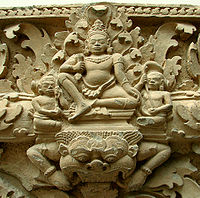
    A 9th-century stone relief carving depicting Indra subduing Vritra, located in Cambodia’s Phnom Kulen National Park

    But, the most prominent figure is the storm god Indra, who, at a later stage of the Rig Veda’s development, eclipses Prajapati in the attention of worshipers, becoming elevated in his place to the chief god of the Hindu pantheon through a hymn recounting his epic battle with the dragon Vritra, whom he slays with his lightning weapon and from whose carcass he fashions the earth, thereby earning his promotion to the status of creator god.

    This is a recurring pattern in virtually all ancient polytheistic cultures.

    For some background: they viewed all of nature, not as a unified, cohesive whole operating according to a single, all-encompassing rational Logos, as we take for granted today, but as a teeming pantheon of independent and autonomous personified forces of nature. As in, the sky was a god, the sun was a god, the sea was a god, the earth a goddess, and abstractions like “war” and “home” and “the hunt” were also, respectively, gods and goddesses, each acting in the world according to their own whims and temperaments and purposes. Religion was a matter of keeping them all individually favorably disposed toward mortals through ritual worship and sacrifice. But, there is only so much time in the year, and with so many different deities to placate, they had to prioritize their worship calendar. As agricultural civilizations dependent upon seasonal rainfall to nourish their crops, they were collectively most acutely concerned about keeping the god of the storm on their side, and so their attentions always eventually centered predominantly on that particular deity, hence the primacy of storm gods in most polytheistic pantheons.  

    The exceptions that prove the rule would be cultures like Egypt and Japan, who relied more on irrigation than rainfall, and so never made their respective storm gods the chiefs of their pantheons.

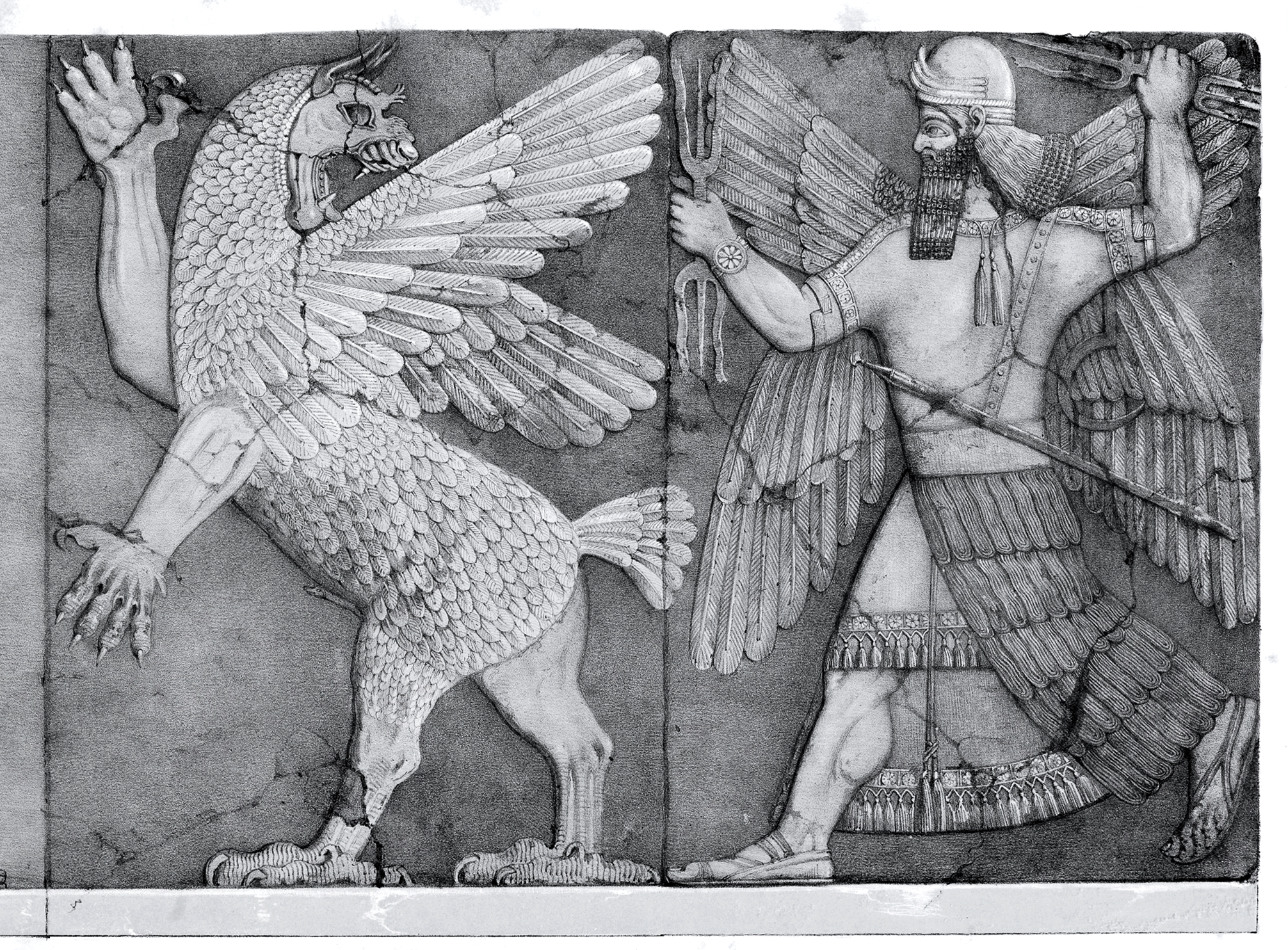
    A bas-relief from the palace of the 7th-century Assyrian King Sennacherib, depicting Marduk slaying Tiamat, in the British Museum

    With those few exceptions, this pattern plays out across the world: in the Babylonian Enuma Elish, the storm god Marduk slays the dragon Tiamat with his wind weapon Imhullu, becoming the creator of the earth and king of the Annunaki. In nearby Canaan, Baal slays the sea monster Leviathan/Yamm, overtaking El as king of the gods and ruler of creation. Zeus overthrows the Titans and becomes king of the gods of Olympus by slaying the dragon Typhon with his thunderbolt. Thor never overtakes his father Odin as king of the Aesir, but he still rises to primacy in the Norse pantheon by slaying Jormungandr, the Midgard Serpent, with his lighting weapon Mjolnir.

    This is just a representative sample of this pattern repeating itself in one ancient religion after another all over the world.

    Pottery from 6th-century BC Chalcis, Greece depicting Zeus slaying the dragon Typhon, exhibited in the State Collections of Antiquities museum in Munich

    And, the Israelites are shown in the Bible to have fallen into this same pattern by their repeated abandonment of the aforementioned Logos by degenerating into Baal worship, against the repeated warnings of prophets like Elijah and Elisha. Only their eventual conquest and exile at the hands of the Assyrians broke them of it.

    In all of these pagan mythologies, the Dragon was a symbol of cosmic chaos, and the storm god’s victory represented the conquest of that chaos by the imposition of order, thereby resulting in the present arrangement of creation and the storm god’s new status as creator god and savior.

    The True Face of the Dragon

    These same elements appear in the Bible – the same basic symbolic language – but it says something profoundly different with that language.

    The Dragon doesn’t appear in the biblical narrative until well after creation.

    God does not create by doing epic battle to impose Order against Chaos as His mortal enemy. God has no mortal enemies. Unlike in those pagan mythologies, God — and He alone — is eternal and self-existent. He is not contingent upon a preexisting cosmos from which He emerged to then engage in violent struggle against monsters to impose order upon it. Nothing can resist God’s will, much less threaten His safety, so He brings about order by merely speaking it calmly into existence: “Let there be … ,” He says, “ … and it is.” And God observes that “it is very good,” and then He rests – not because He is weary from battle and must recover from His wounds, but because His work is finished and there is no more to be done but to settle in and enjoy it.  

    Man, as God’s image-bearer, is the pinnacle and completion of creation.

    As in, the cosmic hierarchy is the reverse of what we see in pagan religion: the gods are not borne of a preexistent world, as the constituent forces of nature, to whom Man is inferior and subservient. God is eternal, creates the world and nature, and then creates Man in His own likeness and sets him above nature as its ruler, as explained in Genesis 1:24-28. Included in Man’s dominion were animals: in Genesis 2, Man is shown exercising that authority by naming the animals.

    Man existed in a state of paradise, perfectly related to both God and nature and himself.

    And that relationship – as with any positive relationship – was based on trust, faith. God had given Man every reason to trust Him by placing him in a paradise in which his every possible need and desire was met, and so that faith was the default state of human life and existence.  

    The only constraint, however, was that God said, “You must not eat from the tree of the knowledge of good and evil, for when you eat from it you will certainly die.”

    Then entered the Dragon.

    In the Bible, he is no less the divine embodiment of Chaos that he is in those pagan mythologies, but not as a cosmic apex predator capable of devouring gods and men, that it takes a great superhuman hero, at dire personal risk and with legendary struggle, to oppose and defeat him.

    “Now the serpent was more crafty than any other beast of the field the Lord God had made,” the Scripture reads.

    The Serpent here is depicted, at first glance, as just another animal of creation. As such, he is subordinate to Man.  

    But he is understood also to be a divine being. Ancient readers, however primitive and pre-scientific, still understood just as well as we do that snakes don’t talk. They didn’t take this literally – at least, not as merely literal. It was plain to them as it is to us that this was no ordinary snake: It was an archetype for what serpents represented in the ancient world: a divine embodiment of Chaos. But by assuming the role of a serpent, he took on the status of an animal. So, he was superior to Man, in terms of his knowledge and cunning, but was nonetheless subordinate to Man.

    The threat he posed to Man, then, was not that of the Chaos Dragon of pagan mythology – the undoing of the order of creation or the violent physical destruction of Man. Rather, it was to the relationship between God and Man (and between Man and woman[1]), and he posed that threat, not by the exercise of brute force, but by guile and temptation.

    His only power over Man was the power he could seduce Man into giving him, because Man, as God’s image-bearer, held the only true power in that scenario. Man outranked the Serpent. Man had all the authority in the situation. He could have commanded the Serpent to leave. He could have done anything he wanted, and the Serpent was bound to obey him, not he the Serpent.

    That is, until he listened to the Serpent.

    The Serpent entered the Garden as Man’s subordinate. He left as Man’s ruler.

    Man’s place in paradise, his status over creation and his access to the Tree of Life – to immortality – was based on his relationship to God.

    The Serpent attacked that relationship by undermining the trust that defined it:

    “Did God really say, ‘You must not eat from any tree in the garden’?”

    “The woman said to the serpent, ‘We may eat fruit from the trees in the garden, but God did say, “You must not eat fruit from the tree that is in the middle of the garden, and you must not touch it, or you will die.”’

    ‘You will not certainly die,’ the serpent said to the woman. ‘For God knows that when you eat from it your eyes will be opened, and you will be like God, knowing good and evil.’”

    Now, this is one of the most misinterpreted and misrepresented passages in all of literature, and many commentators over the past 3,000 years have taken the Serpent’s side in this, framing him as the hero of the story, and it is a trope that refuses to die.

    Typically, this is by misrepresenting it as simply “the Tree of Knowledge” and claiming that the Serpent “liberated” them by bringing them enlightenment. Even some Christians take this position, although from the other side: because they think of faith and knowledge as antonyms – and therefore knowledge as the enemy of faith – they take this to mean that knowledge itself is inherently corrupting and ignorance a virtue. And critics are all too happy to accept this version of the story and add it to their reasons for rejecting the Bible, while certain Christians think heeding the Bible entails staying “innocent” of knowledge.

    It was not the “Tree of Knowledge,” though. It was the tree of a very specific kind of knowledge, not knowledge in general, and that distinction is vital. Throughout the Bible, knowledge is held up as a positive value – something to be sought by the righteous more than gold and wealth – and this passage is no exception.

    Even apart from that specific misreading, though, many readers still think the Serpent might have had some merit to his argument: because God withheld the fruit of that particular tree, Man had at least some reason to entertain the distrust sown by the Serpent. Or, God entrapped them by placing the tree within reach, only to cruelly deny it to them.

    Both interpretations happen to echo precisely the Serpent’s lie to the woman, and both egregiously misrepresent the story.

    God did deliberately place the Tree in the middle the Garden and command them not to eat of it, but it was not to entrap them, and it wasn’t to withhold anything, and it wasn’t because He had preordained the Fall.

    As is typically the case with all sin and temptation, the Serpent enticed them by offering the very thing God wanted them to have, but he offered it on terms that would only poison it and corrupt them.

    They obtained that knowledge by doing the evil – they ate of it, and their eyes were indeed opened. That’s plain enough from the text. Also, it wasn’t “the fruit of the Tree of Knowledge of Evil” alone, but “of Good and Evil.” They were a package deal: there was just the one kind of fruit from the one tree, the eating of which came with the knowledge of both. To know evil is to know good, and vice-versa.

    Based on these cues, it is apparent that there was nothing intrinsic about that fruit or that Tree in particular that made it “the Tree of Knowledge of Good and Evil.” It was simply in the fact that He commanded them not to eat from it that gave it that quality and function, because in so doing, God created the possibility of choice between good and evil.

    What if they had chosen differently? What if they had rejected the Serpent? What if Man had exercised his God-given authority by commanding the Serpent to explain himself? By rebuking him for disparaging God’s character and intentions? By commanding him to leave the Garden and never return?

    He would have become like God, knowing good and evil … by having done the good, and having done so, the question of whether to eat of it would have been moot: the temptation would have been gone, as would the need to forbid it. It would have become just another tree.

    And, there would have been no Curse, no Fall, no banishment to mortality, no severed relationship to God, and no tragic, blood-soaked story of human history as we’ve known it.

    The Serpent was cursed as well – to slither on the ground and eat the dust of the earth, among other condemnations to be discussed.

    Nonetheless, he entered the Garden as the Serpent and Man’s subordinate, but left the Garden as the Dragon, and Man’s ruler.  

    The True Power of the Dragon

    By deceiving Man into obeying his will rather than God’s, he received the authority over the earth that God had given to Man. Having received authority over the earth, he gained the power to dominate, devour and destroy at will.  

    But even then, his power was not rooted in brute force, but in his power to deceive and accuse Man. He is capable of brute force and violence, mind you, but it is predicated on that deeper principle of accusation.

    That’s why he’s called “the Devil” and “Satan.” The English word “Devil” is derived (by a long chain of translation) from the Greek “diabolos,” from the verb “diaballo,” meaning “to slander, defame, accuse.” The Hebrew “Satan” means the same, but in the legal sense of “adversary” or “prosecutor.”

    When he first appears in the Garden, he accuses God of deceiving them, undermining their trust in Him. When Satan appears in the Book of Job, that is also his role: he accuses Job of only being righteous and faithful because, basically, God bribes him, not because he’s actually virtuous. Job (eventually) acquitted himself, but the main point of the story, I would contend – at least as it relates to the overarching biblical narrative – is to reveal the essential point of contention between God and Satan over the fate of humanity: our guilt, our sin, is what gives Satan his power. If we take Genesis 3 and the Book of Job alongside passages like Isaiah 14 and Ezekiel 28, we can infer the following:

    God gave Man authority over creation, which would eventually include the divine beings called “Watchers” and “angels.” At least one of them, the entity described as “the Serpent” and later “Satan,” rebelled against God’s plan, protesting, “They’re not worthy. They don’t deserve it. They’re just animals, unfit to be set above us.”

    The Serpent then entered the Garden to prove his point, and did so, and God conceded his argument.

    Man sinned, and the wages of sin is death, and so Man was made mortal, and “put under the power of him who holds the power of death” – that “power of death” being his rightful claim against the worthiness of Man: because we are guilty, we are fair game for the Devil.

    And, that he has authority is beyond dispute from the rest of the biblical narrative. Jesus called him “the prince of this world,” and when the Devil promised him “all the kingdoms of the world and their splendor” if he would bow down and worship him, Jesus rejected his terms, but did not dispute his right to offer them.

    So, the Dragon owns the world.

    But that, of course, was only the beginning of the story of Man.

    The Mask of the Dragon

    Two other major events followed, in Genesis 6 and 11, which further corrupted humanity and by which the Serpent consolidated his authority by compounding man’s corruption and alienation from God (as explained in a previous article about the Divine Council worldview).

    The overall result of the Serpent’s assumption of power is that he became the Dragon.

    That isn’t to say that there was a distinction between “serpent” and “dragon” in pagan mythology, in terms of their symbolic meaning – they are interchangeable and synonymous.

    But there is a reason that, when he is introduced in the first book of the Bible, he is merely “the Serpent” – an unimposing, diminutive creature that is more a pest than a threat, but as he appears in the final book, he is “the Dragon” – a devouring monster of cosmic proportions.

    That reason is found in another instructive, all-important distinction between the biblical narrative and those pagan mythologies.

    As previously explained, in those pagan religions, as the embodiment of chaos, the dragon is pictured as the archnemesis of the storm god – locally known as “Baal” in Canaan, but also “Zeus” and “Thor” and other names elsewhere. The dragon and the storm god are pictured as fundamentally opposing cosmic forces: one the Ultimate Good, the other the Ultimate Evil – classic mythic hero-versus-villain stuff.

    In the Bible, though, the figures are identical: “Beelzebub,” one of the appellations for Baal in the region, meaning “Lord of the Flies,” is also one of the many names given to the Devil in the New Testament.

    As the chief rival to the worship of Yahweh in the Old Testament, the Jews of the Second Temple period rightly identified Baal with the Devil, recognizing that, far from being archenemies, the Dragon and Baal are one and the same.

    In other words, “the dragon” – as he is depicted in those pagan mythologies – is a false flag. While the biblical writers present him as “the Dragon,” he doesn’t present himself that way – at least, not directly.

    What those pagan mythologies present as a cosmic struggle between divine powers beyond the ken of mortals and before which we are powerless and insignificant collateral victims, the Bible presents rather as a war of influence in which Man is at the decisive center.

    An ancient religious artifact, from my personal collection, depicting Thor doing battle with the Midgard Serpent

    To win that war of influence, the Adversary reframes the narrative – the broader worldview in which that conflict takes place, so that our values and understanding of the true nature of our condition are upended and confused, thereby disguising his true objectives and tactics.

    Within that worldview, Man believes himself to be at the mercy of the gods, and the gods themselves to tremble before the might of the dragon as an irresistible cosmic evil that threatens the order of creation itself. Only a great, divine hero, greater than all the other gods, can defeat the dragon. And so, enter Baal, Lord of the Storm, Rider on the Clouds, Wielder of the Wind and Lightning, the great savior and slayer of dragons, who has come to rescue Man from cosmic, existential destruction.

    The Adversary distorts the threat into something cosmic and insurmountable, and then offers himself as the hero and savior from that threat, seducing humanity away from our true Creator and Savior. His temptations are rarely ever limited to obvious evils. He offers idols to worship and heroes to follow. He doesn’t entice us away to what we know full well to be evil – at least, not at first (nobody thought Hitler was “Hitler” when they elected him). Instead, he offers what we falsely believe to be good, “masquerading as an angel of light.”

    In so doing, the Adversary strengthens his case against Man as unworthy and disloyal, keeping us enslaved like animals to our appetites and base natures, hostile to God and to each other, and so his power indeed grows – humans themselves, in the form of nations and empires and perverse ideologies and dehumanizing philosophies, become his “teeth” and “claws” by which he subjugates and threatens us. That’s why the empires in Daniel 7, Isaiah 14 and Ezekiel 28 are described in terms both of menacing beasts as well as embodiments of malevolent spiritual forces: humans themselves become agents controlled by the Dragon, the glove on the Devil’s hand, puppets at the end of his strings, pulled along by our appetites and delusions. His favorite agent, the Antichrist, is described simply as “the Beast,” emblematic of the animalistic state in which the Dragon wishes to keep all of humanity.

    And so, the Dragon’s power is inflated through illusion and lies, and what should be a mere nuisance and pest grows into a monster that devours the world. But, the lies are layered atop the kernel of a correct accusation that truly is insurmountable by mere mortals, and so it really does take a Divine Hero to defeat him – but not a hero recognizable as such to the world at large, based on the expectations and values conditioned into us by our common stories about mighty warriors slaying dragons.  

    The Dragon is beyond Man’s power to contend with, but only a Man can defeat him, because he can only be defeated by Man being worthy.

    So, God Himself became Man in the person of the Messiah, in order to defeat the Dragon, and this was foretold in the beginning, before even the curse upon Man and the earth were pronounced:

    “I will put enmity between you and the woman, between your seed and hers,” God told the Serpent in the Garden. “He will crush your head and you will strike his heel.”

    As in, the “Seed of the Woman” would destroy the Serpent, at the cost of the Serpent wounding his heel – an allusion to Jesus’ crucifixion. By dying for the sins of all mankind, he nullifies the Dragon’s claim: “They deserve to die because of their sin,” the Dragon accuses. “They have died because of their sin, and so your accusation has no power,” the Messiah answers.

    He is not a mythic hero, like Baal or Thor, who triumphs by meeting force with greater force. He doesn’t risk death by taking on the Dragon – he absorbs the full power of the Dragon’s violence. By taking the punishment he didn’t deserve, on behalf of all who do, and by restoring Man’s trust in God, he reconciles God and Man.

    Having done so, he takes back access to the “Tree of Life,” becoming immortal and passing his immortality to all who belong to him.

    This is how the Son of Man assumes authority over the nations – why all authority in heaven and on earth was taken from the Dragon and given to him.

    The War is Won, the War Continues

    Christ’s death and resurrection and ascension decided the ultimate outcome of the conflict between God and the Dragon over the fate of humanity, but it did not conclude the conflict.

    His authority over humanity has been broken, but the Dragon still has humanity’s obedience, and as long as he does, humanity remains under the same condemnation that he is: when Jesus returns and destroys the Dragon, all who remain aligned with him will share his fate.

    But, God loves humanity and doesn’t want to condemn us, but wants to give all of humanity as much opportunity as it takes to choose Him. And so, He has commissioned the Church to fight and to be the instrument through whom to fight His war of influence to save humanity. As the “Body of Christ,” the “temple of the living God,” we are God’s Presence on earth, the countervailing influence upon humanity to retake the world from the Dragon.  

    “When this gospel of the kingdom has been preached to all nations, then the end will come,” Jesus said.

    It is then that “the full number of Gentiles” will have come in, as Paul said, at which point, Jesus will “destroy all dominion, authority and power” under which humanity is subjugated, finally toppling “the spiritual forces of darkness in the heavenly realms” against which God and Man have contended throughout history.

    This is the inevitable, eventual outcome, and the Dragon has no hope of ever averting it.

    Contra Epicurus

    Also, this is the narrative framework behind the answer to the supposed “Problem of Evil.”

    The Epicurean paradox has it that the very concept of “God” is self-refuting. Because evil exists, God cannot be both all-good and all-powerful: He either wishes to rid the world of evil but cannot, which means He is not all-powerful and therefore not God; or He can rid the world of evil but does not, which would make Him evil, and therefore not God.

    God does not exist, therefore, according to the paradox.

    The Epicurean paradox is often treated like a difficult and complex philosophical conundrum, but it only retains that reputation by confusing its terms. Once the correct values are plugged in, the equation resolves itself and the “Problem of Evil” turns out to be much ado about nothing.

    It’s reminiscent of movies like “Highlander” and “Mortal Kombat” or any number of other scifi/fantasy stories in which an epic struggle between Good and Evil for the fate of the world boils down to a sword duel or a fist fight – where the moral alignment of the characters is incidental to the outcome, since it all depends ultimately on who has the stronger muscles or faster reflexes or better fighting skills, and it just so happens to be the hero. That’s a fun way to frame a movie or a video game so that the action has some stakes, but it’s a terrible framing for a moral philosophy. And to be fair, those movies usually implicitly acknowledge this by including some kind of plot contrivance in which the hero wins because he is good: he’s motivated by love or takes some bit of character-defining wisdom from a mentor or ally by which he triumphs over the villain.

    The Epicurean paradox, though, offers no such acknowledgements. It pictures “evil” in terms of an external threat of mere brute power and poses the question of whether God’s power can match it, and reasons from there – as if “evil” is a cosmic chaos dragon of myth and God is a pagan storm god who is either sufficiently brave and mighty to battle it, or not.

    On those terms, there would be no contest. Except, that isn’t what evil is. That’s how pagan nature-worshippers pictured it – and perhaps why Epicurus got such traction out of it with his original audience.

    But, we know better. The very categories of “Good” and “Evil” are predicated on the reality of free will, and once that is taken into account, the paradox resolves itself simply by correctly defining its terms. Yes, God could eradicate evil by the mere exercise of power, but doing it that way would entail eradicating humanity, since we are the evil He allows to exist. Precisely because He is all-good – Goodness itself – He does not. He is, right now, working to eliminate evil, one human at a time, according to our individual free choice, by working through the Church to influence us to renounce the Evil One and put our faith and trust in Him instead.

    The War Continues, and We are Losing

    The Devil’s demise is the inevitable, eventual outcome that he has no hope of ever averting.

    He can, however, delay it indefinitely. Just like the rest of us who will eventually die, so will he; and also just like us, he is holding it off as long as he can. But unlike us, there is no expiration date, no limit on his lifespan. As long as he can prevent the Church from completing its mission, he is effectively immortal, and history will go on just as it is until that happens.

    And, by that measurement, he is winning.

    Not only are we nowhere near the completion of our mission, but we have completely lost the plot.

    His tactics have grown far more sophisticated, but the Dragon is still doing now what he did thousands of years ago: he confuses our values and reframes the narrative to mask his objectives.

    It’s become something of a worn-out cliché, thanks to “The Usual Suspects,” but Charles Baudelaire’s quotation holds true: “The greatest trick the Devil ever pulled was convincing the world he doesn’t exist.” He has this and plenty of other tricks, and they have succeeded in blinding and crippling the Church, so that we have been taken off the board.

    If the Devil doesn’t exist, then Christianity just isn’t true – this is all just ancient mythology we’re talking about, no different than those fantasy movies or comic books mentioned earlier, just a bit older. But if Christianity is true, then the Devil most certainly exists, and is actively working against us.

    Christians either live as if Christianity isn’t true, by not taking the Devil at all seriously, or we live as if some other religion is true, by taking him entirely too seriously, on all the wrong fronts. It is always one extreme or the other: we either ignore him as irrelevant – as a fictional, mythological character who simply doesn’t factor into the moral therapeutic deism that popularly passes for Christianity; or, we afford him entirely too much power and menace, regarding him with a superstitious dread and reverence greater than what we afford even to God.

    If Christians talk about the Devil at all, it’s typically in terms of some moral panic or imaginary boogeyman, and not for the actual reasons counseled in Scripture. They are too numerous to list, but one timely example is Christians’ recent preoccupation with the supposed “satanic” nature of yoga.

    Many Christians are scandalized by it because they insist that it constitutes “witchcraft” and “gives Satan a foothold” because its various poses are named for Hindu deities, and so can somehow compromise a person’s soul, and because of this, the Devil forever owns breathing and stretching exercises, making them off-limits for all faithful people of God (those same Christians, I am sure, would be equally scandalized by my references to the Vedas in the introduction).

    But if that’s true and Christians’ fears about yoga are valid, we’re already all doomed – every day of the week and every month in our calendar is named for some pagan god or another, but nobody is ever in fear of their eternal salvation for having made reference to “Thor’s Day in Mars’ month.” In fact, much of the English language is made up of loanwords from Greek and Latin, with etymological roots in various pagan deities’ names, so we are constantly doing exactly what the yoga-alarmists fear.

    Because yoga is more exotic and unfamiliar and comes from a faraway land with strange customs, though, it seems more threatening, and we attach so much superstitious awe and dread to it.

    As much as the Bible warns us against witchcraft and the influences of foreign religion, far more strenuous and frequent are its warnings about what lurks in familiar corners. The Devil poses far more of a threat to us from the pulpits of our own churches than he does from any foreign religion or popular fitness fad, or from trick-or-treating or playing tabletop fantasy games like “Dungeons & Dragons.”

    When Paul departed from Ephesus for the last time, he warned them, “I know that after I leave, savage wolves will come in among you and will not spare the flock. Even from your own number men will arise and distort the truth in order to draw away disciples after them. So be on your guard!”

    He and the other apostles made frequent mention of the false prophets who appeared throughout Israel’s history, who prophesied “from their own imaginations” and who exploited the people for their own enrichment.

    “Just as there were false prophets among the people, there will be false teachers among you,” wrote Peter. Many would follow them, bringing Christianity itself into disrepute, he warned, adding that “in their greed these teachers will exploit you with fabricated words.” The Greek for “exploit” is “emporeousantai” and “fabricated words” is “plastois logois,” which could be translated literally as “they will make a business out of you with plastic words.”

    Modern churches and megachurches today are, of course, big business. And, they thrive by telling people what they want to hear, preaching entire sermons on single verses taken out of context, which makes their meaning endlessly manipulable. And, in certain branches of the Church, they love to utter vague, unfalsifiable “prophecies” as if God is speaking through them, exploiting the eagerness of their listeners to believe them.

    But, for fear being “political,” they won’t take any stand on the ongoing culture wars with its insane confusion over sexuality and morality and the human condition, nor address any of the Church’s own failures that led to such a dismal state of affairs.

    And, all of it is predicated on a version of Christianity found nowhere in the Bible itself, which revolves around this preoccupation with “going to heaven” when we die as disembodied souls or spirits, treating this world as a lost cause to be escaped, rather than saved.  

    “Wide is the gate and broad is the road that leads to destruction, and many enter through it. But small is the gate and narrow the road that leads to life, and only a few find it,” Jesus said, which implies that the false prophets and false teachers would be in the majority, and the teachers of truth would be in the minority.

    Yet, Christians always base their security on consensus and longevity – we feel most confident and secure exactly where we were told to expect the most danger.

    And as long as this remains the status quo, the Devil is winning.

    The situation seems dire, and so there is temptation to resign ourselves to despair.

    However, “we are not unaware of his schemes.” That’s exactly what he wants us to think – he wants us to believe the Dragon is undefeatable, and we are powerless before him.

    But, he loses much of his power when his lies are exposed, and we are promised that if we resist the Devil, he will fear us, because we already have all the weapons and power we need to overcome him.

    And, there will come a day when a generation of the Church does repent and rise up and complete its mission.

    There is no reason that generation could not be our own.


    [1] As an incidental note: I do not here capitalize “Man” and lowercase “woman” out of any disrespect toward the fairer sex. I do it because “Man” here is treated as a proper name – in Hebrew “Adam,” but also as an archetype for all of humanity, hence my preference for the translated name. The woman did not receive her proper name of “Eve” until after the Fall, for reasons beyond the scope of this article, and so it would be incorrect to refer to her by it here.

  • To Which ‘Christ’ Do You Testify?

    I’m always told that I have a great “testimony.”

    A “testimony,” of course, being the account of a Christian’s conversion – how we “came to know the Lord.”  

    And, not to brag, but as “testimonies” go, mine is a pretty good one. With all sincerity and gratitude, I experienced what I genuinely believe – and empirically witnessed – to have been signs from God and (to me) clear indications of His direct attention and intervention to bring me to the point of committing my life to Jesus Christ.

    The “sharing of one’s testimony,” of course, is a common ritual among modern Christians, and it’s widely regarded as a vital tool in evangelism/proselytizing. To this end, many churches even offer training on the construction and presentation of one’s “testimony.” This is apparently modeled after the apostles, who are shown in the New Testament to have spread the gospel throughout the Mediterranean world and so created that first generation of the Church by presenting their testimonies of Jesus. So, to continue their work of spreading the gospel, modern Christians are encouraged to likewise share our own “testimonies” with outsiders.

    As much as I value and am grateful to God for my “testimony,” though, I regard it not only as utterly worthless, but counterproductive to the purpose of advancing Christianity, because this modern mindset of “sharing our testimony” is actually a complete reversal and negation of what we find modeled in the Bible.

    I struggled over how to word this, because it sounds far more mean-spirited than I intend, but in the interest of erring on the side of clarity about a monumentally important point, at the potential cost of offending many …  

    Like a great many other components of contemporary church culture, modern Christians’ collective notion of the “testimony” is like a child’s drawing/cargo cult-version of what we see in the Bible.

    The Allegory Made Real

    A “cargo cult,” for those unfamiliar, is the term for an indigenous religion created in the aftermath of a primitive people’s encounter with members of an advanced civilization. A chief example would be when, during World War II, isolated Pacific islanders one day witnessed the sudden arrival of Western soldiers descending from the sky by parachute and airplane. Something as mundane (to us) as a rank insignia, or even a ballpoint pen in the breast pocket of a soldier’s uniform – with its shiny, silvery finish gleaming blindingly in the sun – takes on an instant religious significance in the eyes of a people who have never seen anything made of metal before; to say nothing of these strange, alien beings’ ability to ride the sky and to summon resources from that same sky by speaking into a crackling, talking box. These were people who had not invented the wheel and knew only Stone-Age technology who suddenly encountered complex machines and electricity and beings with the power to shoot deadly thunderbolts from handheld rods and to conjure food and unimaginable wealth from the heavens.

    Today, a modern observer can watch a cargo cult still in operation, performing ritualistic prayers using bamboo prop “radios” to petition “the gods” for an airdrop of food, and perform drills in makeshift “uniforms” with wooden “rifles” in imitation of the god-like beings encountered by their great grandfathers. And we, as members of that advanced civilization, can immediately recognize the practical realities they are attempting to recreate and the vast, gaping chasm between those realities and their superstitiously motivated ritual imitation.

    This same pattern characterizes much of what constitutes modern Christianity, compared to the ancient practices we attempt to emulate. There is the same disconnect between modern form and original function, resulting from the same error of processing.

    We might be inclined to attribute the cargo cultists’ error to a simple lack of intelligence – their primitive minds being unable to grasp the complexities of an advanced civilization’s technology and culture.

    That isn’t it at all. It’s not a question of relative IQ. Any modern Westerner would find himself equally at a loss of comprehension if he had to adjust to their way of life, and would struggle to survive using the same resources by which they comfortably thrive.

    No, the disconnect is because the cargo cultists retained the same worldview and assumptions about reality that they had before they encountered the Westerners. What should have happened was that they realized their worldview was wrong – that reality is not as they believed it to be, and so they should have abandoned those preconceptions and grown into the larger world of which the Westerners were a part. Had they done this, they would have raised themselves up to the same level as their visitors and dealt with them as equals. Instead, they kept their benighted view of reality and processed the new information within that ill-fitting philosophical fabric, according to which, they were mere creatures and supplicants before the supposed “gods” of their strange visitors. Their descendants today continue to attempt to raise themselves to their level by ritualistic imitation, but it only degrades them, because they do not elevate their understanding and their consciousness according to the new information, but instead process it within their old understanding – putting “new wine into old wineskins,” so to speak. They are like prisoners in Plato’s allegorical cave who refuse to leave upon having their chains removed and hearing reports from the outside world, but instead incorporate those reports into their myopic, cave-confined, darkness-cloaked view of reality.

    This is a common human failing, as it turns out, because such growth is daunting for anyone. Abandoning long-held beliefs is a sort of psychic/philosophical death. But, such is the price of enlightenment, and the alternative is its own kind of death. “Whoever tries to save his life will lose it.”

    The gospel, we read, is supposed to elevate us by enabling us to expand our consciousness and grow into the higher reality of God’s kingdom and truth.

    “Do not conform to the pattern of this world, but be transformed by the renewing of your minds,” Paul wrote.

    By default, though, we conform to the pattern of this world – that exemplified by the cargo cults – by interpreting what we read in the Bible according to the assumptions native to the ignorant worldview we have quite apart from the Bible, and so we are not transformed by the renewing of our minds. Our basic understanding of reality remains exactly as it was before we ever picked up the Bible or knew about the gospel, because we don’t grow into the new reality by outgrowing our old worldview. We just wedge the new information into all of our old assumptions, trying to pull it down to our level instead of allowing ourselves to be elevated by it.

    The result is a “Christianity” that bears as much resemblance to the actual beliefs and teachings of the apostles as a cargo cult bears to an actual World War II-era paratrooper unit – it’s a crudely-fashioned costume worn in imitation of the real thing, with little conception of the actual substance and purpose behind that original model.

    An entire book could be written on “Cargo Cult Christianity” (and maybe it will be?), with lengthy chapters dedicated to individual examples of the impassable gulf between the modern practices we call “Christianity” and their original, legitimate function. But, our erroneous concept of the “testimony” is something of a key log in the logjam of these misapprehended concepts, hence my attention to it here.

    The Testimony of ‘Martyrs’

    Terms like “testimony” and its close cousin “witness” immediately take on religious connotations in the mouths of Christians, but as we find them in the Bible – spoken within their original ancient context – they had no such connotations. These were not distinctly “Christian” terms at the time, nor even commonly associated with Christianity, and especially not with religion in general, but had the same meaning then to the original Christians that they do today when we hear them outside of a religious or church context.

    Both terms are derived or translated directly from “martyr” in Greek, meaning, “one who brings testimony, provides evidence/proof, especially in a court of law,” etc. At the time, as well as today, these were legal and historiographical terms in wide use – for what we would call “secular” purposes – and popularized by Greek historians like Herodotus and Thucydides and Polybius and others. As the “fathers of history,” they established the value of eyewitness testimony for documenting events, which remains the gold standard of historiography and (theoretically speaking) of modern journalism.

    As in, when the New Testament writers spoke of “bearing witness” and “giving their testimony” about Jesus, it had the same meaning as today when TV stations market themselves as “eyewitness news” and interview people who personally saw the events reported: the standard is to give objective coverage of actual events witnessed empirically, relying on those witnesses’ reports of what they saw and heard.

    According to the book of Acts, when the disciples gathered to fill the vacancy among the Twelve left by Judas, Peter said, “It is necessary to choose one of the men who have been with us the whole time the Lord Jesus was living among us, beginning from John’s baptism to the time when Jesus was taken up from us. For one of these must become a witness with us of his resurrection.”

    That, of course, was the definitive role of an apostle: to be an eyewitness to the historical events of Jesus’ life, death and new life.

    When Jesus first chose the Twelve and designated them “apostles,” that term held only its straightforward, literal meaning of “one who is sent” – as in, they were to be representatives of Jesus himself, bearing his teachings and authority. As the Christian movement spread, that term very soon took on a narrower meaning, but an expanded membership: the title of “apostle” came to apply to anyone and everyone who had witnessed the risen Jesus, not just the Twelve.

    “Am I not free? Am I not an apostle? Have I not seen Jesus our Lord?” wrote Paul – who was an apostle, but not among the Twelve.

    As in, an apostle’s role was to bring knowledge of Jesus to their listeners. The Twelve in particular did that with a unique, unparalleled authority and credibility, because they had been Jesus’ direct disciples, handpicked to represent him. But all apostles, by definition, brought that knowledge of Jesus to the world, and they did so by means of their historical testimony as eyewitnesses. Each of the Twelve bore firsthand the entire narrative of Jesus’ ministry and teachings, while a mere apostle may have been witness only to a single event or miracle, such as his resurrection, but all were eyewitnesses.

    “That which was from the beginning, which we have heard, which we have seen with our eyes, which we have looked at and our hands have touched – this we proclaim concerning the Word of life. The life appeared; we have seen it and testify to it, and we proclaim to you the eternal life, which was with the Father and has appeared to us. We proclaim to you what we have seen and heard,” wrote the apostle John.

    And, when we consider the historiographical nature of their proclamations about Jesus, one of the (seemingly) weirder, most oft-misinterpreted passages from 1 John potentially makes more sense:

    “This is the One who came by water and blood – Jesus Christ. He did not come by water only, but by water and blood. And it is the Spirit who testifies, because the Spirit is the truth. For there are three that testify: the Spirit, the water and the blood; and the three are in agreement. We accept human testimony, but God’s testimony is greater because it is the testimony of God, which he has given about his Son.”

    Here, John is using shorthand that was presumably more immediately familiar to his original audience than to us, but it might be possible to decipher it if we consider it in context. He is speaking against the nascent Gnostic heresy, which had it that spirit alone is good and flesh/material is intrinsically corrupt and evil, and so they had various ways of misconstruing Jesus’ identity and nature within this outlook, which typically included denying his death on the cross and, in turn, his resurrection from the dead: if he wasn’t a physical, material being, he can’t die, and if he can’t die, he can’t have risen from the dead, they argued. Another common feature of Gnosticism was the notion of a distinction between Jesus the man and Christ the spirit, according to which, Jesus was “adopted” as God’s Son at his baptism when “Christ” descended upon him in spirit-form.

    So, this was written as an emphatic denial of Gnosticism by affirming in contrast the same basic formulation we saw in the passage from Acts, according to which, the apostles were to bear witness to the historical events of Jesus’ life, beginning with his baptism (the water), through to his crucifixion (the blood) and most importantly, his resurrection from the dead in fulfillment of prophecy (the Spirit), all of which constituted God’s endorsement of Jesus as the Messiah foretold in the scriptures.

    John emphasized the “testimony of God” here, but it is the testimony of God through these historical events, of which the apostles were eyewitnesses.

    The Gnostics valued only the event of Jesus’ baptism as relevant to their beliefs, denying the rest, and John refuted them by appealing – not merely to established Christian doctrine – but to the historical facts related to Jesus’ death and resurrection as well. Jesus was not some mystical “spiritual” phantom who merely appeared human, but a flesh-and-blood person of history. While the Gnostics embraced “spirit” to the exclusion of flesh, John’s point here was that it was the very Spirit they claimed to seek who testified to the flesh that they denied.

    As in, this was not a dispute rooted in mere doctrinal dissent, but over historical reality, and it was those historical facts that lay at the foundation of the gospel itself and to which John appealed to refute heresy. As in, the gospel – as “the good news” – is not, primarily, a religious proclamation. It is a historical proclamation, and its religious meaning is contingent upon and valid only on the basis of its historicity.

    It is that historical testimony of Jesus’ life, death and resurrection through which God reveals Himself to the world and through which He offers new life. As Paul told the Athenians at Mars’ Hill, “God has set a day when He will judge the world with justice by the Man He has appointed. He has given proof of this to all men by raising him from the dead.”

    And so, their testimony to those events, collected in the writings of the New Testament and in the traditions and teachings of the original Church, stands as a monument for all generations of humanity, available to be accessed and evaluated on the same terms as any other events of history. And, upon doing so – objectively and without the blindfold of our philosophical presuppositions – we discover that God lives and has made Himself knowable to everyone through Jesus Christ.

    The Broad and Narrow Paths of ‘Testimony’

    In light of all this, the idea of modern Christians supposedly following the apostles’ example and continuing their work by “sharing our testimony” and “witnessing” is, frankly, beyond absurd.

    And, it’s dizzyingly ironic on multiple levels.

    Critical biblical scholars of the past 200 years or so, as well as more recent proponents of the so-called “Christ myth theory” assert that the early Christians either did not regard Jesus to be an actual historical person or they were simply unconcerned about any legitimate historical information about him, but cared only for the “mystical Christ” with whom they imagined themselves to be interacting in their prayers and church gatherings and ecstatic experiences. And so, according to these skeptics and scholars, early Christians played fast and loose with the memory of Jesus, making no distinction between their own imaginings and what early, reliable reports they had about him, and so the legendary embellishments and invented teachings attributed to Jesus that met their “spiritual needs” of the moment were those that were retained and recorded for posterity in the written Gospels.

    This is, of course, completely devoid of any basis in actual recorded evidence. Its enduring appeal lies solely in its accommodation of their prejudices. But more than that, it flies in the face of all of the aforementioned evidence, which is that the early Christians were indeed quite intensely concerned about historical legitimacy, which is why there is such a recurring emphasis upon eyewitness testimony and the empirical experiences of the apostles, to the extent that apostles ranked higher in authority within the early Church than even prophets and miracle-workers.

    But, like the aforementioned cargo cultists, those scholars and skeptics bring their theological beliefs to their “research” and try to wedge the data into their preconceptions, rather than changing their beliefs according to the evidence. Because they start out already “knowing” there is no God, and so no messiahs or prophets or miracles or resurrections, therefore there cannot have actually existed this person – this “Jesus Christ” – as he is described, because no such person can ever exist, according to their theological presuppositions. And so they have to somehow make sense of the evidence of history within their prejudices, and their solution is to invent a distinction between the “Jesus of history” and the “Christ of faith,” along with their revisionist fictional narrative about the early Christians caring nothing for the former in favor of the latter.

    Naturally, faithful Christians, by definition, reject this, since it’s hostile to the faith we profess.

    Yet, our own practice of our faith is exactly as the skeptics slanderously describe for the early Christians, and bears little meaningful difference from the practices of the Gnostic heretics condemned by those early Christians.  

    When we speak of “sharing our testimony” and “witnessing,” nobody who gives it a moment’s consideration can think we’re really doing what the apostles did.  

    To state the obvious … we weren’t there. None of us are in any position whatsoever to testify or bear witness about the Jesus of history. Our “testimonies” can only ever be about the “mystical Christ” – the “Christ” of our own personal, private faith.

    As in, our personal “testimony” can only ever be about the Christ of our own imaginations – our own subjective experiences and feelings about Jesus and Christianity.

    Just like those cargo cultists, we have our own set of assumptions and preconceptions we bring with us from our native worldview.

    Our culture insists that religion and faith are matters of subjective feelings and ineffable internal leadings, and not a matter of objective reality that can be known by reason and evidence and verified by rational processes. We passively absorb these attitudes and adapt Christianity to them, and so in a lot of ways, we prefer the “Christ” of our imaginations to the real person of history.

    A belief system rooted in objective reality and historical evidence can be investigated and verified. And, that is exactly what the New Testament and other early writings by and about those first Christians invite us and the world to do.

    But, a religion that can be investigated in such a manner can also be disproven if it’s false. A religion rooted in subjective experience and private feelings, on the other hand, can never be falsified. No one can ever tell us our own experiences and feelings are invalid, because these are unfalsifiable by nature.

    And so, like those cargo cultists, we pull Christianity down to our level, adapting it within our native worldview, and that way, we can never be disabused of it. We feel safe, hiding beneath the security blanket of our subjective religion, where no one can touch us with rational challenges or evidence to the contrary.

    But we’re also impotent to pass it on, because on those terms, we cannot possibly do what the apostles and early Christians did, because no one else can believe on the basis of our subjective faith and feelings. They can be pressured and indoctrinated to manufacture their own subjective feelings, but that’s not actual faith — at least, it’s not faith in God Himself, based on His actual revelation of Himself in history, but faith in our own more recent imaginings about Him. And, in so doing, we create obstacles to genuine faith, because we are tacitly denying the objective and verifiable historical reality of Jesus by reducing him to the level of a gnostic phantom or an imaginary friend.

    So, in our insecurity and weakness of faith, we make a sort of “deal with the Devil”: he doesn’t bother us by challenging our religion, but we don’t bother him either by becoming sufficiently empowered or enlightened to ever pass it on and thereby encroach upon his territory. We stay in our ever-shrinking enclave while he runs roughshod over our civilization, safe from any challenge from us.

    Now, for the sake of argument, let’s say our imaginations are accurate, or that it really is the actual risen Jesus with whom we are interacting in these personal stories of our conversions, and not just a figment of our subjective imaginations.

    As I said in the introduction – I genuinely believe that about my own experience.

    Regardless, it still does more harm than good to “share my testimony” as a method of evangelism.

    At best, I’m asking someone to take my word for it and accept my story on faith that I’m not crazy, not lying or embellishing, or not suffering from an overactive imagination. And let’s say I manage to convince them. Then what? What can they do with that?

    It’s not a hypothetical situation. My experience has often been that they concluded, “God must be real, because He revealed Himself in this person’s life through signs. Now where’s my sign?”

    So, if they believe me at all, they’ll think I’m somehow special because I benefited from God’s special attention (and I may well be, but not the flattering and admirable kind of “special”), and until they experience such signs of their own, they’ll consider themselves rejected, outside of His grace.

    Or, if they’re already or ever become a believer, they’ll feel pressured to embellish their own “testimony” by punching up the drama and exaggerating whatever “signs” their story includes.

    But, I can’t promise them that God will ever give them a sign. He certainly hasn’t made that promise. Quite the contrary.

    “No sign will be given, except the sign of Jonah,” Jesus said, which of course, is a reference to the sign given for all time for all of humanity: his resurrection.

    That isn’t to say that there is anything inherently wrong with mature Christians sharing the stories of our own conversions with each other, and glorifying God by those stories. I still do that all the time.

    But the idea that this practice should have any value or effectiveness in persuading unbelievers or could ever be remotely comparable to what the apostles did by testifying to their empirical experiences of Jesus …

    It is at least as foolish, misguided and preposterous as those cargo cultists calling for an airdrop of supplies with a toy wooden “radio.”

    So, I would rather have 10 minutes to make the historical case for the resurrection than 10,000 hours to tell them my own “testimony.”

     If we want to follow the apostles’ example (and we should), we cannot do that by sharing our “testimonies,” but by sharing theirs. As in, our efforts should be devoted to presenting the historical evidence and arguing the case for the resurrection of Jesus, not relying on our own stories about our own feelings and subjective experiences.

    For more information about that historical case for the risen Jesus, I recommend Richard Bauckham’s book, “Jesus and the Eyewitnesses,” or the free documentary “The Jesus of Testimony.” Or, for an introductory course in Christian evidential apologetics, I recommend Josh McDowell’s “More Than a Carpenter.”

  • A Plan of Action for an American Renaissance

    No, That’s Not Christianity, Part 0

    “Our Constitution was made only for a moral and religious people. It is wholly inadequate to the government of any other,” wrote our second president of the United States, John Adams.

    If we read this in the context of his 1798 letter to the Massachusetts Militia, we can find there a prescient description of our current age: a time when our people “assume the language of justice and moderation while practicing iniquity and extravagance … while it is rioting in rapine and insolence.”

    “This Country will be the most miserable habitation in the world,” he warned, “because we have no government armed with power capable of contending with human passions unbridled by morality and religion.”

    For a people without the collective religious conscience and the virtue that goes with it to govern ourselves, our vices and baser passions “would break the strongest cords of our Constitution as a whale goes through a net,” Adams foretold. 

    Today – collectively, as a nation – we are no longer a moral and religious people.

    Because of this, our Constitution – as profound, beautiful and inspired as it is – cannot save us. It is, sadly, little more than a museum piece from a bygone age. As our founding father said, it just wasn’t made for us. It was made for a moral and religious people with the requisite virtue for self-governance, which we, as a nation, no longer possess.

    Our country – our entire civilization, no less – is in mortal danger because of this.

    If we continue along this path, the United States of America – our shining City Upon a Hill that gives light to the world – will be no more.

    We all know it. Anyone with a television or an internet connection and a basic awareness of history and human nature can see that.

    And if we don’t get it back – that religious virtue Adams understood to characterize that first generation of Americans, we stand at the threshold of another dark age, far more terrible than the last. There has always been, and always will be, a superpower at the center of the world of men, but never one as great and as noble as the United States of America. If we lose beyond recovery either our worldwide hegemony or our collective nobility, or both, whatever takes our place will be an imperialistic horror by comparison. And, there will be nowhere else to flee for people who yearn for freedom and opportunity.

    As another great American president once said, “We’ll preserve for our children this, the last best hope of man on earth, or we will sentence them to take the first step into a thousand years of darkness.”

    Averting the Coming Dark Age

    Christianity has lost its influence on our culture and our nation, and that is the ultimate reason for all of our current political, social and cultural troubles.

    “Politics is downstream from culture,” one commentator famously said. This is certainly true, but incomplete: Culture is downstream from religion. Our politics have been corrupted by a culture that has been uprooted from and turned hostile against the Christianity that once informed and nourished it. 

    We can recover that influence, though. All is not lost. As Christians, we have every reason to believe absolutely that we can; and not only that we can, but that it is a moral imperative – our divinely-commanded mission – to do so. If we don’t think that falls under the Great Commission, then we don’t know what the Great Commission is. To know we’re in the situation we’re in and to not expend every possible effort to rectify it is to betray our purpose and mission as the Church. It is a betrayal of Jesus Christ, to say nothing of future generations who – should we fail to set this right – will inherit only the smoldering ruins of our once great civilization. No one who is a Christian can deny this objective and truly remain a Christian. “If anyone, then, knows the good they ought to do and doesn’t do it, it is sin.”

    And at the end of the day, it wouldn’t even actually be that complicated. Not really. All it would take is for the Church to just … be the Church, by doing what the Church is already supposed to be doing, by dint of being the Church.

    But to achieve this, we need to come to a clear understanding of why we had our influence in the first place, and how we lost it. Only then will we be in any position to recover it.

    The Keys to the Kingdoms of the World

    There are two key elements of civilization we need to consider and understand: the role of language in defining our humanity and driving advancement, and the role of storytelling.  

    I struggled to decide how much attention to devote to this, because it’s a lot like explaining to fish that they’re wet: it’s such a basic observation that making it at all feels like belaboring the obvious, but it is precisely because it’s so familiar that, well … fish don’t know they’re wet. Likewise, language and storytelling are such basic aspects of our existence that we are rarely consciously observant of how they’re being used and how we’re being shaped by them.  

    All human advancement, since the very moment we became “human,” has been tied to our ability to communicate. As I touched upon briefly in my article on the Trinity (the section entitled “In His Image”), our ability of language is the defining attribute that makes us human. Or, to be more accurate, it aggregates and manifests all of the defining attributes of our humanity.

    When behaviorally-modern humans first appeared about 50,000 years ago, we were able to develop tools and form small communities and pass these innovations to successive generations through language, but — as far as we can tell by modern anthropological investigation — that’s as far as humans could advance until about 5,000 years ago, when our ancestors figured out writing.

    And, this blew the lid off of everything. The development of writing roughly corresponded with and made possible the leap from nomadic hunter-gatherer communities to settled communities tied to specific geographic regions. This is because the invention of writing meant that information could be accumulated and recorded and passed on with much greater stability, depth, breadth and complexity than mere oral transmission allowed, which enabled the development of agriculture, property ownership, technological innovation and organization of large groups of people.

    Human advancement continued at a steady, gradual pace for the next few thousand years, as we graduated from clay and wax tablets to scrolls of parchment and papyri, then to the codex, the proliferation of paper, until the next “great leap forward” only a few short centuries ago in the form of the invention of the printing press, which enabled the Protestant Reformation and the Enlightenment, along with all of the political and scientific and industrial advancements that ensued as a result. This, of course, led to still greater advancements in our ability to communicate: the telegraph, then the radio and then television and other mass media, and now, the internet and artificial intelligence.

    These technological “great leaps forward” that have enabled us to communicate with greater and greater speed and complexity are happening with increasing frequency, and each time it happens, human civilization is transformed suddenly and dramatically and in ways that were unfathomable to previous generations. The earlier advancements were separated by millennia and humans had centuries to adjust and adapt their ways of life. The more recent advancements have been separated by mere decades, though, many of them happening within a single lifetime. And we have not yet adapted, and it remains to be seen if we ever will, and even now, along with the undeniable spectacular benefits, the internet is proving also to have unintended negative consequences for human development, individually and societally, the true extent of which we haven’t even begun to understand.

    And that’s the impact of the internet, which is brand spanking new.

    The Church has still yet to adapt to the development of radio, television or movie theaters, though. We don’t generally realize it, because most of these inventions were commonplace years before most of us were born, along with the fact that the relevance of these inventions to the Church and to Christianity is not immediately apparent to us, so we’re inclined to take all of these for granted and to regard them as somewhat static features of modern life. But, their effects upon the Church have been profound, and are only now finally beginning to catch up to us.

    To explain, it must be reiterated that communication is the fundamental feature of all of these advancements. These advancements relate to the speed and reach and scope of our delivery, but the content itself is still just language, which is fundamentally identical to what it was thousands of years ago before the advent of writing – it’s still all just people talking to each other. We generally don’t see it in such reductive terms, because the effect of such communication – ancient or modern – is to erase the perceived distinction between direct experience and second-hand information.  

    Phonetics – individual sounds and syllables – are the fundamental building blocks of language, which are expressed in letters, which form words, which are arranged into sentences, then paragraphs, etc.

    These are the building blocks, but the superstructures – language in its highest and most complex construction – are narratives, stories.

    And that’s the magic – real life, literal magic – of how we can, as a sort of telepathy, transport our thoughts and experiences from mind to mind and share in a collective consciousness: You hear a story set in a place you’ve never been about events you’ve never witnessed, but you feel like you were there, and you’re shaped by the experience almost as if you were.

    We tend to think of them as frivolous entertainment and mere escapism, and nothing more: “It’s just a movie,” is a common rebuke if ever someone takes their pop culture too seriously.

    But, there is no such thing as “just a story.”

    As touched upon in the previous installment, stories are the souls of civilizations.

    We tend to think civilizations are made out of physical infrastructure – like the walls of an ancient city-state or the borders around a country – or upon government systems and laws. And that isn’t entirely wrong, but these are not civilizations at their most fundamental and foundational level. Laws distill the underlying values of a civilization and governments enforce and embody them, but the values themselves come from the stories.

    Ancient Greek civilization had Homer’s Iliad and Odyssey at its heart. Likewise, Augustus Caesar commissioned Virgil to write the Aeneid to serve as the Roman national epic, which was the sequel to Homer’s epics in the same way that the Romans saw themselves as the successors to Greek civilization. The Israelites/Jews, of course, had the Hebrew Bible as their national epic. Medieval Britain had the Matter of Britain, with King Arthur as its central figure, which incorporated both the Judeo-Christian and Greco-Roman narratives. India has the Mahabharata and the Ramayana. China has “Romance of the Three Kingdoms.”

    Examples are endless, but where there is a great civilization, there is always a deep, rich, sprawling national epic at its heart, and the greatness, longevity and reach of historical influence of the civilization tends to be directly proportionate to the greatness of its national epic.

    Communities and cultural identities have always been rooted in stories, and so having a shared story is what makes a collection of individuals into a community, be it a tribe, a nation or a military unit or any other closely-knit group of people with a shared identity. The protagonists of our stories model virtue and heroism and teach us how to be good members of the community, while the villains are cautionary tales to warn us against emulating their shameful behavior. The values we see modeled in our stories are inevitably and unavoidably the values we will serve and seek to embody in real life, and humans learn how to live in community with each other through our stories. And, when that story encompasses existential topics like the origin and destiny of humanity and the people’s place within the universe and relationship to God or the gods, that story is the basis for a religion. And, typically, religious narratives and national epics are either one and the same, or they overlap so much that the distinction is meaningless.

    This is why storytelling has typically been a religious function: the shamans, seers, prophets, priests and preachers have always been the custodians of the community’s stories, and the community is forged and maintained and perpetuated by the regular activity of gathering together to hear The Story. This function wasn’t strictly reserved for religion and religious functionaries – they had bards and playwrights and theater, all the way back in ancient Greece. But even these drew from the sacred stories, through quotation or thematic allusion, at the very least, because that was the basic operating system of their audiences.

    Storytelling is our central occupation as humans and underlies all other pursuits, because language is our defining attribute as humans, and stories are the most highly-developed construction of language. Humans are most human when we’re telling or receiving stories, and stories are how we discover and define and communicate our humanity.  

    And – seemingly paradoxically – we also use stories to train and condition and control each other like animals.

    A Shattered Monopoly

    In Western civilization for the past 1,600 years, churches and clergy have been the custodians and purveyors of our sacred stories, and so Christianity was the source of our collective values and worldview. Even if a person didn’t believe, it was nonetheless Christian values that informed their moral outlook, whether they were conscious of it or not.

    And, this happened by default. Towns were typically situated around churches, which often functioned as the local community center or town hall. Communities gathered weekly to hear the stories, and if a person opted out, it was noticed and commented upon. The seasons of the year were punctuated by Christian holy days, when the community would gather to hear the most important stories to frame their celebrations.

    All of that changed, virtually overnight, in the 20th century. Automobiles encouraged people to spread out. People don’t even know their neighbors anymore, much less are we bound by geography to any church-centered local communities.

    But the real change is due, not to our ease of travel (as earth-shattering as that is), but to our communication advances: We are constantly bombarded with media and deluged with stories.

    Even among devout, active, churchgoing Christians, the Church’s historical monopoly on storytelling is not only broken, but shattered – pulverized to dust and scattered in a million different directions. We don’t even think of “church” in terms related to that function anymore.

    Not only that, but the Church’s enemies have caught on to the fact that ultimate power – I wouldn’t say “power over society,” but “power under society” – lies in controlling the stories. As in, they cannot quite exercise top-down, dictatorial power over society, just yet (but then, I don’t live in Europe). But by controlling the stories, they can exert a more subtle, long-term and lasting influence by controlling the values.

    Politics is downstream from culture.

    This is why our civilization is so balkanized and set against itself. It used to be that we were all more-or-less united as a civilization by a single general narrative; even if there were competing factions within our civilization, they at least competed within the framework of that shared narrative. Now, college graduates barely know anything about that narrative, and there are interests who are actively working to discredit it and impose their own in its place, even as a thousand different stories compete for our attention through movies and television and video games and books.

    Our technological advances have functioned like a jackhammer, demolishing our civilization from the ground up, and then constructing an endless patchwork of smaller, pop-up civilizations in its place. But, it happened invisibly, right under our noses, and the Church hasn’t quite caught on and still thinks of itself as the default community center and the source of values, and cannot understand why the world has moved on.

    All Warfare is Spiritual Warfare

    Again, we tend to think of these stories as nothing more than frivolous entertainment, and so we trivialize their influence and importance.

    It is simply impossible to overstate how profoundly foolish this is.

    One story among a deluge might be trivial (unless it’s ‘Star Wars’ or ‘Harry Potter’ or the like). But, the deluge itself is far from trivial, especially when many of the stories advance a common agenda, or when they crowd out the foundational story through sheer volume.

    Imagine casually popping what we think are tic tacs into our mouths all day, not realizing that they are in actuality powerful psychotropic drugs that bend our thoughts and perceptions and make us subject to hypnosis and mind-control.  

    That is the effect the stories we consume have, not on our brains, but on our minds, and the less conscious we are of that fact, the more effective they are in controlling us.

    And, while it might seem tedious for me to keep mentioning this, but the fact remains that we are, right now, in this very moment, at war.

    And while I do ultimately mean a “spiritual war,” do not take that to mean that we’re at war only in some abstract, figurative sense. No, we are literally at war, in the most concrete and objective possible sense, absolutely no different than if bullets were zipping overhead and mortars exploding nearby as you read this. It is a war that will determine the future state of the world and how institutions are structured, power is exercised and resources are distributed, no different than if we were uniformed soldiers fighting with rifles and bayonets.

    Yes, physical violence is the most conspicuous and visceral manifestation of warfare, but it’s not the only form of warfare, and it’s not even the predominant form of warfare practiced in the world today between nations and governments.

    In the Bible, we read about spiritual warfare, and how it played out in human affairs: the corrupt gods of the Divine Council moved against one another through their human counterparts, taking territory through literal battles, redrawing literal borders of human empires.

    As long as human civilizations were strictly defined by borders and centralized around top-down, autocratic governments, that was the most common form of warfare.

    But, in the age of liberal democracies and mass communication, where voters’ opinions determine policy, that is no longer the case. The United States, as just one example, has shown a consistent pattern over the past century of surrendering wars we’ve already won because we lack the political will to follow through. If the Roman Empire conquered a region, they would set up a permanent garrison to maintain control and establish a local system of incentives for compliance and assimilation, and this would ensure that the subjugated populace would be less motivated or capable to regroup and revolt, so they wouldn’t have to fight the same war again. The United States, on the other hand, will establish military control over a region, and then eventually abandon it as soon as the political winds at home shift in another direction, and the region will revert back to the same state as before. Afghanistan today is virtually indistinguishable from Afghanistan in 2001, despite nearly two decades of American occupation and 6,307 American lives and more than $2 trillion lost.

    I don’t say any of that in the interest of arguing for or against any given military action. I only say it to point out that controlling the beliefs and attitudes of the voting public has far more strategic impact over time than controlling any given stretch of land through military force in the moment. Military action follows public attitude, and so for any given military objective to succeed in the long term – or to happen at all, the battle must be won on the field of public opinion first and foremost. So, a bit of propaganda worked into a popular Netflix show or a cleverly devised internet meme that goes viral can have far more strategic impact than battlefield tactics. All of the battlefield superiority in the world doesn’t matter if the enemy has won the psyops war: A world leader can order an invasion or airstrike, and it can succeed in its immediate objective, but if it causes his own population to riot and remove him from power, he is defeated by his own military strength.

    This is why a free press with integrity and credibility is so vital to the freedom and moral health of a nation, and it’s why foreign powers have flooded the internet with bots and why the Chinese government prizes apps like Tiktok and WhatsApp, and why a million other operations and tactics that we’ll never even know about are playing out in cyberspace this very moment – all because the ultimate prize is always the hearts and minds of the people, as the key to all else.

    Actual, literal wars are being fought, right this moment, not over borders and territory, but over image and ideology, to control the thoughts and attitudes of the public. The war is over the story, the narrative, because that’s how populations are controlled. As anyone who’s been paying attention knows, the Cold War never really ended; the enemy just regrouped and retooled its tactics, and instead of fighting over territory and borders, the fight is over institutions and voting blocs.

    Again, we read about spiritual warfare in the Bible, and Paul tells us that “our struggle is not against flesh and blood, but against the rulers, against the authorities, against the powers of this dark world and against the spiritual forces of evil in the heavenly realms.”

    When the people of God were limited to a visible nation living among other nations, and those spiritual forces of evil were territorial gods ruling over their own nations, that struggle played out through flesh-and-blood armies warring over territory and vying for regional dominance: Joshua’s conquest of the Promised Land was both a “war” in the sense conventionally understood, as well as a “spiritual war,” and there was no distinction between the two in the minds of any of the people at the time.

    By Paul’s time, with the Law of Moses fulfilled and consummated through the death and resurrection and ascension of the Son of Man to rule over all nations, that spiritual war did not abate – it continued apace, but on different terms, with different objectives. With Judaism “packaged for export,” so to speak, that war was no longer about a single nation of God’s people controlling a specific stretch of territory, but liberating all nations everywhere from the gods of this world by turning them to the one true God.

    It wasn’t a war fought through physical violence to forcefully subjugate the enemy by controlling their territory – doing so would negate the very objective for which the war was being fought. If people could be redeemed and made right with God simply by having the right set of laws imposed upon them, God wouldn’t have sent His Son to die for our sins on a Roman cross. He would have just had David and Solomon and their descendants continue their conquests, expanding the borders of Israel to encompass the world.

    In other words, we wouldn’t have Christianity at all, but Islam.

    Instead of a war of physical violence, it was a war of arguments with the objective of reasoned persuasion. It was a war of philosophy and faith, fought through language to change their very natures by imparting the life of God into them, thereby freeing them from evil itself – the evil of their own natures. Instead of taking territory through force from the top down, now the war was about winning territory from the bottom up – one person, family, community at a time – through reasoned persuasion and voluntary commitment to self-discipline and love.

    Which is why, Paul said, “For though we live in the world, we do not wage war as the world does. The weapons we fight with are not the weapons of the world. On the contrary, they have divine power to demolish strongholds. We demolish arguments and every pretension that sets itself up against the knowledge of God, and we take captive every thought to make it obedient to Christ.”

    But, make no mistake, that doesn’t mean it was only “war” in some figurative, abstract sense. It was a war no less literal and with stakes no less crucial than the war fought by Joshua.

    And, even today, we see a similar kind of war being literally fought between governments. Historically, we have always made a distinction between “literal, actual” war and “spiritual war,” but that’s a false distinction, and as we can see today, even the illusion of that distinction has disappeared.

    When we qualify a war as “spiritual,” this speaks only to the ultimate objectives, not the methods. The conquest of Canaan was no less a “spiritual war” for the fact that Joshua and the armies of Israel shed blood on the battlefield, and today’s wars of ideology and psyops are no less literal, actual warfare for the fact that they do not. The objective is the collective spirit of the people.

    It is a war of influence, of Truth against Falsehood, Good versus Evil, for the willing and informed loyalty of the human race.

    A Blessing in Disguise

    It could be said that we’re losing the war right now, but that would imply that we’re actually fighting it. It isn’t as if we were advancing in victory, and then the Church was outmaneuvered by the advent of mass communication and then we lost our advantage.

    No, the Church abandoned the war centuries ago and was only coasting on the fact that it was the default center of the culture. The loss of our default cultural monopoly didn’t defeat us. It just exposed the fact of our longstanding tacit surrender.

    It was a tacit surrender because the Church settled for an apparent victory, which the enemy was all too happy to concede, because it was no real victory at all.

    Notice again how Paul stressed that “the weapons we fight with are not the weapons of the world.”

    He wasn’t just talking about non-violence.

    Stories are also the weapons of the world. Every culture has them. Every civilization runs on them. It wasn’t just Israel and early Christianity.

    Did you think that because the Christian story became the dominant one, that meant victory?

    No, that was no more a victory, in any final and meaningful sense, than it would have been if the apostles had raised an army and simply conquered the Roman Empire by force. Sure, that would pass as “victory,” but only on the world’s superficial and ultimately meaningless terms. It wouldn’t have achieved the actual objectives of the spiritual war for which the Church was founded.

    Sure, winning the cultural victory went deeper beneath the surface than a military one, but only by a matter of degree. It didn’t accomplish the true victory.

    It’s certainly true that the biblical narrative is a story, and true victory includes getting people to accept it, but that alone achieves very little.  

    Humans tell stories, and it’s part of what makes us human.

    But the gospel is about transcending our mere human nature and becoming a newer, higher order of humanity.

    The Bible is a story, and stories are indispensable for communicating values and truth. But they’re also used to tell lies. Stories are the human operating system, and they can be hacked in the same way computers can. Or, if you prefer – stories are magic. They can be used to empower and give life, or they can be used for evil to destroy and manipulate. Call it “black magic,” call it “human computer-hacking” – either is accurate. The point is, as long as we’re running on stories alone, we can be manipulated and controlled and corrupted by the very forces of evil we are meant to conquer, and this is precisely what is happening in our civilization just now.

    Just as the gospel is supposed to impart the divine life into us so that we can master and transcend our animal lusts and base passions, it should also make us “unhackable,” immune to black magic – no longer subject to the manipulations and mind-control of storytelling.

    That’s why Paul and the other apostles didn’t rely on mere storytelling to spread the gospel. Their methods went deeper by connecting people to the very ground of reality and building a firmly-rooted foundation from that deepest possible level.

    “When I came to you, I did not come with eloquence or human wisdom as I proclaimed to you the testimony about God. For I resolved to know nothing while I was with you except Jesus Christ and him crucified. I came to you in weakness with great fear and trembling. My message and my preaching were not with wise and persuasive words, but with a demonstration of the Spirit’s power, so that your faith might not rest on human wisdom, but on God’s power,” Paul wrote to the believers in Corinth.

    This passage is often misconstrued to mean that Paul bypassed reason and relied instead on mysticism in his preaching, but that isn’t the report Luke gives: Paul used rational argument to convince them. His remarks above are the other side of the same point he made elsewhere to the Corinthians about “destroying arguments and strongholds.”

    His point about not using “wise and persuasive words” didn’t mean he didn’t persuade people through wisdom and reason. It meant that he didn’t rely on sophistry and rhetorical tricks and theatrics to manipulate their emotions. He testified to what he had seen of the Spirit’s power in his encounter with the risen Jesus. As discussed more comprehensively in Part 2 of this series, he and the other apostles relied on reason and logical argumentation and evidence about factual events to spread the gospel.

    Paul’s point was that he didn’t want them to believe the gospel because of any skill in speaking or presentation that he brought to it. He wanted them to believe it solely on its own merits. In other words, his point was the opposite of what people often claim it was.

    They didn’t want people to accept and believe the gospel because it was a good story – because it tugged at their heartstrings and made for a compelling drama. They wanted people to accept it because it was true, and for no other reason, and so they relied on logic, reason and evidence to convince them.

    This is how Christianity spread so far, so fast, in its early centuries. Gentile converts abandoned the stories that had been in place for millennia, on which their civilizations and cultures were based, in order to embrace this new Story. They did so because Christian evangelists employed evidence and logic to persuade them of its objective truth.

    And then, something happened along the way, and it happened at the worst possible moment for the life of the Church.

    Right on the heels of the most brutal and far-reaching empire-wide, systematic persecution of Christians in history … the Christians “won.” After centuries of being hated and hunted by one emperor after another, suddenly, the head of the Roman Empire became a Christian himself. Very soon afterward, his successors made Christianity not only the favored religion of the realm, but compulsory.

    Professing Christians now ran the world. They held the sword and controlled the territory, the laws, the culture and the stories. Whether or not a person actually believed Christianity to be true was beside the point now – you don’t have to convince people to believe it if they don’t have a choice. The truth or falsehood of it was now entirely incidental to conversion and compliance.

    So, the Church’s advance in the true war halted, because Christians enjoyed an apparent victory, and so stopped fighting.

    Historians often characterize this turn of events as the final stage of the “Christianization of the Roman Empire,” but it was the opposite. It was the Romanization of Christianity. It had the outward forms and terminology and the apparent story of Christianity, but it was Roman in spirit and operation. Christianity was reduced to just another human story – a piece of cultural furniture on which to seat the civilization, and a banner under which to conquer.

    It was not the victory of Christianity. In truth, it was Christianity’s defeat. It was the Church finally bending the knee and giving in to the same temptation Jesus rejected when the Devil offered “all the kingdoms of the world and their splendor.” He gave them what he offered, and then a Romanized Christianity ruled over a thousand years of darkness as the Devil himself donned clerical robes and turned the Church into an instrument of oppression.

    It wasn’t a final defeat, of course. It was a stalemate, and the forces of darkness were happy to let the Church enjoy what progress it had made, because as long as the advance was halted, their final defeat was indefinitely postponed. Their doom is inevitable, so their only objective is to buy time, so the Devil loves a stable status quo.

    Christians have been coasting on that phony “victory” ever since. Sure, there have been various movements and struggles and reforms, and I’m not saying those weren’t improvements or that no Christian has been sincere or genuinely regenerated in the time since. We’re living under the benefits of that stalemate, even now, and they are considerable.

    But, there was a price to pay for it, and that bill is coming due.

    Also, it might have been possible to launch something like a “great awakening” 300 years ago with a well-preached sermon at the right time to the right audience, but that’s never going to happen again – not when most of the audience is likely to head straight home and have that sermon crowded out by whatever they binge on Netflix.

    All of this might sound quite pessimistic and dour, but the fact that the advantage won by that stalemate has begun to expire is actually a very good thing.

    When Christianity still enjoyed that default cultural dominance, it was easy to mistake defeat for victory. Now we know better. Or, at least, we should.

    Our loss of cultural influence just burns away the straw and stubble to reveal the truth of our condition, which makes our next steps all the more clear and obvious.

    The Plan

    Don’t get me wrong – the prognosis isn’t good for us. Christianity is dying in the West. We stand in grave danger of “losing our lampstand.” We need to reckon with that.

    But if we do understand the gravity of our situation, that makes our choice easy.

    We have to mobilize for war. We have to embark upon a true and meaningful and lasting reformation of the Church. The only other option is to accept the annihilation of Christianity in the West and the ruination of our civilization, and the world along with it.

    And that’s no choice at all.

    By now, though, you might be catching on that the headline and opening paragraphs were something of a bait-and-switch. But not entirely, and certainly not in a bad way.

    Will this plan bring about an American renaissance? You bet. But we’re setting our sights far too low if that’s all we want.

    This will end the War.

    A faithful and functional Church is automatically a victorious one. We will have the infinite power of God Himself at our disposal, and the forces of darkness cannot resist us, if we just fight.

    Can we achieve an American renaissance? Sure. And then some.

    But, before that … we’ve got a fight on our hands, and it’s going to get bloody.

    If you’ve read this far, it probably means you agree with me to at least some extent, and so hopefully you’re on board for that fight.

    That fight begins within the Church itself. The Church itself is our mission field.

    The first installment to this series, “The Promised Land … of Confusion,” addresses the ugly but undeniable fact that what passes for “Christianity” in the world simply is not. It’s not what the Bible teaches and has nothing to do with the actual biblical narrative, and the fact that so many people are so wildly mistaken about it proves that people just don’t read the Bible and don’t really care what it teaches – clergy and laypeople alike.  

    That’s a problem.

    We need to call attention to it. We need to shout it from the rooftops and confront as many people with it as we possibly can, as often as we can.

    Simply getting people to read the Bible to find out what it actually teaches will go a long way toward fixing many of these problems. But also, confronting them with just how far off they are and how completely the Church has failed them will shake them out of complacency and make them at least receptive to the need for comprehensive, sweeping changes throughout the Church.

    One such fundamental change would be to our collective epistemology – our understanding of knowledge and the nature of belief. The second part of this series, “We Are the Church Negated – We Are the Anti-Church,” explains how we have mutilated the concept of faith and belief as it is taught in the Bible. The Church has turned Christianity into a brain-eating cancer by construing faith as the antithesis of reason and evidence, thereby turning anti-intellectualism, ignorance and credulity into supposed virtues, and inverting the nature of salvation itself.

    If the Church successfully repented of its epistemological backwardness and instituted a collective embrace of a true, biblical epistemology as described in Part 2, it would (ironically, given that it was written as an anti-Christian polemic) resemble something like the Vulcan logic revolution from “Star Trek.” It wouldn’t be the purging of emotion in order to embrace pure logic – having more of one doesn’t actually equate to having less of the other. But, emotion that precedes or is divorced from logic is disordered; logic should be the basis for true thought and beliefs, and emotion should follow, not lead.

    It’s the Church’s job to teach us the logical, evidentiary case for the truth of Christianity, and in so doing, it not only immunizes us from the emotional manipulation and fallacious logic of our culture and its mind-warping stories, but equips us to make that case to others. The fact that Christianity is in retreat in our culture instead of advancing is testament to the Church’s failure to meet this basic responsibility.

    As a consequence of the Church’s failure in that regard, collectively, we do not see the new, transformed nature that is supposed to characterize the Church. Christians, by and large, do not live any differently than our “lost” neighbors. The reasons for that are addressed in the third installment of this series, “Reclaiming Our Stolen Inheritance.”

    In part 1 of that installment, we discuss the true narrative of the Bible that we’ve missed by, not only not reading it for ourselves, but by believing so many falsehoods about it. Namely, we learned about our War against the spiritual forces of darkness, and how we are destined to replace them as the gods of this world, and how our legends and heroic fantasies and superhero stories offer us glimpses of what God has promised.

    In the conclusion of the third installment, we discuss how it is the Church’s job to teach us about that inheritance and to train us in our participation in the Divine Nature, and why it continually fails to do so, as well as how to restore the Church to faithfulness and functionality, and what that should look like in practical, functional terms.

    These are discussions we need to have in our churches.

    Again, since you’re reading this right now, I have to assume you agree with me, at least to some extent.

    If so, it’s in your hands.

    The next steps to take in the restoration of the Church and the salvation of our civilization and our world … are yours to take.

    Don’t just read this and then do nothing.

    Take action. Do something about it.  

    Raise these issues with your fellow Christians in church. Bring them up to your pastor. Start conversations in your Bible studies, in your Sunday school classes, over lunch after church service. Confront them with the failures of the Church and call them to repentance. Or, if nothing else, call them to discuss these issues at greater length. Refer them to my blog so they can see what you’ve seen.

    Be respectful and kind and gentle, but be firm and insistent.

    I’m not very good at sloganizing, but maybe you are, and you can come up with some quippy, pithy distillations of some of the points raised here, in order to spark these conversations and to get others talking about these issues as well.

    Or, maybe you don’t necessarily agree with me about all of this, or any of it, but you still recognize that the Church needs reform and our civilization is in decline, and a resurgent Christianity is our only hope.

    Just the same, point people to my blog. Whether they agree or disagree or like what they read is less important, for the time being, than just having these conversations.

    But, pay close attention to their responses.

    Do they agree? If so, what are they willing to do about it?

    Do they disagree? If so, why? Do they give good reasons for it? Do they offer good alternatives to the arguments I’ve made here?

    I don’t expect people to accept all of this without question or challenge or struggle, and I would have to question their sincerity and comprehension if they did. I understand how difficult much of this is to accept and to implement.

    Whatever response any of this elicits, we cannot afford to continue as we are and do nothing. We can see where this path leads. If the leaders of our churches can only offer more of the same and want to pretend we’re on the right path, we are lying to ourselves if we continue to follow them.  

    I have offered a plan. If it’s the wrong plan, I’m happy to hear about it and to entertain proposals for a better one. But the status quo is, simply put … satanic. It is a willful, eyes-wide-open, unresistant surrender to self-destruction.

    The most typical objection I encounter, however, is that of incredulity over the daunting ambition of my goals: “Brian, we can’t overhaul the entire Church. We can’t change the tides of our entire civilization. That’s not just difficult. It’s impossible.”

    Which, of course, is absolutely true. It is impossible.

    So what? What difference should that make?

    We worship a God who raises the dead. We claim to follow a Messiah who walks on water and bids us – not only to follow, but to do greater works than his. Can we truly claim to believe in him at all if we limit our objectives to what is merely possible? Aren’t we lying to ourselves when we claim to believe, but then let a triviality like “That’s impossible” limit our expectations?

    It is impossible.

    Nonetheless, that is our mandate.

  • Reclaiming Our Stolen Inheritance (2/2)


    No, That’s Not Christianity: Part 3

    If the entire biblical narrative had to be summed up in one scene, one concept, one tidy parable that boiled everything down to its purest, most vital essence, it would be the picture of Billy Batson shouting the name “Shazam!” to summon that bolt of mystical lightning to transform the orphaned outsider into a perfected, indestructible man with the powers of the gods, anointed to go forth and crush the forces of evil that are menacing the world.

    Or, we could swap that out for any of a number of other identically-patterned stories, like the crippled Dr. Donald Blake who, upon striking his Mjolnir-in-disguise walking cane to the earth, is likewise engulfed in mystical lightning that transfigures him into the mighty god of thunder (this was the original, 1962 version of Marvel Comics’ Thor, to which the movie gave only a subtle nod). Or it could be Aang the last airbender summoning the power of the Avatar State in his moment of greatest need, to vanquish the evil empire subjugating the world. There’s even some “Transformers” lore that fits this pattern.

    And, yes – I know how this looks. If you haven’t been turned off by the apparent silliness of my seemingly juvenile premise, you might be rolling your eyes just the same, wondering where this is going and if you should bother reading on. I hope you’ll bear in mind, though, that it is the stone the builders rejected that becomes the chief cornerstone, and give me the benefit of the doubt.  

    That said, it should be noted that these are parables, not, say, documentaries – these are not here presented as literal depictions of the gospel, but as long as we account for the nature of parables as such and translate accordingly, this motif is a dead-on accurate representation of genuine Christianity.

    And, we need such a parable.

    Stories are the souls of civilizations – the vehicles by which societies and communities collectively understand and communicate their shared values and cultural identities, and to pass these on to the next generation. If you control the stories, you control the civilization, which is why, for all of human history until about five minutes ago, it was the shamans, seers, priests, prophets and other religious functionaries who filled the role of “storyteller” in any given society.

    Theoretically, as Christians, we have such a story, and it is a true story. Our very reason for existence as the Church is to live within that story, to live it out, and to remake ourselves and the world around us according to it.

    But we don’t understand it. We’ve lost the plot.

    We think we know it, and that assumed familiarity has bred a general contempt for Christianity within our broader culture. Even Christians collectively treat it with a casual boredom and routine disregard when we claim to believe it, and even when we believe that we believe it. Consequently, the Church has no real sense of itself and its own purpose and mission, and so it is crippled with a pervasive indolence, vapidity and vacuousness as it lapses into deeper and deeper depths of irrelevance and negated influence upon our culture, while others control the stories and steer our civilization into depravity and darkness.

    Our apathy and impotence do not change the fact, however, that we are at war. It just means we’re losing, as anyone with a television or an internet connection can plainly see.

    Meanwhile, the so-called “secular” culture is teeming with echoes and iterations and multimillion-dollar franchises modeled after our story, full of messiahs and heroes clothed with power from on high. And, our ideological adversaries have used stories to great effect – also appropriating elements of our story for their perverse ends. Atheists, acolytes of Critical Race Theory, LGBT ideology and other so-called “Progressives” often frame their “coming out” and “deconversion” experiences and the like in terms of “spiritual rebirth” and “awakening,” offering within their movements the kinds of rites of passage and initiatory rituals that are typically the domain of religion. And, indeed, these are rival religions to Christianity, and they are in ascendancy while our influence and numbers dwindle.

    It’s not because they’re so effective in their use of stories and appropriation of religious concepts – although they are quite effective. It’s because of the vacuum left by the Church. If the Church would awaken and rise up and retake our rightful position of centrality and influence within Western civilization, they wouldn’t have the power that they do in our culture, and there wouldn’t be such a widespread unmet hunger for meaning and purpose that people would be drawn in by them.

    The Church is not failing, however, because we haven’t made effective use of our story … although, we haven’t.

    It’s because we have the wrong story.

    The Bible simply does not teach what is commonly offered as “Christianity,” which is why Part 1 of this article was an overview of the true narrative, albeit immensely abbreviated. We have a collection of doctrines that we hold out as the nuts and bolts of the gospel, but we teach those doctrines within the framework of a narrative that is nowhere to be found in the Bible.

    The Divine Council worldview is greatly helpful to a correct understanding of those doctrines, but the real obstacle is the aforementioned false familiarity and the institutional baggage that comes with it. We think we understand these concepts, and so we are inoculated against learning about them. Even when we accept corrections on particular points of doctrine, those changes rarely impact our overall perspective.

    We need an overhaul. We need to read and understand the Bible anew, through a new paradigm – which is really just the old paradigm restored. And, my hope is that by seeing how wildly different the actual biblical narrative is from the familiar, comfortable, boring and false version we all know, we’ll be shaken out of our complacency and reevaluate our beliefs.

    The Lightning of Rebirth

    In the 1st century, just after the death and resurrection and ascension of Jesus, the Church was born of virtually the same kind of miraculous transformation pictured in those stories when the first believers, by invoking the sacred name of the risen Messiah, were suddenly enveloped in a violent wind and fire from heaven fell upon them, imbuing them with power from on high as they were regenerated by the indwelling of the Holy Spirit, who was a seed, a deposit/down-payment, guaranteeing an eventual physical transformation more spectacular, even, than anything seen in our wildest heroic fantasies.

    Their “speaking in tongues” was the antithesis and reversal of the Tower of Babel incident, in which the confusion of language was reversed so that God could reclaim the nations He previously disinherited. Likewise, this transformation through divine power was the antithesis of the sin of the Watchers: just as humanity was once corrupted by the mixing of human and divine natures, this was the beginning of humanity’s redemption through the union of human and Divine Nature.

    As individual believers today, we don’t typically undergo quite the same “lightning bolt” experience as they did, but we are the recipients of the same reality. In the previous installment in this series, we discussed the epistemological basis for belief in Christ and Christianity: we don’t believe the resurrection because we have faith. We have faith because we believe the resurrection, on the basis of evidence and reason. With that foundation for a genuine, rational faith, we are initiated into that same transformational fire from on high – “grafted into the olive tree,” so to speak – through baptism, which is a vicarious enactment of the death and resurrection of Jesus, on the basis of which we receive the divine nature. Baptism gives us an immersive, tactile, sensory analogue to being lowered in death and raised to life again, as he was, and having undergone that vicarious reenactment, we carry the experience of it as a sort of internal monument, an experiential touchstone, and thereby know, on His promise, that we are transformed.

    And we should think of it in the same terms as those aforementioned heroic metamorphoses: we are impotent and mortal in ourselves, but we invoke the name of the risen Messiah, who died for our sins and rose again, and so God answers by sending us the Power from on high, and so we are reborn through the Spirit of God, who fills and transforms us and bestows all of the nature and – yes – power of Christ himself, and now God is our Father and we are His children, bearing His likeness and nature.

    As it turns out, the “lighting of transformation” parable is much closer to being literal than not. There’s no actual lightning (although, there was on Pentecost), nor visible or outward metamorphosis (yet), and we can’t actually bench-press mountains (besides figuratively) or fly (just yet), but beneath the superficial and ultimately useless cosmetic differences, the reality is the same, yet … infinitely greater. We don’t get the powers of the gods. We get something better – something for which the gods themselves are bitterly jealous: the very nature of God Himself. The parable, as it turns out, is a shoddier, albeit superficially flashier knock-off of the greater reality. If the parable was literally true, it would be an inconceivably inferior downgrade from what we actually get.

    Of course, none of this is so shockingly different from what is already basically familiar to regular churchgoers, so maybe this feels like a let-down after all that preparation to be shaken from our complacency.

    So, here is the exciting twist: there is one feature that these parables get right and that the mainstream, market-standard version of Christianity always and unfailingly gets wrong, and it’s crucial to the whole thing.

    Just like in those stories, not just anybody can invoke the Name and summon the lightning. It is conditional, and if you don’t meet the all-important condition, you will not be answered. God simply will not listen to you.   

    You have to be worthy.

    And we – collectively, as the Church – are unworthy.

    Abandon the Wide Path

    Of course, I can hear the howls of outrage and apoplectic bellows of “Heresy!” and “False gospel!” even as I type this.

    This, of course, is not what you’ve been told, and all Christians everywhere are conditioned to respond to what I’ve just said with immediate offense and swift condemnation. It is constantly drummed into us from the pulpit that our favor with God has absolutely nothing to do with our personal merit or worthiness.

    But just think of everything you’ve been told that, as it turns out, is spectacularly wrong.

    You weren’t told about the Divine Council. Instead, you were taught to deny the existence of such beings as a matter of doctrinal fidelity and loyalty to God.

    You were told that it’s all about going to heaven as a disembodied spirit when you die. There isn’t a single word in the Bible about that, though. Instead, it’s all about heaven coming here, to earth, where we are physically raised from the dead.

    It is commonly taught that regeneration precedes faith. But, once again, the Bible teaches the precise opposite: faith always precedes and is the condition of regeneration.

    Those are just the tip of the iceberg of popular teachings that seem to have the ring of truth to them because they make use of recognizable biblical terminology, but reverse the order or redefine terms, and so wind up negating the true biblical teaching.

    We read in Scripture that our faith in God on the basis of our belief in the resurrection effects the transformation we’ve been talking about. Typically, we understand this to work because Jesus’ resurrection is the proof and promise of our own – it is the foundation and catalyst for our faith.

    That is absolutely certainly true, but that’s just the beginning, and it goes far, far beyond that.

    But, we gloss over it because the conditioned presuppositions we bring to the Bible make us directly antagonistic to much of its actual teachings. All of those reversals, negations and redefinitions of biblical terms and concepts create blind spots and barriers that keep us from what would otherwise be clear and straightforward instruction. 

    It almost seems as if we’re in a vicious and brutal war with spiritual forces of darkness bent upon blinding us and denying us what God has promised to us, for fear that if we access the full power that is rightfully ours, their power will be broken and their dominion will end.

    For some of what follows, its relevance to the resurrection and our transformation might not be immediately clear, but it will be. And if we can reach the summit of the mountain before us, suddenly, and before we know it, we’ll find ourselves enveloped in that lightning, filled with the Gift that was promised, because we’ll see it all laid out clearly before us, without the scales in our eyes.

    The Knowledge of Good and Evil

    Our metamorphosis from spiritually-dead objects of wrath into sons and daughters of the living God will be consummated at Christ’s return when we are resurrected from the dead. Here, now, in our mortal bodies, we have only the seed of what we will be, but that doesn’t mean the transformation has not begun – or, at least, that it should not have already begun.

    That transformation is arrested and thwarted, however, by the aforementioned popular falsehoods, and among the most significant and crippling of which is our common misunderstanding of the nature of morality.

    Humanity fell from grace by eating the fruit of the Tree of Knowledge of Good and Evil, and the result was shame.

    Consequently, shame now dominates our moral thinking. If we have any self-awareness at all to be cognizant of our sin, we are – quite rightly – ashamed of ourselves, ashamed of our desires, ashamed of our failure to deny them, ashamed of our shortcomings and moral “nakedness.” We know our sinful proclivities to be fundamental features of the self, and we seek to deny them. Or, we give in to those desires, and are ashamed of having done so, and so we attempt to compensate by parading our sin as supposed “pride” and seek out others defined by the same sins to assure us that it’s Ok, because it’s “natural” and “normal.” We’re sensitive about our sin and feel vulnerable because of it, so we hide the true self while presenting the most sanitized version of ourselves to others. Because of our shame, “morality” is both an offensive weapon and a defensive wall.  

    That shame is appropriate, to a degree, but it has also thoroughly warped our collective moral understanding.

    The Jedi were terrible at moral philosophy.

    Specifically, we commonly define “evil” as synonymous with “selfishness.” And, that’s somewhat natural and intuitive, given that the self is the source of evil, and so to deny evil, we deny the self. So that is the line we commonly draw between Good and Evil: the wicked are “selfish” while the heroic and righteous are “selfless.”

    While this is almost universally intuitively agreed upon, it’s not what the Bible teaches, nor what is revealed by clear and objective reason.

    In his essay “The Weight of Glory,” C.S. Lewis wrote:  

    “If you asked twenty good men to-day what they thought the highest of the virtues, nineteen of them would reply, Unselfishness. But if you asked almost any of the great Christians of old he would have replied, Love. You see what has happened? A negative term has been substituted for a positive, and this is of more than philological importance. The negative ideal of Unselfishness carries with it the suggestion not primarily of securing good things for others, but of going without them ourselves, as if our abstinence and not their happiness was the important point. I do not think this is the Christian virtue of Love. The New Testament has lots to say about self-denial, but not about self-denial as an end in itself. We are told to deny ourselves and to take up our crosses in order that we may follow Christ; and nearly every description of what we shall ultimately find if we do so contains an appeal to desire.”

    Lewis understates the point.  

    It isn’t merely that Unselfishness is “not the highest virtue.”

    It is that Self-interest is at the very heart of virtue.

    Love is the highest virtue. Absolutely. But the foundation of virtue itself is Self-interest. You cannot reach the pinnacle that is Love without first building upon the foundation that is Self-interest. We so often fail to reach the height because we haven’t built up from the proper foundation.

    This idea is distasteful, if not repugnant to most people and, I have found, to Christians especially, but it is undeniable from the Scriptures. That is their shame coloring their outlook, not their reason and not the Bible.

    As Lewis noted, every invitation Jesus ever made to follow him was predicated on an appeal to self-interest. At no point did Jesus ever say anything like, “Anyone who comes after me must deny himself, take up his cross and follow me, and in so doing, be killed, then rejected by God and cast into hell … but you should still do it, because it’s the right thing to do – because it’s unselfish.”

    No, he warned of suffering and death, but always on the promise that in the end, the rewards will infinitely outweigh the costs: “For the Son of Man is going to come in his Father’s glory, and he will reward each person according to what they have done.”

    He typically characterized following him as a matter of wise, self-interested investment:

    “The kingdom of heaven is like treasure hidden in a field. When a man found it, he hid it again, and then in his joy went and sold all he had and bought that field. Again, the kingdom of heaven is like a merchant looking for fine pearls. When he found one of great value, he went away and sold everything he had and bought it.” (Matthew 13:44-46)

    So, it could hardly be said that the person who followed him was “unselfish” or “selfless,” and followed him for that supposedly “noble” reason, while the person who rejected him was “selfish” and did so for that reason. It was because the person who followed him understood that his ultimate self-interest would best be served by doing so, while the others – such as the rich young man – sought theirs elsewhere.

    Consider two hypothetical college dormmates: one is what we would all regard as a “good kid” because he studies, trains hard at his sport, gets good grades, performs well on the field and in the classroom; while the other is a “bad kid” because he squanders his tuition on booze and other self-indulgences, doesn’t apply himself to anything beyond chasing girls and gratifying his appetites, stays up all night partying and skips class the next day, and so eventually flunks out of school and gets cut-off by his parents for wasting their money. The good kid goes on to a high-paying career in the field of his choice, gets married, raises children, loves them and spends quality time with them and teaches them the value of hard work and integrity, and lives a happy and fulfilled life and eventually dies surrounded by his loving family. The bad kid, on the other hand, goes on to work menial jobs for low pay, sells drugs on the side and has a string of short-term girlfriends, many of whom he impregnates and abandons, leaving them to either abort or raise their child on their own, while he drifts from town to town, getting arrested for one petty crime after another before he eventually dies in jail, alone and unmourned.

    The difference between them is not that one is “selfless” while the other is “selfish.” The good man pursued his own perceived self-interest absolutely no less than the bad man did. The difference is in where they believed their self-interest to be. The good man had a longer-term understanding of where he could find the greatest rewards in life and sacrificed his immediate gratification in favor of those rewards, while the highest reward of which the bad man could conceive was in his next drunken binge, drug score or sexual encounter.

    The difference that made one man good and the other evil is in what they valued.

    Every person who has ever lived has been “selfish” in that they acted in service to their own values, whatever those might be. Jesus was absolutely no exception. It was “for the joy set before him” that he endured the cross, we read. He sacrificed himself, but he did it because he believed he was getting something in return, and it was something he valued more than what he lost. That doesn’t make his sacrifice any less heroic. That is precisely the reason it was heroic: it was because he so loved the world that he gave his life. The man who willingly dies for his country or his family does so because he values these more than he does his life: he does it in service to what he values. A coward isn’t contemptible because he values his life. Everyone values their life. Jesus did too. No, it’s because the coward thinks just living, just going on existing, in avoidance of pain and risk – but without virtue or self-respect or the bonds of love and faithfulness to other people or any higher principle or cause – is of greater value than what he could serve by endangering himself.

    The difference that makes one person good and the other evil is not that one is “selfish” and the other isn’t. The difference is in what they believe brings the highest benefit to themselves – what they value, where they believe the greatest reward is to be found. Is it in loving other people and investing yourself in them, and potentially sacrificing yourself for them? Or is it in preying upon people in service to your appetites? Or is it just existing comfortably, without virtue or conviction or principles?

    The difference between Good and Evil is simply this: Where you place your faith.

    That’s what “faith” means: where you believe your self-interest lies. On what are you betting? Where do you place your hope? How are you investing your time, your money, your intentions, your affections?

    These are all just different ways of describing faith.

    “Where your treasure is, there your heart will be also,” Jesus said.

    Consider the Garden of Eden and how the Serpent tempted them. He asked, “Did God really say, ‘You must not eat from any tree in the garden’?”

    He portrayed God as more restrictive, withholding more from them than He really was: in truth, they could eat from every tree in the garden, except for just the one.

    When the Woman corrected him, the Serpent responded, “You will not surely die. For God knows that when you eat from it your eyes will be opened, and you will be like God, knowing good and evil.”

    In other words, “God is lying to you because He’s holding out on you. This thing that will benefit and enlighten you, He is denying to you, because He doesn’t love you and have your best interests at heart.”

    The Serpent’s objective was to undermine their faith in God and get them to invest it elsewhere. The Devil always promises the same rewards God offers and wants us to have, but on terms that degrade and defile the very thing he promises.

    God Himself placed the Tree of Knowledge of Good and Evil in the Garden, but not because He wanted them to sin. By definition and nature, God hates sin. He never wants anyone to sin. Yet it was He who placed the Tree there and commanded them not to eat from it, thereby creating the potential for sin.

    But why?

    Because He wanted them to have the very thing the Serpent claimed He withheld – He wanted their eyes to be opened so they could become like Him, knowing good and evil. There was nothing intrinsic about the fruit or the Tree that made it “the Tree of Knowledge of Good and Evil.” It was simply in the fact that He commanded them not to eat from it that gave it that quality and function, because in so doing, God created the possibility of choice between good and evil, obedience and disobedience, life and death.

    This is consistent with the pattern of Genesis so far. In very Taoist/yin and yang-fashion, God created and ordered the universe by the division of opposites: He created time – the variation between day and night – by separating light and darkness; He created space by separating the waters above from the waters below; He created earth by separating the water from the dry land. He created humanity by separating male and female.

    Then, the same pattern plays out when God placed Man in the Garden of Eden, as it was characterized by the same duality of opposites: in the middle of the Garden were the Tree of Life and the Tree of Knowledge of Good and Evil, eating the fruit of which would bring death. In other words, these were the trees of Life and Death.  

    To become fully like God, Man had to be able to negotiate that duality. To be a free moral agent, that is, he had to exercise the power of choice. He had to obtain wisdom by learning the knowledge of good and evil. God wanted Man to obtain that wisdom by doing good – by trusting and obeying the One who made him. Instead, it was by doing evil.

    Their evil was not in being “selfish” for wanting to obtain wisdom. Their evil was in misplacing their faith with regard to how to obtain it. Having sought it by choosing the “Tree of Death,” they were thereby denied access to the Tree of Life.

    Indeed, all sin — sin itself — is in essence either a failure of faith or a matter of misplaced faith.

    The Rise of Man

    Our first parents’ faithlessness brought about the Fall of Man.

    Now, the Rise of Man is offered by way of the same kind of faith that our first parents failed to exhibit.

    God calls us to faith in Him on the basis of Jesus’ resurrection from the dead. But, it isn’t faith solely with regard to Christ’s resurrection. That is the basis for our faith, while our own resurrection is the object of it: we trust God’s promise of our own resurrection because He has proven His faithfulness to do so through Christ’s resurrection.

    That doesn’t mean merely holding a particular doctrine about it, though. We aren’t supposed to just believe about it. That’s not what faith is. We must believe in it. We must invest in it – we must believe that our ultimate good lies in claiming and pursuing what God has promised us.

    That’s how the original Christians thought of it. The Fall of Man led to the moral degradation of humanity. The Rise of Man is the inverse and opposite: it is – at root – a moral transformation, of which our eventual resurrection to eternal life is only the consummation, the final maturation and completion of it.

    And it is our belief in that resurrection which effects this transformation, beginning at the moment we first believe. The continuation of that transformation is in making the values of God and of Christ our own – we learn to love what He loves and to hate what He hates, and in so doing, we participate in His nature, and our motivation for doing so is our belief that this is where our ultimate good lies.  

    As the apostle wrote:

    “See what great love the Father has lavished on us, that we should be called children of God! And that is what we are! The reason the world does not know us is that it did not know him. Dear friends, now we are children of God, and what we will be has not yet been made known. But we know that when Christ appears, we shall be like him, for we shall see him as he is. All who have this hope in him purify themselves, just as he is pure.” (1 John 3:1-3)

    Consider that last sentence carefully. It is the hope of being made like the risen Christ that purifies us – makes us pure, just as Christ himself is pure. This hope is the mechanism by which Christ’s moral purity becomes our moral purity.

    But, again – because this cannot be overstated – this “hope” is not mere doctrinal assent.

    The apostles thought this hope – if it is genuine – entailed doing something about it:

    “I want to know Christ and the power of his resurrection and the sharing of his sufferings by becoming like him in his death, if somehow I may attain the resurrection from the dead. Not that I have already obtained this or have already reached the goal; but I press on to make it my own, because Christ Jesus has made me his own. Beloved, I do not consider that I have made it my own; but this one thing I do: forgetting what lies behind and straining forward to what lies ahead, I press on toward the goal for the prize of the upward call of God in Christ Jesus …  He will transform the body of our humiliation that it may be conformed to the body of his glory, by the power that also enables him to make all things subject to himself.” (Philippians 3:10-21)

    Clearly, Paul understood his own resurrection as something to be attained. It was something to strive for, and he didn’t consider himself to have yet attained it.

    “The Prize” to which Paul directed his lifelong striving was not a given. It was not automatic. Yes, it was that for which Christ had taken hold of Paul, but Paul himself didn’t thereby regard it as inevitable, or as something that would just fall into his lap by default. He had to strive after it.

    Elsewhere, in the passage in which Paul most famously defends and defines the promise of the general resurrection, he concluded with this: “Therefore, my dear brothers, stand firm. Let nothing move you. Always give yourselves fully to the work of the Lord, because you know that your labor in the Lord is not in vain.”

    As in – the resurrection is that for which they labored. It was not in vain, Paul said, because Christ’s resurrection was the proof and promise of their own.

    But it is a conditional promise – there is labor expected. Not just for Paul, but for all Christians.

    “Therefore, my beloved, as you have always obeyed – not only in my presence, but now much more in my absence – continue to work out your salvation with fear and trembling,” he wrote.

    So what does this mean? What is this “labor” to which we are called, in light of our hope of resurrection? How do we “work out our salvation”?

    As we find instruction about this in the New Testament, we could categorize it as “internal labor” and “external labor.”

    The internal would refer to our personal spiritual growth into Christ-likeness.

    As a lead-up to a description of that “internal labor,” the apostle Peter gives a concise description of salvation itself:

    “His divine power has given us everything needed for life and godliness through our knowledge of Him who called us by His own glory and excellence; through these He has given us His very great and precious promises, so that through them, you may participate in the divine nature and escape the corruption in the world caused by appetites.” (2 Peter 1:3-4)

    It is participation in the divine nature that is the objective, the goal of all else – that is “eternal life,” and to participate in the divine nature is to escape the corruption of the world caused by fallen human appetites and lusts. These are both obverse ways of describing the same thing, that being salvation itself: to “participate in the divine nature” is to “escape the corruption of the world,” and vice-versa, and that is what it means to be “saved.”

    This is accomplished, the apostle wrote, through the promises of God: because He has promised our resurrection, and He has promised us that, if we believe, we have His very Spirit and Nature within us, therefore we can “participate” in His nature.

    He continues with a step-by-step, systematic explanation of what this means:

    “For this very reason, make every effort to add to your faith excellence; and to excellence, knowledge; and to knowledge, self-mastery; and to self-mastery, perseverance; and to perseverance, godliness; and to godliness, brotherly affection; and to brotherly affection, love.”

    Each of these seven terms, in the original Greek, carried connotations within the biblical worldview or were familiar technical terms within Greek philosophical thought, and so conveyed meaning to the original audience that mere translation cannot do justice, and so each would be worth a sermon-length word study that is beyond the scope of our purposes here.

    Suffice to say, each is an attribute of the divine nature we inherit as heirs of God and co-heirs with Christ, and they are arranged here in successive hierarchical order, culminating with the highest attribute: Love. Or, in the Greek, “Agape,” which is the highest of the four Greek terms for “love” and is the term used by another apostle to describe the essential nature of God Himself.

    In other words – these are divine qualities that exist within us, but in seed form, as potentialities. We must cultivate them. It doesn’t happen automatically. Like the namesake of this blog – the divine nature is like a third helix added to our double-stranded human DNA. We have the “raw materials” within our own nature, but our inherited godhood can only be brought to fruition through intention and discipline. That is why the apostle exhorted his readers to “make every effort” to add these qualities to their faith.

    And, notice that he didn’t write, “make every effort to add to your faith love.” No, he started with “excellence” or “virtue” (Greek “arete”), with each successive quality built upon the last. You have to build up to Agape.

    But it starts with faith – with wise, self-interested investment by claiming God’s promises.

    And, it continues on the same principle, because love itself is definitionally self-interested. “Love your neighbor as yourself” presupposes self-love – you cannot give what you do not have. But, the shame of our fallen nature cripples us from being able to love ourselves, and makes us hostile toward God and our neighbor. That is why we need a new nature. “We love because He first loved us,” another apostle wrote. And because God loves us, we are not only permitted, but commanded to love ourselves, and only then is it possible to love our neighbors as ourselves.

    We have to grow into that, and if we truly believe His promises and have our faith rightly placed, we make every effort to do so.

    “For if you possess these qualities in increasing measure, they will keep you from being ineffective and unproductive in your knowledge of our Lord Jesus Christ,” Peter continued.

    This speaks to the external aspect of that labor. As we grow in the divine nature, we become more and more like Christ in this world, and so cannot help but to do as he would do, which is to lift up and edify our fellow believers, exhorting them to likewise make every effort to add to their own faith those qualities.

    This, in fact, is what the Church is for.

    “The Church” is an assembly drawn together by our common faith in these promises and our shared purpose of cultivating the divine nature within ourselves, and so help each other to “make every effort” to do so.

    When Paul echoed a similar “make every effort” exhortation and spoke of the spiritual gifts and offices within the Church apportioned by Christ, the purpose of it, he wrote, was “to equip his people for works of service, so that the body of Christ (i.e., the Church) may be built up until we all reach unity in the faith and in the knowledge of the Son of God and become mature, attaining to the whole measure of the fullness of Christ.”

    This is the purpose for which Christ supernaturally empowered believers with miraculous gifts in the 1st century. This is how the Church is supposed to function, and how it grows, how it saves the world and takes back the nations from the gods of this world.

    In such a functional, biblically-faithful church, you shouldn’t be able to just walk in on Sunday morning and immediately be able to tell who the pastor is. To be a member of such a church should entail being paired with a mentor and taught how to pursue these divine qualities, and in so doing, discovering and learning how to implement your own spiritual gifts. That means it’s not a one-man show on Sunday morning. Every single member contributes and is actively involved – on Sunday, and the rest of the week, in various forms of ministry. As the leader of the local church, it should not be the pastor’s job to preach a sermon every Sunday morning, but to lead the church. He is the “shepherd.” It should be his job to coordinate discipleship and to recruit members to whom to delegate responsibilities for the general operation of the church. Maybe he’ll preach a sermon of his own once in a while, but if he’s not grooming other capable members of his congregation to be able to do that and other ministerial tasks, he simply isn’t doing his job as the pastor, and he isn’t leading an actual church.  

    In other words, the Church should look more like the Jedi Order than what we commonly think of as “church” today (sans their abysmal moral philosophy).

    What we have today instead is the performance of “church,” an impersonation – not genuine, functional churches.

    Has God Really Said …?

    It is quite obvious why this is the case: virtually every single idea, value and belief that is commonly taught in Church today cultivates a general attitude of pious-sounding hostility against everything I’ve described here.

    Most glaringly, our concept of “worthiness,” and our lack thereof, is openly antagonistic to the promises of God.

    Christians absolutely love to parade their unworthiness and declare what great sinners they are. It’s one of our most common shibboleths to convey our identity as churchgoing Christians, and it’s not uncommon, even, for it to be used as a show of status or dominance within a group of Christians – the person who is most conspicuously contrite over their great and terrible sin is the most “spiritual” person in the room.

    And, memes like these are common fare in Christian corners of social media, because they reflect our common thinking:

    But, why would a Christian – a genuine, sincere, born-again Christian who truly believes and is imbued with the divine nature – be unworthy?

    To teach that is nothing less than a denial of the gospel.

    If we put our faith in Him, we are justified. According to Paul, this is no different than if we had kept every single requirement of the Law perfectly.

    That doesn’t mean we earned it. That doesn’t mean that God owes us anything because of our worthiness, obviously, because it’s a worthiness He gifted to us.

    But it does mean we are worthy.

    What’s more, we have the very nature of Christ himself – of God Himself – within us, if we believe.

    So when we declare ourselves unworthy, what could that possibly mean, but that, either, we don’t have Christ’s nature within us – which means we’re not actually Christians, or it means that having his nature within us isn’t sufficient to make us worthy – which would imply that Christ himself is unworthy.

    Neither of these is an acceptable position for a Christian.

    Whoever created this meme, as well as the millions of Christians who liked and shared and commented “Amen!”, simply do not understand the gospel. What it should have read is that “the Lord checked for the blood on the doorposts … and by that He knew those inside were worthy.”

    Of course, Christians will quote to me all the passages that speak of our sinful nature, especially 1 Timothy 1:15-16:

    “Here is a trustworthy saying that deserves full acceptance: Christ Jesus came into the world to save sinners – of whom I am the worst. But for that very reason I was shown mercy so that in me, the worst of sinners, Christ Jesus might display his immense patience as an example for those who would believe in him and receive eternal life.”

    The argument is that, because Paul described himself as “the worst” in the present tense, this means he still regarded himself as “the worst of sinners,” post-salvation.

    That’s quite obviously wrong. His grammar was present tense, but he’s still speaking of the past. Paul is – in the present tense – an example of someone who was the worst of sinners.

    Elsewhere, he wrote:

    “Do you not know that the unrighteous will not inherit the kingdom of God? Do not be deceived. Neither fornicators, nor idolaters, nor adulterers, nor homosexuals, nor sodomites, nor thieves, nor covetous, nor drunkards, nor revilers, nor extortioners will inherit the kingdom of God. And such were some of you. But you were washed, but you were sanctified, but you were justified in the name of the Lord Jesus and by the Spirit of our God.”

    Paul clearly didn’t expect Christians to remain in the state of depravity in which they previously existed, and so he could not have meant that about himself.  

    Another favorite proof-text is Romans 7, in which Paul made such statements as, “I am sold as a slave to sin,” and “For I know that good itself does not dwell in me …” and “What a wretched man I am! Who will rescue me from this body of death?”

    But, Romans 7 is the “‘before’ picture.” That was not Paul describing his life as a Christian. That was his state of existence prior to salvation, trying to be justified under the Law.

    This is plain from Romans 8, in which he wrote, “For what the law was powerless to do because it was weakened by the flesh, God did by sending his own Son in the likeness of sinful flesh to be a sin offering.” (verse 3)

    Romans 8 is the “‘after’ picture,” in which Paul describes the life of the Christian, in contrast to the “before” of Romans 7: “Those who are in the realm of the flesh cannot please God. You, however, are not in the realm of the flesh but are in the realm of the Spirit, if indeed the Spirit of God lives in you.”

    The point is, Christians are not supposed to wallow in our sin and unworthiness anymore. Yes, we still have a sinful nature. Yes, we still sin. I’m not arguing for sinless perfection as our standard.  

    But it’s clear from Romans 8 that Paul thought the Christian’s life should not be characterized by sin any longer. He contrasted and defined those “before” and “after” pictures, respectively: “Those who live according to the flesh have their minds set on what the flesh desires; but those who live in accordance with the Spirit have their minds set on what the Spirit desires.”

    It is the flesh that is still dominated by the shame of our sinful nature and fixates upon it.

    Living in the Spirit, though, means keeping our minds intent on “the Prize,” pursuing the qualities of the divine nature, the virtues of Christ, which define our new natures.

    In other words – we cannot escape the sinful nature by fixating upon it, but by pursuing virtue and the divine qualities, committing ourselves to the process described in the previous section.

    The common refrain among Christians is to reject any idea of a “process” at all and to condemn it as “works-based salvation.”

    They’ll deal with passages like those I cited by trying to lawyer them – finding whatever loopholes and wiggle-room and sophistry they can to make them say something other than what they do.

    For instance, when Paul instructed the Philippians to “work out your salvation with fear and trembling,” Christians commonly find recourse in the next verse: “ … for it is God who works in you, to will and to act according to His good purpose.”

    “See?” they’ll argue. “It is God who works in you. You don’t do anything at all. It’s all God, not you.”

    They have a ready-made interpretation like that for every possible passage that could be cited in which the biblical writers exhort Christians to “make every effort,” to strive, to discipline themselves, to act, to take any initiative, to do anything. It’s always, “Yes, the passage says that, but …” as they follow up with something to blunt the urgency, to lower the stakes, to get themselves off the hook. The common pattern is that where the biblical writers exhorted Christians to exert effort and take active initiative and responsibility, the modern churchgoer lawyers it to justify passivity, taking no responsibility, rejecting any demands that might be placed on them as Christians, and they do so in a way that makes it sound very pious and devout, as if these are all virtues to be cultivated instead of the vice and cowardice that they actually are.

    Christians like to parade their unworthiness because it gives them an excuse to fail. It normalizes sin within the Church and establishes a lack of spiritual progress as the expectation for all Christians.

    We want that license to fail because we don’t really believe what we read in the Bible.

    Read that again and let it sink in. And, consider the hollow, flimsy excuse of what passes for “faith” and evangelism (as discussed in Part 2), in light of that widespread demand for this license to fail.

    We are promised that we have His nature within us. If we truly love and worship Jesus Christ for who he is, for his virtues and character and holiness, and we are told that we also have these qualities within ourselves, if we would but cultivate them, if we truly believed that, we wouldn’t see these exhortations in Scripture as burdensome chores to reluctantly undertake as a condition of salvation, and so try to explain them away and excuse ourselves from them. We would see them for what they are – these “chores” are salvation itself, and we would be thrilled to take them up. To be like Jesus Christ? To have his nature within us, right now? To know that we can be like him? What could possibly be better? Why wouldn’t we happily throw off every encumbrance and distraction and pursue this Prize with our whole being, with every possible moment of our attention?

    If we find these promises in Scripture, yet declare that we are powerless, wretched and unworthy … well, we truly are unworthy.

    We’re letting the shame of our fallen nature veto the glory to which God calls us, which is rightfully ours if we would but listen to Him and trust Him. We’re putting our faith in the leadings of the Serpent who tells us, “You’re not worthy. You can’t do it. You don’t really have His nature in you. God hasn’t really promised any of this …”

    And that is why the lightning never comes, and why we remain mortal and unworthy and defeated.

  • Reclaiming Our Stolen Inheritance (1/2)

    No, That’s Not Christianity: Part 3

    It’s a recurring theme in heroic fantasy, and in comic books in particular: he is an unassuming nobody, apt to be dismissed and ignored, as there is nothing appealing about him, no great talent or charisma or attractiveness to set him apart as deserving of any attention, much less as someone on whom to place any great hope or faith. But, unbeknownst to his peers, his family, the girl he loves unrequitedly, and everyone else predisposed to overlook or reject him – including, no less, himself – he alone is worthy to draw the sword from the stone, to sit in the Siege Perilous, to lift the enchanted hammer, to hold aloft the mystical talisman and to utter the sacred words that will summon the lightning – the power from on high by which the lowly and marginalized Everyman is reborn, empowered and glorified as the Hero.

    Billy Batson of DC Comics’ “Shazam!/Captain Marvel”-fame is among the most conspicuous examples of this template, along with his imitators in Marvel Comics’ “Thor” and Adam/He-Man from “Masters of the Universe,” but there are endless repetitions and echoes of it in other stories. The basic pattern is of a frail mortal transfigured into godhood due to some hidden, previously undiscovered virtue – typically, but not necessarily always, in sudden, dramatic fashion by means of lightning or some other display of blazing light and fireworks to signify a dispensation of awesome supernatural power. And, often, it is at the moment of greatest need – to effect, perhaps, a resurrection from the dead, figurative or literal.

    The aforementioned are some of the more mainstream commercial examples of the trope, but they are recapitulations of an ancient pattern, and it’s one that has echoed throughout our fantasies and heroic narratives for millennia. It’s something we fantasize about, something that continues to resonate within us, tapping into our deepest yearnings, and so we keep returning to it in our stories in one variation after another.

    Despite its ubiquity, and just like the unaware supporting characters who ignore the pre-transformation everyman in those stories, we are inclined to dismiss this motif as nothing but the stuff of puerile escapism, since we find it predominantly in children’s cartoons and superhero comics. But, for us no less than them, that is a mistake born of misplaced values and faulty assumptions.   

    I couldn’t say whether these stories are the “good dreams” mentioned by C.S. Lewis by which God gives glimpses of divine truths to humanity, or if they are deliberate or unconscious imitations, or some mixture thereof.

    What I can say is this:

    That lightning of rebirth that transforms the mortal and mundane into a god … ?

    For those of us who declare with our mouths that “Jesus is Lord” and believe in our hearts that God raised him from the dead, that is our inheritance. It is God’s promise to us. That is the hope Jesus came to deliver to us, which he purchased for us with his blood and pledged to us by his resurrection.

    Most of us don’t recognize it, though. It’s too foreign to our common paradigm of what Christianity is. It is a concept that has been stolen from us, buried and hidden behind walls of confusion, distracting dogma and centuries’ worth of institutionalized error.

    As discussed in the first installment to this series, we have a concept of what the Bible teaches that would be unrecognizable to the biblical writers themselves, because we don’t actually read the Bible, much less teach and implement it in our churches. Consequently, we don’t easily recognize God’s promises as they are, and we often gloss them over when we do find them in Scripture. And, as discussed in the second installment, collectively, we have an epistemology that undermines our understanding, confidence and commitment to what we do apprehend, which turns us from the genuine gospel to the “broad path” and “wide gate” of popular religion (and, this installment won’t penetrate quite like it should if you haven’t read those two first, which is why they’re conveniently linked above).   

    As we read and understand the Bible on its own terms, and actually believe it, we find that it presents a concept of relating to God that is every bit as dramatic, powerful and transformative as any wish-fulfillment fantasy or superhero origin story we find in fiction.

    But accessing it requires, first, an understanding that is withheld by our popular conception of Christianity, as well as a level of commitment and motivation denied by the same, which includes a level of collective cooperation that is antithetical to our common understanding of what “church” is for.  

    Reframing the Narrative

    It shouldn’t surprise anyone that “resurrection” is the short explanation, but it isn’t widely understood what all is meant by that term, and there is widespread, deeply entrenched confusion about what it does mean.

    Contrary to popular misconception, it does not mean, merely, “life after death.” It includes that, yes, but that doesn’t begin to cover it. And, it absolutely does not mean “life after death” in the sense commonly understood – that of “getting into heaven” as a disembodied spirit or soul. 

    No, by that term, we are promised nothing less than immortality and godhood itself, on this very earth.

    This will, of course, scandalize many churchgoers, who will immediately dismiss this out of hand as “pagan” and therefore beyond the pale of orthodox Christian belief: there is only one God, and glory belongs to Him alone, and any deviation or differentiation from this central truth must be immediately rejected and anathematized before it can be given any hearing whatsoever, according to common institutional Christian thinking.

    Those observations are, of course, basically correct, but the applications are not, because, as we have discussed, they arise from a misguided narrative that is entirely foreign to the Bible.

    A brief overview of the actual biblical narrative is in order.

    Some of this – much of it, actually – might strain credulity at first, since it’s so foreign to the belief systems and philosophical outlooks most of us take for granted, even as Christians. But, I propose that we set questions of “true” or “false” aside for the time being and concentrate solely on what the Bible actually and positively teaches, and then we can decide if it explains the world we live in better or worse than the positions we now hold.  

    In the Old Testament, we find repeated mention of these divine beings who are referred to variously as “the sons of God” or “the gods” (in Hebrew, the “bene Elohim” and “elohim,” respectively) among other terms and descriptions.

    Their first mention is in Genesis 6, where they are described as lusting after mortal women and by them fathering a race of demigods and titans, the Nephilim. This episode is expanded upon in 1 Enoch (chapters 1-36, specifically), according to which (and corroborated by various passages of Scripture), the sons of God were set over humanity as “watchers,” but 200 of them rebelled when they descended upon Mount Hermon and swore a pact to trade forbidden knowledge with mankind in exchange for sexual access to their daughters, and thereby became a source of deepening corruption to fallen humanity, precipitating the Flood. According to the New Testament writers, they were condemned and imprisoned in darkness until the Day of Judgment for having “left their proper station.” But, their legacy of corruption and the curse of their offspring, the demonic “Rephaim,” are recurring elements throughout the biblical narrative.

    Set against the backdrop of other literature from the ancient Near East, such as the Enuma Elish and the Epic of Gilgamesh, this is understood by scholars to be a polemic against the Babylonians, according to whom, divine beings known as “apkallus” gave the secrets of magic, warfare, seduction and other esoteric knowledge to humans, and it was to this advantage that the historical Babylonians attributed their ascendancy as an empire during the period of the Jews’ captivity. (This is all explained in the paper, “On the Origin of Watchers: A Comparative Study of the Antediluvian Wisdom in Mesopotamian and Jewish Traditions,” by Amar Annus, among other literature.)

    (On a related note – whether you believe the Bible on any level or not – the Great Flood was a real event, by – quite literally – all accounts. Modern geology does not support the notion of a one-time global flood that covered the highest mountaintops in 20 feet of water. But we do know that at the end of the last Ice Age, during the Younger Dryas period, climate change resulted in meltwater pulses that raised sea levels by hundreds of feet, flooding the coasts and waterways along which humans always tend to most densely settle, which resulted in a dramatic human population bottleneck. Concordantly, every ancient culture on Earth includes a myth about a worldwide flood that wiped out all of human civilization, leaving only a handful of survivors to start over.)

    In other words, what the Babylonians celebrated as the basis for their successful conquest and subjugation of the known world, the biblical writers condemned as a corrupting influence upon mankind.

    As the biblical narrative continued, sometime after the Flood, humanity collectively defied God’s reiterated command to “be fruitful and increase in number, multiply on the earth and increase upon it” by gathering to settle in one place, where they attempted to build a tower to heaven. If we likewise consider the Tower of Babel episode within the cultural and historic context of the ancient Near East, their objective was not, as is commonly supposed by modern lay readers, to create a way for humans to get into heaven, but the opposite: to create a sacred space to receive visitors from heaven. The Tower is acknowledged by modern scholars to have been a ziggurat, which was a sort of man-made sacred mountain meant to serve as a meeting point between heaven and earth, upon which the gods were believed to descend. The name “Babylon” means “Gate of the Gods,” and it was called that because the city, in its various iterations over the centuries, was always centered upon a ziggurat. The city was conceived of as an embassy of sorts for the gods to come to earth. 

    The implication appears to be that Nimrod and his followers, in building the Tower, were attempting to repeat (pre)history: they wanted the Watchers/apkallus to return. The very same corruption that moved God to grieve over the wickedness of humanity, and for which He wiped out human civilization, they wanted to reinstate.

    To sum up human history so far: in the Garden of Eden and in the time just before the Flood, humanity was corrupted at the enticement of these supernatural beings, first by the Serpent, then by the Watchers. In this third rebellion at Babylon, humans ran headlong into it, initiating the corruption themselves by inviting the Watchers to return.

    God’s response was to disinherit humanity, giving them over to the rule of those lesser gods whose favor they sought. As Dr. Michael Heiser explains, this was a definitive example of the pattern described by Paul in Romans 1, according to which, because of our rejection and rebellion against Him, God gave humanity over to our sinful desires and shameful lusts. Understood in the context of what came before, because they rejected God in order to seek the favor of the Watchers, God gave humanity over to their dominion. It was both a punishment as well as an acquiescence to their own misguided desires (which is what God’s punishments typically amount to throughout the Bible: simply reaping what is sown, including the final punishment of the wicked in what is commonly referred to as “Hell.”).

    The “sons of God” who rule over humanity are referred to throughout the Bible as “the Assembly of the Gods” and “the Divine Council,” over which God Himself presides.

    All of this – the narrative of Genesis 1-11 – is the prologue that set the stage for the birth of God’s chosen nation of Israel, which began with God’s call of Abraham in Genesis 12, through whom “all peoples of the earth will be blessed.”

    This is summarized in Deuteronomy 32:7-9, which, in its earliest version, reads:

    “Remember the days of old; consider the generations long past.

    Ask your father and he will tell you; your elders, and they will explain to you.

    When the Most High gave the nations their inheritance, when He divided all mankind,

    He set up boundaries for the peoples according to the number of the sons of God.

    For the Lord’s portion is His people, Jacob His allotted inheritance.”

    So, the gods – the sons of God – were appointed by God to rule over the nations of the world, under His supervision, while God called out Abraham to be the progenitor of a special nation whom God set apart for Himself and through whom He planned to ultimately reconcile the rest of the nations of the world to Himself.

    At some unspecified point, though, the Divine Council went the way of the antediluvian Watchers and became corrupt, according to Psalm 82. The psalmist narrates God addressing the Divine Council, affirming them as “gods” and “sons of God,” but condemning them to die like mortals for their unjust rule and their neglect to protect the vulnerable and uphold the needy against oppression and evil, and the psalmist concludes by asserting God’s ultimate sovereignty over the nations.

    This is known as the “Divine Council worldview,” and it has been popularized in recent years by the aforementioned Dr. Heiser, predominantly through his books “The Unseen Realm” and “Reversing Hermon,” as well as his Naked Bible podcast and various other publications and lectures, all of which I cannot recommend highly enough.

    The Biblical View of the Human Condition

    This is the state of affairs that defines the status quo of the biblical worldview and sets up the conflicts to be resolved through the course of the rest of the biblical narrative: humanity at-large is ruled over by “the gods” and is subject to their wicked rule, which compounds the suffering of humans and the conflicts between nations, and it redefines false religion and idolatry as worse even than sins committed by humans, but also as the chains that keep humanity enslaved to these dark forces, and to our own base natures.

    And, once you’re aware of this as a dominant plot feature of the prologue of Genesis, the rest of the biblical narrative just explodes with deeper and richer meaning, because this subtext is woven throughout, and without that background, we tend to gloss over major features of what we read and wind up confused and denominationally divided over much of it.

    Some of the more conspicuous among innumerable examples of this subtext would be passages like Luke 4:5-7, Isaiah 14, Ezekiel 28 and Daniel 10, which make reference to supernatural beings, i.e. the Watchers, as the powers behind nations, with titles like “the Prince of Persia” and “the Prince of Greece” who are engaged in ongoing cosmic warfare against those who are still loyal to God, such as Israel’s “prince,” the archangel Michael, over the fate of humanity, with significant, real-world stakes for the nations and peoples under their dominion.

    The obvious question this raises, of course, is: Why would God allow this state of affairs to continue? He is sovereign and all-powerful, and He has already decreed the death sentence against the Divine Council and could smite them into oblivion with an effortless shrug.

    So why doesn’t He? Why didn’t He do that thousands of years ago, before any of this was written down in the first place?

    He doesn’t do that because He loves mankind, and – along with being infinitely powerful – He is also absolute in His justice, as well as His resolve.

    His resolve in creating humans in His own image and likeness includes us being free moral agents. That means we have free will, and that God honors and holds us to our choices, with all of the consequences thereof. He gives us the freedom to sow as we choose, and whatever grows from it is rightfully and deservedly ours.

    Humans, collectively, chose to go after other gods, and so we are rightfully under their dominion. And, even if we don’t take Genesis 1-11 as literal, factual history (and I’m not saying we shouldn’t or should, I’m just addressing those who reject it as such), even if it isn’t attributable to that single incident in that particular time and place, the outcome is the same: regardless of whether we’re talking about ancient Mesopotamians, Greeks or Norsemen or early settlers of the Indus Valley or pre-Columbus Americans, humanity has indeed collectively given the loyalty and devotion that rightfully belongs to the one true God to other gods, worshiping created beings, personified forces of nature and man-made images.

    Indeed, Mesoamerican pyramids are basically identical to ancient Near Eastern ziggurats, in both function and general architecture, which demonstrates – at the very least – that the sinful proclivities seen in Genesis 1-11 are common to humanity, and could even suggest that the Watchers’ transgressions were not limited to the ancient Near East.

    And, prior to that, however we take the Garden of Eden story – literally, metaphorically, archetypally, psychologically, hyperbolically, mythologically, proto-historically or whatever – we chose to rebel against Him by eating the fruit of the Tree of Knowledge of Good and Evil, whatever it is that means or represents (something we’ll explore more thoroughly in Part 2). The outcome is likewise the same: our default internal disposition is hostile and estranged from our true Creator, and we are thereby cut off from Ultimate Reality and enslaved to our appetites and instincts.

    As previously mentioned, God has pronounced a sentence of death upon these supernatural rulers, but humanity is under the same sentence. So, God cannot justly apply that sentence to the gods without also applying it to mortals.

    This is why humanity had to be ransomed.

    Having paid the ransom with his own blood, Jesus has taken back authority over the nations. As the Son of Man whose dominion will never end, he is the One who will carry out the sentence of death against the gods.

    But, it is still an authority that has been delegated through the gods, their authority has been broken, but they still have humanity’s obedience, as long as we are under the curse of sin. To carry out the sentence against them would justly include applying that sentence to all who remain under their dominion. Humanity – individually, nationally, collectively – must choose the dominion of Christ in order to come out from under the authority of the gods, and to receive forgiveness of sins and be spared the ultimate penalty.

    This is why Jesus sent the apostles to “make disciples of all nations” and to “turn them from darkness to light, from the power of Satan to God.”

    When all of humanity has been given the choice and the full number of people have come in, then the sentence will be carried out.

    Until that time, though, we are at war with the gods, and we are in enemy-occupied territory. These are “the rulers, the authorities, the spiritual forces of darkness in the heavenly realms” mentioned by Paul. We typically think of the Devil and his angels as being in hell, but no – they still rule over us from heaven. This is their world – hence Jesus calling the Devil “the prince of this world” and Paul calling him “the god of this age.”  

    Their objective is not, as some might suppose, to try to ultimately dethrone God or to conquer heaven or anything comparable that is sometimes advances by preachers as the Devil’s supposed motivation to achieve some kind of final victory in which they avert their fate or secure their dominion over humanity. No, their objective is to hold off their fate as long as possible by maintaining the status quo, which they do by making war upon God’s instrument for winning back the nations – that is, the Church – by keeping us distracted and indolent and impotent as best they can (more on this to follow). And, as long as they do that, they are winning. But, they know that their sentence is inevitable and ultimately unavoidable.

    The Promise

    That is what the death and resurrection of Jesus saves us from.

    Yes, we all (or most of us) still die, but it is promised that we will come through the other side.

    But, the sentence of death is not merely reversed by our eventual resurrection.

    As we read the New Testament and consider what it is Jesus has saved us to, there are hints and allusions, but ultimately, we are told, mere language is inadequate to communicate it: “No eye has seen, nor ear heard, nor the human heart conceived, what God has prepared for those who love Him.”

    We find Paul repeatedly speaking of the destiny of believers as something that defies description, and so can only be truly apprehended spiritually, supernaturally, by revelation from God: “I pray that the eyes of your heart may be enlightened in order that you may know the hope to which he has called you, the riches of his glorious inheritance in his holy people, and his incomparably great power for us who believe,” he wrote.

    Our ultimate destiny defies easy description, but that doesn’t mean there aren’t concrete parameters that should give us some idea – and it is most definitely not an afterlife as disembodied spirits in some other world.

    We know, first and foremost, that we will be raised, as Jesus was. His resurrection is the proof and promise of our own.

    After his own resurrection, along with being immortal, Jesus could appear and disappear at will – he could appear suddenly inside a locked room, and leave just as he came. This was not because he was immaterial – because he lacked physical substance, like a phantom, and so passed through walls. It was because he was beyond mere physical substance – he wasn’t less than flesh and blood, but more than flesh and blood. He didn’t lack physicality; he was at least physical. His existence transcended the three spatial dimensions of our present existence, so that appearing in a locked room was as simple for him as it would be for us, as three-dimensional beings, to get from point A to point B in Flatland without traversing the territory in-between. We often fantasize about being able to fly, but to Jesus, flying would have been as pedestrian as crawling on all fours would be to Superman.

    And, we are told in Scripture that, in being raised as he was, we will be like him.

    Also, we are repeatedly told that we are “heirs of God and co-heirs with Christ.” As in, we will inherit what Christ inherits.

    What’s more, the Scripture reads that “the creation waits in eager expectation for the sons of God to be revealed.”

    There it is again – “the sons of God,” but in the New Testament.

    In the Old Testament, the “sons of God” were the gods, the Watchers who ruled – and still rule – over fallen humanity.

    But in the New Testament, the “sons of God” refers to us, to believers, to redeemed human beings.

    As heirs of God and co-heirs with Christ, we read, we will “reign with him.”

    When Paul rebuked the believers in Corinth for bringing lawsuits against each other instead of settling their disputes internally, he said, “Do you not know that the Lord’s people will judge the world? … Do you not know that we will judge angels?”

    Humanity is presently ruled over by “the gods,” but we will one day rule over them. We will be exalted to greater status than beings who are repeatedly referred to in Scripture – without qualification, exaggeration or irony – as “gods.”

    We will become the new gods.

    These are beings of immense, unfathomable power. Whenever benevolent angels appeared to humans, typically, their first words were, “Do not be afraid …” The prophet Daniel described the messenger he encountered as a figure blazing in glory and so awesome to behold that he was reduced to a catatonic state in his presence, while others fled in abject terror.

    Consider the vision John of Patmos had of one such being:

    “Then I saw another mighty angel coming down from heaven. He was robed in a cloud, with a rainbow above his head; his face was like the sun, and his legs were like fiery pillars … He planted his right foot on the sea and his left foot on the land, and he gave a loud shout like the roar of a lion. When he shouted, the voices of the seven thunders spoke.”

    Reasonable people can disagree and debate over whether this description was intended as literal or figurative, but “For what is it figurative?” is the question that should interest us here.

    If that is the measure of the power and glory of one of these divine beings, and we will replace them as the gods of this world, what will the new “sons of God” become when we are revealed?

    So, when we are promised “resurrection” as our inheritance, that is what is meant: we will become gods.

    And, the straightforward teaching of the Bible is that we will rule on this earth. There isn’t a single word in all of Scripture about leaving this earth and residing in heaven:

    “And I saw an angel coming down out of heaven, having the key to the Abyss and holding in his hand a great chain. He seized the dragon, that ancient serpent, who is the devil, or Satan, and bound him for a thousand years. He threw him into the Abyss, and locked and sealed it over him, to keep him from deceiving the nations anymore until the thousand years were ended. After that, he must be set free for a short time.

    “I saw thrones on which were seated those who had been given authority to judge. And I saw the souls of those who had been beheaded because of their testimony about Jesus and because of the word of God. They had not worshiped the beast or its image and had not received its mark on their foreheads or their hands. They came to life and reigned with Christ a thousand years. (The rest of the dead did not come to life until the thousand years were ended.) This is the first resurrection. Blessed and holy are those who share in the first resurrection. The second death has no power over them, but they will be priests of God and of Christ and will reign with him for a thousand years.”

    This is consistent with the overall and unwavering teaching in the Old Testament about the rule of the Messiah on earth, in this world, which was the central hope and focus of the original Church.

    That is the promise, the endpoint, the destiny to which all genuine Christians are called, which can only be rightly understood within the narrative of what the Bible actually teaches: nothing less than godhood itself, on this earth.

    Just knowing and accepting the narrative isn’t enough, though. It is a promise Jesus Christ holds out to all of humanity, and it has practical application here, now, in this age of history.

    But, it is a promise with conditions, and we are not meeting them, which we’ll discuss in Part 2.

  • ‘The Batman’: A Slow, Plodding Trojan Horse of Wokeism

    At long last, the new Batman movie is out.

    And it sucks.

    Of course, all my friends are rolling their eyes right now, because I’m known to be pretty hard on movies – particularly, big cultural-event movies, like massively hyped superhero or franchise movies such as this one.

    I don’t universally hate big franchise movies just for being big franchise movies, mind you. I loved most Marvel movies prior to “Avengers: End Game,” including “End Game,” and I even kind of liked “Solo: A Star Wars Story,” despite the fact that it bombed with most “Star Wars” fans, and just had no reason to exist.

    I’m a lifelong DC Comics fan (I happen to own more “Batman” shirts than I do pairs of socks, and even more “Superman” shirts), so I wanted to love “Man of Steel” and “BvS” and the rest, but … they just didn’t merit it (except for “Shazam!,” which was highly flawed, but still great).

    All of that is to say that – contrary to my reputation – I don’t automatically hate big franchise movies, as a rule, so the eye-rolling is unjustified. I have reasons for loving and hating movies, and they are not arbitrary nor the result of unfair bias, nor even political partisanship.

    So, I felt the need to justify it this time, and it’s hard to imagine how any objective observer could reasonably disagree.

    Be warned: This will be full of spoilers (in many different senses of the word), so if you haven’t seen in it and plan to, etcetera, etcetera … you know the drill.

    Good Plan, Failed Execution

    The best thing I can say about “The Batman” is that it has a really cool mood, tone and look to it. From the costume, the casting, the red-themed marketing, the music and the style, “The Batman” looks like it should be exactly the kind of Batman movie I’d want to see and should be my favorite. It looks like a Batman movie made by people who get Batman the way I’ve always gotten him since I was a kid reading Frank Miller comics in the ‘80s.

    But, it is long and boring and tedious and suffocating, and that mood wears very thin very soon, and so it fails to sustain what feels like the 183-hour run time of “The Batman.” That mood and tone and music made for a great set of trailers, but unfortunately, if you’ve seen the trailers, you’ve already seen everything good about this movie.

    The music and style do a really good job of conveying the kind of movie director Matt Reeves was supposedly going for: in stark contrast to the Zack Snyder-style “smashing action figures together and pretending something meaningful is happening”-fare of recent memory, “The Batman” is offered as a psychological suspense thriller/crime drama in the same vein as “Se7en” or “Zodiac” or “Silence of the Lambs,” which is a great fit for Batman as a character. In the comic books, he is the reputed “World’s Greatest Detective,” which is an aspect rarely explored in the movies. Batman is a genius-level investigator, a modern-day Sherlock Holmes, who relies on his superior intellect to defeat his enemies as much as he does his athleticism and martial arts. Just like the protagonists in the aforementioned suspense thriller movies, he is often pitted against enemies whose intellectual powers rival his own, doing mental combat through high-stakes chess matches of clues and deductive puzzles, eventually outwitting the killers before their sinister machinations can play out.

    Like I said, Matt Reeves does a tremendous job of conveying the kind of movie, and the kind of Batman, he’s going for (or wants us to think he’s going for).

    Except, “The Batman” has none of the substance, internal logic or connective tissue of that kind of movie. It has all of the external packaging of that kind of movie, but inside, it’s a jumbled mess of pretensions, genre tropes and failed executions.

    Batman never outsmarts the Riddler. He only finds the clues the Riddler specifically spoon-feeds to him, but then spends half the movie chasing down bogus leads resulting from his misreading of one of those clues, until the Riddler deliberately surrenders. Instead of the expected cat-and-mouse, “hero tracks down the killer”-progression of these kinds of movies, Batman is more of a mouse being led through a maze by the Riddler, despite all of the musical and narrative cues that tell us Batman is winning.

    Batman never outsmarts the Riddler, because there’s nothing really there to outsmart. The audience is meant to think there’s something meaningful going on behind all the breadcrumb trails of clues, but there is no internal logic or broader meaning to any of it. It wasn’t like “Se7en,” for instance, where the underlying themes of his crimes gave them insight into the killer’s psychology, indicating clues to his identity and a puzzle to solve. Rather, the “clues” are nothing but empty plot devices meant to move the narrative along and get Batman into position for the next action sequence or car chase. It’s a story about a puzzle – in which the characters are shown exerting tremendous effort over each of the individual pieces – but there is no actual puzzle. There is nothing for the pieces to fit into. We are just told by the narrative that they are puzzle pieces, as the villain promises a grandiose and magnificently shocking revelation when that puzzle is finally assembled … but there is no puzzle to assemble, and so no big payoff in the form of that shocking revelation, apart from what we already knew when the movie started: Gotham City is full of corruption. Likewise, the narrative itself promises a John Doe/Hannibal Lecter/Zodiac Killer-level villain in the form of the Riddler, but instead, we get a cardboard cutout of such a villain. The Riddler is a bundle of tropes meant to be evocative of such a villain, but there is no substance inside.   

    So, instead of smashing action figures together and pretending something meaningful is happening, Matt Reeves just walks those action figures slowly through a scene with evocative mood music, and pretends something meaningful is happening. He tells us that “The Batman” is an intense and cerebral suspense thriller, and we have to take his word for that, because it’s never demonstrated.

    Bruce Wayne? More like Bruce Woke! Amiright?

    That isn’t to say that there was nothing meaningful going on.

    Walking out of the theater, I remarked to my friend, “That wasn’t nearly as Woke as I thought it was going to be.”

    The Wokeness to which I referred came from a couple of lines delivered by Zoe Kravitz’s Selina Kyle about Bruce Wayne’s “privilege” of being a rich white orphan, who got to grieve his parents’ murders from the luxury of a mansion, surrounded by wealth. It was such a callous and incongruous thing to say that I half-suspected in the moment that it might have been intended as a subtle repudiation of Woke ideology, considering the irony that she said it to Batman, who, of course, is Bruce Wayne sacrificing that very privilege and security on a nightly basis for the betterment of the city. If it wasn’t meant as a repudiation, it had the feel of having been inserted into the movie at the urging of some studio executive in the interest of checking off a box for virtue-signaling points, so I just shrugged it off as the obligatory Leftist pandering we’ve all come to expect from any movie in Current Year.

    Upon reflection, though, “The Batman” was way more Woke than I thought it was going to be.

    To put it in Woke terminology: taken as a whole, “The Batman” is about a privileged white man “doing the work,” so to speak, by coming to terms with his privilege and culpability for society’s problems by adopting a “kinder, gentler,” more Left-leaning approach to the “systems of corruption” in Gotham City.

    It should be obvious to longtime fans of the character, if not to casual moviegoers, that there is virtually zero chance of ever seeing a faithful depiction of Batman on film in our current era, in which Hollywood views movies as little more than vehicles for reprogramming the unwashed masses with Leftist dogma.

    The character of Batman, in his classic iteration, is the consummate conservative hero and the embodiment of everything the Left hates, so of course “The Batman” would have no purpose but to destroy and replace that classic iteration.

    When Leftists speak in terms of “white privilege” and “wealth inequality” and the like, someone like Bruce Wayne is whom they have in mind. He’s a white man born into fantastic wealth who uses his power to fight crime, i.e., “underprivileged minorities.”

    Yet, at the same time (paradoxically, unless you follow his backstory), he would fit perfectly as a hero in an Ayn Rand novel, because he is the consummate self-made individualist. He rises to heroic stature on his own terms, by his own merits, by serving his own values. Yes, he inherited his wealth, but he expands it and puts it to effective use only by disciplined application of his mind, as an inventor and an innovator, both in the Wayne Industries corporate headquarters and in the Batcave.

    But he also crusades on behalf of the family values he learned from his parents. The loss of his family is the defining tragedy of his life, and he’s out to stop that from happening to anyone else. He is, in that regard, a champion of the nuclear family.

    And, of course, he’s a cop, of sorts. He’s an ally of the police. He sets himself against corrupt authorities, but his crusade is to purify and preserve the system of policing itself, and he is himself a sort of “super cop,” which is signified by his classic black/blue-and-yellow coloring.

    In other words, he embodies everything Woke ideology is out to destroy.

    And, destroy him they do, in “The Batman.”

    A Batman of Straw

    Of course, they couldn’t depict Bruce Wayne/Batman as he is in the comics. They had to make subtle changes to justify the character arc they set forth for him.

    There is a scene early in the film in which Alfred tells him that some accountants are coming to go over his finances. We don’t see that meeting with the accountants nor are we told what is amiss with Bruce’s finances – suffice to say that they are in disarray, because, apparently, Bruce has just been coasting on his inheritance.

    And, nothing ever comes of this. Nothing about the current state of Bruce’s finances is mentioned again in the movie. It has no bearing on his pursuit of the Riddler or his exploits as the Batman. And, it has no further relevance to his life as Bruce Wayne, because in this movie, he has no life as Bruce Wayne, because there is virtually no separate identity. Andy Serkis’ Alfred makes a remark about “keeping up appearances,” but there is no indication that, apart from this off-screen appointment with some accountants, there is any actual public appearance to maintain. He comes up from the Batcave for air and the occasional change of clothes, but his only existence, as far as we can see in this movie, is as the Batman. Even in those rare instances in which he goes out in public in civilian clothes, he behaves no differently as Bruce Wayne than he does as Batman.

    So why include this brief bit of dialogue about his finances?

    This is, of course, to establish the fact that he has earned none of his wealth. He is nothing but the unwitting beneficiary of inherited privilege and the unjust “system of wealth inequality.”

    This is reinforced later on when he encounters the soon-to-be-elected mayor, Bella Reál, who complains that he doesn’t return her calls and remarks that, while his parents were known for their philanthropy, as far as she can tell, he “isn’t doing anything” with his wealth to help the city, and this is something she would see corrected, “if I’m elected,” she says.

    Of course, the audience knows that, as Batman, he is doing something with his wealth to help the city (at least, as far as he is concerned), but her point is otherwise treated as valid: we, as the audience, are meant to simply accept as perfectly evident that she has every right and obligation to call him to account for what he does with his wealth. It isn’t seen as intrusive or presumptuous or grasping in the least for her to chase him down to impose demands upon him for the proper use of his wealth, especially if she is elected mayor … for some reason that is never explained, but is simply taken for granted.

    Her character is set in sharp distinction against the outgoing mayor and the network of other corrupt old white men who run Gotham and make it the cesspool of crime and graft that it is. Even Thomas Wayne, Bruce’s father, was established as a corrupt politician prior to his death, so that Bruce – at least by association – could be folded into and made a beneficiary of the general fabric of political corruption that characterized Gotham City.

    Reál’s election is then treated as a turning point in the political history of Gotham – her moral authority is treated as genuine and deserved. It is never explained, exactly, why she is different than any of the corrupt politicians who preceded and surround her. No backstory is ever given, nor any explanation of where she came from or what makes her any better or any different. She just is.

    Of course, the fact that she’s black has nothing to do with it. At least, not as far as the movie overtly indicates.

    But now that I mention it, it just so happens that James Gordon – the one police officer Batman trusts, who hasn’t been corrupted – is also black. Jeffrey Wright is a great actor and he brings a gravitas and seriousness that makes him perfect for the role, so I have no problem with this casting, on principle. I thought it was a pretty cool casting choice when it was announced.

    Naturally, there is nothing overtly said in the movie about the comparative virtues of one race against the other, but once the distinction is noticed, it’s hard not to register the fact that all of the morally upright characters – the characters who offer the voices of conscience throughout the movie, happen to be black, while the rest of the characters – characters who are predominantly outright evil or at least tainted by corruption, to some degree, are white.

    Of course, we’re not supposed to notice that, and we are absolutely not supposed to notice it out loud. It would be “racist” to notice and comment upon it.

    But, I’m sure the filmmakers wouldn’t object if we just so happened to unconsciously internalize the idea that white people in power are corrupt and dangerous, while black people coming into power is a relief, and an automatic victory for goodness and virtue.

    The character arc of this movie’s Bruce Wayne points toward his abdication of power and privilege, and most of all, policing. No, we don’t see him explicitly give up his wealth or property (I’ll place some bets on that for the sequel), but we do see him give up his crusade, at least in its standard form.

    Throughout the movie, Bruce Wayne is set in parallel to the Riddler, both with their crazed journal-writing and operating out of some kind of cave, both depicted as recluses or “Incels,” both on a mission to confront and root-out the corruption of Gotham. Both were orphaned as children by violence. Both are driven by vengeance, and say so often.

    The difference between them is that Bruce was “privileged,” and the Riddler was not, and Bruce’s character development is in recognizing this — the suggestion being that, but for the comforts of his privilege, Bruce would have turned out the same, and so he cannot rightly condemn the criminality of others who didn’t have his advantages.

    In the end, we see Bruce make a gesture of self-sacrifice in order to lead the new mayor and her retinue to safety, and then he narrates about the wrongfulness of his form of policing: he shouldn’t be punishing the criminal underclass of Gotham, but actively helping the vulnerable instead.

    Of course, this lesson would be moot for the character in his classic iteration, because he does both, and he has almost always done both, for virtually the entire history of the character since long before there was any discussion in the broader culture about “white privilege” or “wealth inequality.” But, to make their point about the evils of “white privilege” and “wealth inequality” and the like, they had to change the character in order to create a dichotomy where there previously was none. They had to recast Bruce Wayne into the role of their stereotypical “privileged white man” so that he could model what they demand of “privileged white people” in general, which is to “do the work” and abdicate our supposed institutional power.

    In conclusion, “The Batman” was a bait-and-switch: it was made to resemble a psychological suspense thriller, but its actual substance was a subliminal parable of Leftist dogma.

    I don’t automatically hate movies for being Woke … despite my principled hatred of Wokism itself. There are plenty of Woke movies and TV shows that I love, despite being Woke. I happen to love “Star Trek: Discovery,” and it’s the Wokest thing on TV – there was a storyline, for instance, in which they literally saved the universe through the power of gayness (not an exaggeration). But, “Discovery” is also extremely well-written, and I could watch Sonequa Martin-Green in anything.

    So, I don’t automatically hate shows or movies if they’re Woke. I understand that art will always unavoidably reflect the values of the artists, whether they mean for it to or not, and it isn’t realistic or fair to expect them to keep their values out of their art (even if their values are misguided and repugnant). And, engaging with art is how we participate in the ongoing cultural conversation, and disengaging from the conversation isn’t an option for anyone who wants to influence the culture, or, at the very least, be aware of what’s happening in the culture.

    But, there is a difference between art and outright propaganda, and “The Batman” leans more heavily toward the latter.

    That’s not even the worst thing about it, though. Its primary transgression is just being so insufferably long and boring (kinda’ like this blog article, maybe, I’ll grant? If so, you can get a refund by emailing me).

  • We Are the Church, Negated – We Are the Anti-Church.

    No, That’s Not Christianity: Part 2

    My last article was about how Christians just don’t follow, nor even actually read the Bible. We think we do, but we don’t. We’re indoctrinated into a certain set of assumptions about what it teaches, but we don’t know what it’s really about, what God’s purposes are for the Church or what the overall narrative is. We have a collective idea about what the Bible teaches – about the afterlife, as just one glaring example – but it is demonstrably wrong.

    But it’s not just our ideas about the afterlife that are wrong. As bad as that might sound, this is far from the worst aspect of our failure as the Church.

    There is a more subtle and insidious, and immensely more destructive and far-reaching symptom of our collective, functional apostasy.

    To explain, some background is in order.


    The Engine of Rebirth

    When the Church first began on the Day of Pentecost in the year 30 AD, their central, defining mission was to bear witness to the risen Jesus:

    “‘God has raised this Jesus to life, and we are all witnesses of it … Therefore let all Israel know with certainty that God has made this Jesus, whom you crucified, both Lord and Messiah.’

    When the people heard this, they were cut to the heart and said to Peter and the other apostles, ‘Brothers, what shall we do?’

    Peter replied, ‘Repent and be baptized, every one of you, in the name of Jesus Christ for the forgiveness of your sins. And you will receive the gift of the Holy Spirit. The promise is for you and your children and for all who are far off – for all whom the Lord our God will call.’ With many other words he warned them; and he pleaded with them, ‘Save yourselves from this corrupt generation.’” (Acts 2:32-40)

    Soon after, when Peter and John drew a crowd at the temple by healing a beggar, they quickly brought it back to that central point: “You killed the author of life, but God raised him from the dead. We are witnesses of this.” (Acts 3:14-15)

    The apostles proclaimed the resurrected Jesus – and not just that Jesus had risen from the dead, but that they were witnesses to it, to him, and that this historical event to which they bore witness validated the overall biblical narrative. As Peter explained in that inaugural sermon, it was that belief in Christ’s resurrection that was the catalyst for faith in God, which was the condition of receiving the Holy Spirit, who transformed their inner natures; and it was on the basis of that shared nature, identity and cause in Christ that they formed that community we call “the Church,” which was “the Body of Christ” – the new temple through which God dwelled on Earth.

    And, this sequence of salvific conditions is reiterated throughout the New Testament:

    “You also were included in Christ when you heard the message of truth, the gospel of your salvation. When you believed, you were marked in him with a seal, the promised Holy Spirit,” wrote Paul (Ephesians 1:13).

    “I would like to learn just one thing from you: Did you receive the Spirit by the works of the law, or by believing what you heard?” Paul also wrote (Galatians 3:2).

    As the apostle Peter wrote later, “Through (Christ) you believe in God, who raised him from the dead and gave him glory, and so your faith and hope are in God.” (1 Peter 1:21)

    People put their faith in God because of the resurrection, and, we read, they were justified before God on the basis of that faith; being justified, God gave them His own Spirit to transform their inner natures to regenerate them into the likeness of Christ, making them immortal – destined to be resurrected as he was.

    As Peter continued, “You have been born again, not of perishable seed, but of imperishable, through the living and enduring word of God.”

    A Subtle Inversion

    All of this might sound quite basic and possibly even tediously familiar to regular churchgoers, but there is a crucial component to that formula that we typically get terribly wrong.

    Did you catch it?

    Note again how Peter wrote that, “It is through Christ that you believe in God, who raised him from the dead and gave him glory, so that your faith and hope are in God.”

    Many Christians today, if you asked them why they believe in Christ, why they believe he rose from the dead, why they believe the Bible is the word of God and Christianity is true, will tell you something like, “It’s because I have faith.”

    It is entirely common to hear remarks like, “No, we don’t know that he rose from the dead …”  or “ … we don’t know that God exists and that Christianity is true. That’s where faith comes in.”

    (The Daily Wire’s Andrew Klavan, whom I respect and admire and watch every week, and who is a professing devout, born-again Christian, made virtually this exact remark not too long ago on his show at the start of an interview with Jordan Peterson.)

    But notice how Peter didn’t say, “We believe the resurrection … because we have faith.”

    No, he said, “We have faith because we believe the resurrection.”

    That distinction might at first seem subtle, and therefore inconsequential. But there is nothing trivial about the difference. The enormity and impact of the difference cannot be overstated.

    The resurrection is not true for us because of any faith that we bring to the question – not according to the founders of Christianity. No, it is by learning that the resurrection really and truly happened that we understand God’s nature and character at a visceral and fundamental level – realizing that He is the living God, who exists and is absolute Master over death and life and has intervened powerfully in actual time and space and history and empirical human experience – and so we put our trust in Him. That is what “faith” means – not an alternative to reason or to knowing, nor a suspension of disbelief nor “blind faith” nor superstition, but a personal trust. Faith is a relationship orientation, not an epistemology nor a side-stepping of our rational faculties. Faith is beyond logic or intellect, but it doesn’t bypass logic and intellect – it stands on their shoulders. Faith is a response to what is apprehended by logic and intellect, not an alternative to our use of logic and intellect.

    Clearly, if we tell a friend or loved one, “I have faith in you,” it doesn’t mean, “I can’t really be certain of anything about you, or even your existence …”

    No, it means, “I trust you – on the evidence of the pattern of your past behavior, I believe the best about you: you’ll do what you promise and you won’t betray me or break your word, and you’ll do what you set out to do.”

    In several places in the Bible, Abraham is presented as the prototype for the faith that justifies us to salvation: “Abram believed God, and it was reckoned to him as righteousness.” If we look at that episode in context, “faith” quite obviously doesn’t mean the blind belief or superstition or suspension of disbelief that we too often mean when we use that word. Abram was in the midst of a face-to-face, in-person encounter with God, and God had already physically manifested to Abram multiple times in his life by that point. So, God’s mere existence was not the object of Abram’s faith, nor any given doctrine about God. These were matters of established, empirical fact already. It was the assurance of God’s promises to him that Abram believed – his trust in God’s character and faithfulness – by which he was justified.

    That is the faith that justifies us before God: we believe He will do what He has promised, and the resurrection is our reason for believing that.

    Paul, in his sermon to the Athenians on Mars Hill, said that the resurrection is itself the proof of the truth of Christianity: “God has set a day when He will judge the world with justice by the Man He has appointed. He has given proof of this to all men by raising him from the dead.” (Acts 17:31)

    Also, returning to that inaugural sermon, the point that Peter drove home was that, on the basis of his resurrection from the dead, Israel should “know with certainty that God has made this Jesus both Lord and Messiah.” (Acts 2:32-36)

    The resurrection is our basis for faith, not the object of it. Our faith doesn’t authenticate the resurrection – the resurrection is the catalyst and justification for our faith.

    And — contrary to Calvinism and other popular teachings — faith is the condition of regeneration, not the other way around. Regeneration occurs on the condition of faith, and faith is a response to rational belief in the resurrection, according to the consistent teaching of the New Testament writers.

    Rebirth Rooted in Reason

    So, persuading people that it was actually – literally and objectively – true, through reasoned argument and appeals to empirical and verifiable evidence, was their primary occupation as apostles:

    “We did not follow cleverly invented stories when we told you about the power and coming of our Lord Jesus Christ, but we were eyewitnesses of his majesty,” wrote the apostle (2 Peter 1:16).

    “The life appeared; we have seen it and testify to it, and we proclaim to you the eternal life, which was with the Father and has appeared to us. We proclaim to you what we have seen and heard,” wrote another (1 John 1:2-3).

    When Paul stood before King Agrippa and told him of Christ’s resurrection and Festus the proconsul accused him of being out of his mind, he answered: 

    “‘I am not insane, most excellent Festus. What I am saying is true and reasonable. The king is familiar with these things, and I can speak freely to him. I am convinced that none of this has escaped his notice, because it was not done in a corner. King Agrippa, do you believe the prophets? I know you do.’

    Then Agrippa said to Paul, ‘Do you think that in such a short time you can persuade me to be a Christian?’

    Paul replied, ‘Short time or long – I pray to God that not only you but all who are listening to me today may become what I am … ‘“ (Acts 26:25-29)

    They cited recent history and empirical evidence for their claims of Christ’s resurrection. Paul appealed to their knowledge of public events to support his case, with the goal of reasoned persuasion, which was essentially Paul’s full-time job as an apostle working to initiate people into the Christian religion: 

    “Saul grew more and more powerful and baffled the Jews living in Damascus by proving that Jesus is the Messiah.” (Acts 9:22)

    “As his custom was, Paul went into the synagogue, and on three Sabbath days he reasoned with them … explaining and proving that the Messiah had to suffer and rise from the dead.” (Acts 17:2, 3)

    “So he reasoned in the synagogue with the Jews and the God-fearing Greeks, as well as in the marketplace day by day with those who happened to be there.” (Acts 17:17)

    “Every Sabbath he reasoned in the synagogue, trying to persuade Jews and Greeks.” (Acts 18:4)

    “(Paul) went into the synagogue and reasoned with the Jews.” (Acts 18:19)

    “He vigorously refuted the Jews in public debate … “ (Acts 18:28)

    “Paul entered the synagogue and spoke boldly there for three months, arguing persuasively about the kingdom of God.” (Acts 19:8)

    They devoted their efforts so fully to persuading them of the truth of the resurrection because that was how they imparted faith in God, and it is only by faith in God that anyone could receive the Holy Spirit for regeneration/rebirth to eternal life. Apprehending the literal, factual truth of the resurrection was not a matter of faith, but of fact, and it was how they initiated people into everything else for which the term “Christianity” is shorthand: faith, repentance, baptism, discipleship, obedience to God, fellowship, the sacraments, theosis/eternal life, the world to come, etc.

    Without the truth of the resurrection, Paul said, all of that was a tragic and deceptive exercise in futility, but with it, immortality and the world itself were their inheritance.

    A Trifling Truth

    Now, compare that picture of the early Church and its outlook, objectives and methods – particularly with regard to the central Fact underpinning the gospel – with what we call “church” today.

    If you’re there in church on Sunday morning, sitting in a pew and taking part in the proceedings, typically, the people running the show presuppose that you are a “believer,” in some sense, but very little if any meaningful effort is made to ensure that this is the case. The actual truth or falsehood of Christianity is rarely if ever raised for consideration or concern, much less addressed with any earnest and vigorous presentation of evidence and arguments with an intent to persuade, nor to equip members of the congregation to persuade outsiders, nor even to defend themselves against the inevitable and unrelenting challenges with which they are constantly confronted outside the church walls.

    Whether or not the resurrection actually happened is entirely beside the point for most people in church, by all appearances – including the leaders.

    If it is being addressed, it’s an afterthought and it’s done off to the side in what we call an “apologetics” ministry, while the main activity of the church is more preoccupied with life-coaching and mining the Bible for “relevance,” or support for whatever pet topic the preacher has in mind that week, or any number of other worldly concerns (again, see my last article if my point here isn’t clear).  

    All too often, the resurrection is affirmed as true only in an implied “Yes, Virginia, there is a Santa Claus”-kind of sense. As in, the actual literal, factual truth of it isn’t seen as important. What’s important is that it is “true” to the extent that we affirm whatever abstract sentimentality it is believed to represent. Preachers might make impassioned emotional appeals to believe the resurrection, but no one is likely to leave that service with any greater rational understanding of the historical case for it: they’ll just be exhorted to “have faith,” and possibly made to feel guilty about it if they don’t, and so passively pressured to pretend that they do in order to fit in as a “good Christian.”

    A (Supposedly) Biblical License for Negligence

    Of course, there is a wide gamut of pious-sounding slogans and cliches for why God supposedly wants it that way.

    As already discussed, their mis-definition of “faith” is among the most frequent.

    “You can’t argue people into heaven,” is another favorite, which I believe has also been thoroughly refuted by now.

    “It’s the Holy Spirit’s job to make people believe, not ours,” is an equally frequent objection.

    This just isn’t taught anywhere in the Bible, though, and it betrays a profound ignorance of what the Bible does teach.

    One of the most oft-cited passages for this position is Ephesians 2:8, which reads, “For it is by grace you have been saved, through faith, and this not of yourselves, it is the gift of God.”

    “See? Faith comes from God, not us,” they argue.

    If that’s true, though, it’s only true in the aforementioned sense that God has given us an evidentiary basis for faith in the form of the resurrection of Christ, as Peter wrote and as Paul told the Athenians. And, of course, it’s true in the sense that it is God in Whom we are placing our faith, which can only be because He merits it, so in that sense, “faith comes from God,” just as our faith in anybody is rooted in who they are as a person, and so originates from them. It does not follow, however, that God bypasses our rational processes to bestow faith by way of the Holy Spirit.

    As has already been established, faith precedes and is the condition of regeneration. Claiming that the Holy Spirit gives us faith puts the cart before the horse — regeneration does not precede or provide the causal basis for faith. That is a distortion, reversal and negation of the gospel taught in the Bible.

    Besides all that, it is grammatically impossible that Paul wrote this passage to convey that “faith comes from God, not from us.” Words in Greek always have gender: masculine, feminine or neuter. Relative pronouns, such as “this” or “that” or “these” always agree in gender with the noun to which they refer. The word for “faith” in that verse, “pisteos,” is feminine, while the word for “this” in that verse, “touto,” is neuter. It doesn’t agree in gender with the other two nouns in that verse either, which means the “this” doesn’t refer to any of the terms individually, but to the whole clause. Paul is saying, “This is God’s plan.” He isn’t speaking to God as the supplier of any particular component of the plan, but to the plan as a whole: it is the gift of God that we are saved by grace through faith. It isn’t our plan, but His. But, it is abundantly clear from innumerable other passages throughout the Bible that there are conditions to that plan that we are required to meet – namely, faith. 

    Another favorite proof-text for this idea is from 1 Corinthians 2:

    “The Spirit searches all things, even the deep things of God. For who knows a person’s thoughts except their own spirit within them? In the same way no one knows the thoughts of God except the Spirit of God. What we have received is not the spirit of the world, but the Spirit who is from God, so that we may understand what God has freely given us. This is what we speak, not in words taught us by human wisdom but in words taught by the Spirit, explaining spiritual realities with Spirit-taught words. The person without the Spirit does not accept the things that come from the Spirit of God but considers them foolishness, and cannot understand them because they are discerned only through the Spirit.” (v. 10-14)

    According to this, they explain, Christian belief comes from the Spirit of God, because it is only by the Spirit of God that a person can accept the things of God. And that seems like a reasonable interpretation of this passage, at first, until you pay attention to what he’s actually saying.

    If you read it in context, it simply cannot mean that. Paul clearly wasn’t speaking to the question of how people come into faith – he isn’t talking about how unbelievers become believers. The portion cited above, Paul said, was “a message of wisdom among the mature” (v. 6). He’s not speaking to or about unbelievers or yet-to-be believers. He’s speaking to the already initiated.

    There is nothing in this passage about how one receives the Spirit, but you obviously have to first have the Spirit in order to be able to listen to the Spirit speaking to you from within, and we’ve already seen from numerous other passages that faith is a prerequisite of and therefore precedes the receiving of the Spirit.

    He credits the Spirit with empowering him to preach, but he says nothing about the Spirit empowering belief – except, perhaps, by implication, as the Spirit spoke through Paul. Paul is hardly citing the Spirit here as some disembodied mystical force that bypassed their faculties of reason to bestow belief. Quite the opposite. The Spirit is present in the world only through the Church – through believers. In fact, there is no example anywhere in Scripture of the Spirit of God acting in the world on His own. He only ever acts in the world through believers, through human agents. In order to act in the world, the Spirit of God must be embodied, and He is embodied – by definition – through the Church. That is what the Church is: the dwelling place in which God lives on Earth by His Spirit.

    As Paul wrote elsewhere:

    “If you confess with your mouth, ‘Jesus is Lord’ and believe in your heart that God raised him from the dead, you will be saved … for, ‘Everyone who calls on the name of the Lord will be saved.’

    How, then, can they call on the One they have not believed in? And how can they believe in the One of whom they have not heard? And how can they hear without someone preaching to them? And how can anyone preach unless they are sent?” (Romans 10:9-15)

    Without people through whom to act, the Spirit of God does nothing. The Church is how the Spirit of God manifests in the world. That’s what the Church is for. That’s what it means for us to be “the body of Christ.”

    So, anyone who argues, “Such and such isn’t our job – it’s the job of the Holy Spirit,” betrays a fundamental ignorance of their own role as Christians, as members of the Church. It is, in effect, an abdication of our calling as Christ’s followers. If it is the job of the Holy Spirit, it’s our job, because we are the vessel through whom He acts.

    Toward the Abolition of ‘Apologetics’

    When I have this conversation in person, by this point many people will have responded, “Oh, OK – you just want more apologetics in church …”

    While that’s not precisely wrong and, really, any attention to apologetics would be an improvement on what happens in most churches today, that also completely misses the point.

    No, ideally, we would abolish entirely any concept of “apologetics” from our thinking.

    “Apologetics” is the term for that category of Christian study concerned with proving the truth of Christianity. It comes from the Greek word “apologia,” meaning “defense,” and Christians have historically based this on passages like the aforementioned episode in which Paul presented his legal defense, and 1 Peter 3:15: “Always be prepared to give an answer to everyone who asks you to give the reason for the hope that you have.”

    By now, though, it should be apparent that the apostles themselves would be utterly dumbfounded at our concept of apologetics. While we can find tenuous support for it in their writings, “apologetics” — as a distinct concept — is nowhere to be found in the Bible.

    Obviously, that doesn’t mean we shouldn’t provide a rational justification for Christianity. It means that arguing the case for the truth of Christianity was so essential and central to everything they did that “apologetics,” as such, would have been nonsensical as a distinct endeavor.

    As we think of “apologetics” – and if we give it any attention at all – it’s an option to Christianity, an add-on. And, it’s done passively, defensively: in the event that some outsider takes the initiative to “ask about our faith,” that’s where “apologetics” comes in.

    If we could go back in time to speak with that first generation of Christians and describe our concept of “apologetics,” they would be horrified at our apostasy.

    Yes, you read that correctly – apostasy.

    “You call that ‘apologetics’?!,” they would ask with outrage and disdain. “We call that ‘doing church.’” The idea that we would have that as a distinct category of ministry or study would elicit the question, “So what is it that you actually do in church, then?”

    The Church is described in Scripture as “the pillar and foundation of the truth.” Proclaiming and arguing for the truth of our claims should hardly be optional to our mission – it is the very essence of our mission.

    As we’ve seen, what we call “apologetics” is how all Christians (besides rare exceptions like Paul, who had the benefit of a direct epiphany) were initiated into the faith to begin with, and their maturation as followers of Christ was significantly, albeit not exclusively, concerned with learning how to initiate others in the same manner, which is how the Church grew so rapidly from a peculiar, localized sect of Judaism to an international world religion in only one generation.

    So-called “apologetics,” then, should not be a subset of Christian ministry. It should be the other way around: all of Christian ministry should be subordinated under what we call “apologetics.”

    Apostles Outranked Prophets

    That isn’t to say that every single individual believer must become what we would regard as an expert “apologist” (for lack of a better term). There was a variety of different roles within the Church.

    But, the structure of authority within the Church was one and the same as the epistemological hierarchy within orthodox Christian thought at the time. And, if that sounds like an unintelligible word salad at first, please read on and it will become clear.

    For those unfamiliar, “epistemology” is the study of how we obtain knowledge — how we know things, and the hierarchy of authority within the original generation of Christians directly mirrored – and should inform today – the epistemological foundation of Christianity itself:

    “So Christ himself gave some to be apostles, prophets, evangelists, pastors and teachers, to equip his people for works of service, so that the body of Christ may be built up until we all reach unity in the faith and in the knowledge of the Son of God and become mature, attaining to the whole measure of the fullness of Christ,” wrote Paul (Ephesians 4:11-14).

    This paralleled another passage he wrote to another community of believers:

    “Now you are the body of Christ, and each one of you is a part of it. And God has placed in the church first of all apostles, second prophets, third teachers, then miracles, then gifts of healing, of helping, of guidance, and of different kinds of tongues. Are all apostles? Are all prophets? Are all teachers? Do all work miracles? Do all have gifts of healing?” (1 Corinthians 12:27-30)

    There are different roles, different areas of ministry within the Church, so not everyone is expected to excel in the same areas. But, the purpose of all of these roles was the collective building up, equipping and maturing of the Church, and twice Paul listed them by order of authority and importance: Apostles and prophets outranked all other offices within the Church, while apostles outranked prophets.

    A “prophet” is defined in Deuteronomy 18:14-22 as a person who speaks directly for God.

    An “apostle,” on the other hand, is defined in Acts 1:21-22 and 1 Corinthians 9 as an historical eyewitness to the risen Jesus, primarily, and to his earthly ministry and teachings more generally.

    Apostles outranked prophets.

    Think about that.

    It would be reasonable to assume that prophets would outrank all others, apostles included, since God Himself speaks through them. And, that typically is the paradigm we assume when we read the New Testament and the rest of the Bible: it is the divinely-inspired “word of God” first and foremost, and everything else about it is a corollary to that – we believe it because it is the word of God, and so if it reports an event of history, for instance, we can be certain that the event happened exactly as it is recorded in Scripture, because it’s the word of God.

    That was not the epistemology of the early Church, though.

    Apostles outranked prophets.

    An apostle’s defining task was to provide eyewitness testimony about the risen Jesus and other firsthand historical information about the Messiah, and so their writings and instruction were valued primarily for that reason – as we can see from the repeated emphasis on the value of eyewitnesses and direct testimony throughout the New Testament. This is a value that survived into the period of the Apostolic Fathers and beyond, as we can see from the writings of the early Church Fathers (particularly in the writings of Papias of Hierapolis, for instance, who sought out and interviewed any firsthand witnesses to Jesus he could). This was in keeping with the historiographical best practices of the ancient world, established by the likes of Herodotus, Thucydides and others, which continues to this day to be the gold standard of historiography: the writer of history (and the modern journalist) should either be a firsthand witness to the events he reports, or should interview those who were.

    And, this was the repeated basis for the New Testament writers’ reports about Jesus. They did not preface their accounts with “The word of the Lord came to me … “ or “Thus saith the Lord” or anything else to indicate direct supernatural revelation as the source of their information.

    Rather, they wrote:

    “He who has seen has testified, and his testimony is true; and he knows that he is telling the truth, so that you may believe … This is the disciple who testifies to these things and who wrote them down. We know that his testimony is true.” (John 19:35; 21:24)

    “Since many have undertaken to set down an orderly account of the events that have been fulfilled among us, just as they were handed on to us by those who from the beginning were eyewitnesses and servants of the word, I too decided, after investigating everything carefully from the very first, to write an orderly account for you, most excellent Theophilus, so that you may know the truth concerning the things about which you have been instructed.” (Luke 1:1-4)

    These were supernatural events they witnessed, but they offered their reports about them on the same terms as any other events of history – on the basis of eyewitness testimony – and so they were meant to be evaluated accordingly, on the same terms as any other historical writings.

    Yes, Really – Apostles Outranked Prophets

    When Peter wrote about having personally witnessed the glorification of Jesus – reiterating that these were not “cleverly devised stories,” but events he personally witnessed and experienced – he went on to write, “So we have the word of the prophets confirmed, and you will do well to pay attention to it, as to a light shining in a dark place, until the day dawns and the morning star rises in your hearts.”

    This is a perfect representation of the overall pattern we’ve seen in the New Testament, according to which, in the minds of early Christians and the New Testament writers themselves, the historical validated the supernatural and prophetic: Jesus’ death and resurrection proved him to be the Messiah and thereby confirmed the writings of the prophets who foretold him, thereby validating the overall biblical narrative, and so the same prophets who foretold the Messiah in the first place should be believed when they also promised his return.

    But, popular thinking within the Church today is militantly hostile to this idea, and nowhere is that more clearly on display than in the controversy surrounding this particular passage.

    In his MacArthur Study Bible commentary on the NKJV’s rendering of 2 Peter 1:19, John MacArthur wrote:

    “This translation could indicate that the eyewitness account of Christ’s majesty at the Transfiguration confirmed the Scriptures. However, the Gr. word order is crucial in that it does not say that. It says, ‘And we have more sure the prophetic word.’ That original arrangement of the sentence supports the interpretation that Peter is ranking Scripture over experience. The prophetic word (Scripture) is more complete, more permanent, and more authoritative than the experience of anyone. More specifically, the Word of God is a more reliable verification of the teachings about the person, atonement, and second coming of Christ than even the genuine first hand (sic) experiences of the apostles themselves.”

    I realize, of course, that John MacArthur is a giant in the eyes of Western Christians today and has more credibility in the Church than I am likely to ever have. That is precisely why it’s so important to address this. If we can look past his towering stature and influence within the Church and evaluate his commentary objectively, we’ll see that his thinking is not only dead wrong, but is emblematic of the thesis of this article, which is that today’s Church catastrophically sabotages its own mission by working in direct opposition to the actual teachings of the Bible.

    To put it bluntly, his reading of 2 Peter 1:19 is preposterous on its face.

    First off, let’s step back and take stock of what he’s actually claiming: MacArthur thinks Peter was saying that the Scripture was “even more sure” than his personal experience of seeing Christ glorified before his very eyes and hearing the voice of God endorse him with his own ears. But why in the world would that be? He had a tradition that claimed the Scripture to have ultimately come from God, sure. But how did he know that tradition was correct, and why would it be more reliable than his direct experience, from which he knew for a fact that God had endorsed Jesus? Well, he tells us exactly why the tradition is correct: because he saw the prophecies fulfilled in his own experience. His experience confirmed the tradition. Prophets are intermediaries through whom God speaks, while Peter got the truth directly from the Source — from God Himself and from Jesus himself — but MacArthur would have us believe that Peter is instructing us to put greater stock in the intermediaries.

    Secondly, I will freely grant that my self-taught smatterings of Greek don’t approach what I assume MacArthur’s expertise to be, but they don’t really need to for the weakness of his argument to be evident. He tells us that the Greek word order is “crucial,” but we don’t come away from his commentary with any greater knowledge of the original Greek – merely his word that it “supports the interpretation that Peter is ranking Scripture over experience.”

    In other words, there is nothing explicit in the Greek that demands that reading. If there was, we can be sure MacArthur would have said so instead of relying on weak inferences.

    There is nothing about the Greek word order that makes it say what MacArthur claims. He merely asserts that because Peter’s affirmation of Scripture follows after his discussion of his own experience, he must be comparing them to each other, but nothing in the text itself supports this. MacArthur is just fitting it to his own preconceived epistemology.

    The Greek reads, “and (kai) we have (echomen) confirmed/more sure (bebaioteron) the (ton) prophetic (prophetikon) word (logon).”

    The Greek word translated “confirmed” or “more sure” is “bebaioteron,” and it comes from the root “bebaios,” which is the same word translated “confirm” or “sure” a few lines earlier in verse 10, where Peter wrote, “Therefore, brothers, be all the more eager to confirm/make sure your call and election … ”

    Combined with the suffix -teron, the word indeed becomes comparative, meaning “made more sure,” but there is nothing about the text itself to indicate that the comparison is between the word of the prophets and Peter’s experience, as MacArthur claims. No, the comparison is between the word of the prophets before Peter’s experience, and the word of the prophets after, with the latter being more reliable and assured precisely because of Peter’s experience. He was an apostle referencing the prophets, and we know from elsewhere that apostles outranked prophets.

    Not only is this in keeping with the pattern we’ve already seen in the New Testament, but it’s also consistent with the explicit teachings of the Old Testament:

    “You may say to yourselves, ‘How can we know when a message has not been spoken by the Lord?’ If what a prophet proclaims in the name of the Lord does not take place or come true, that is a message the Lord has not spoken. That prophet has spoken presumptuously, so do not be alarmed,” said Moses in the aforementioned definition of the role of a prophet. 

    “When all this comes true – and it surely will – then they will know that a prophet has been among them,” wrote Ezekiel (33:33).

    This phrase or something like it is repeated more than 50 times throughout the book of Ezekiel, because prophecy is validated by its fulfillment in history, and Peter was just appealing to this basic, elementary idea that all students of the Scripture understood. 

    MacArthur’s interpretation is representative of a different and decidedly anti-biblical mentality that is characteristic of the modern Church, which comes from a warped, absolutist idea of Sola Scriptura. This slogan, meaning “by the Scripture alone,” comes out of the Protestant Reformation to express the idea that it is the Bible in which final authority resides, as opposed to the Roman Catholic Church. As in, the Church should be held to the standards and practices found in the Bible, rather than fitting the Bible to the traditions and dictates of the Church.

    On those terms, Sola Scriptura is reasonable and good and indispensable to genuine Christianity.

    Those are not the terms on which MacArthur and much of the rest of the modern Church apply Sola Scriptura, though.

    They apply it as an absolute – it isn’t just “Scripture versus man-made tradition and dogma.” To them, Scripture trumps logic, reason, evidence and everything else. To them, Scripture is a substitute for the basic rational processes by which a person arrives at a set of beliefs. To them, the authority of Scripture is what philosophers call a “properly basic belief”: it is axiomatic, foundational to all else. They regard the Scripture as “self-authenticating,” and so side-step basic questions like, “Why the Bible instead of the Quran or the Bhagavad-Gita or the Book of Mormon?”

    This pays lip-service to the authority of Scripture while actively undermining its actual teachings.

    Applied absolutely – even in its original, correct sense of “Scripture versus Church” – Sola Scriptura presents a false dichotomy. The Scripture is authoritative precisely because it is the product of and connects us back to that original community of believers, and to the Jewish people of whom they were an outgrowth. The proper comparison is not “Scripture versus Church,” but “original Church versus the Church in all other times and places.” The Scriptures are authoritative because they came from the Church, represent the Church and tell us how to be the Church. The Scriptures are the monument left by the original Church that enables us to connect with them across history.

    Also, as we have seen, the Scripture doesn’t offer itself on those terms. It is an epistemological error to start out insisting that the Bible is the Word of God and go from there. It puts the cart before the horse. You should end up there, but you can’t start there. The biblical writers did not teach, “this is true because it says so and the Scripture is the word of God.” No, they taught, “these things actually happened in history, fulfilling the prophets, therefore, this is the word of God.”

    As in, we are not supposed to believe these things happened “because the word of God says so.” Rather, we believe the Bible is the word of God because these things happened, which we can and should verify by the same standards we would any other events of history.

    What’s more, if we are truly following the Scripture and heeding the teachings we find there, we find that, according to the Bible, there are truths that are more basic and fundamental than the Bible.

    Paul wrote, “What may be known about God is plain … because God has made it plain … For since the creation of the world God’s invisible qualities – his eternal power and divine nature – have been clearly seen, being understood from what has been made.”

    He also said, “Indeed, when Gentiles, who do not have the law, do by nature things required by the law, they are a law for themselves, even though they do not have the law. They show that the requirements of the law are written on their hearts, their consciences also bearing witness, and their thoughts sometimes accusing them and at other times even defending them.”

    As in, the Bible itself tells us that the arguments of “natural theology” or “general revelation,” i.e., classical apologetics – arguments like the Cosmological, Teleological and Moral arguments – are more foundational and fundamental than the Bible.

    So, if the Bible is indeed true, we should be able to start (epistemologically speaking), not with the Bible, but with observation of nature and deductive reasoning to arrive at God’s existence and attributes, and then evaluate the Bible on historiographical terms, and then, by these objective and verifiable means, discover that the Bible is true, rather than presupposing it on the basis of tribal loyalty and cultural indoctrination.

    A Church that Works for the Devil

    The original Church and the generations of Christians who immediately succeeded them made new Christians and advanced God’s kingdom on Earth by rationally persuading people of the objective truth about the literal, bodily resurrection of Jesus. This was the catalyst for their faith in God, and so God gave them His Spirit to regenerate them into the likeness of His Son as well as to empower them to continue the work of advancing His kingdom.

    When we consider the modern Church in comparison, is it any wonder that Christianity is dying in the West, our lampstand is nearly extinguished and our civilization is plunging ever more deeply into depravity and darkness?

    Our apostasy is not merely in the fact that we fail to make new Christians by teaching the historical fact of the resurrection, though.

    That would be bad enough on its own, but we’re also actively doing the Enemy’s work for him. Not only do we fail to preach the gospel, but we actively work against the gospel.

    When we speak of “faith” as if it’s beyond the reach of rational apprehension, we effectively turn it into a sort of gnostic mystery religion reserved only for the special people so chosen for it. “If you don’t have faith, you just don’t have faith,” we effectively convey, as we abdicate our responsibility to persuade people. From an epistemological standpoint, we shut the door to Christian belief by presenting it as something unverifiable and unknowable apart from the intervention of disembodied mystical forces beyond our control or comprehension.

    As if that’s not bad enough, the situation is even worse still.

    When we say things like, “I believe the resurrection …” or “I believe the Bible …” or “I believe Christianity is true … because I have faith,” again, we are establishing “faith” as subjective, personal, private and self-defined. “It’s true because I believe it,” we effectively convey. 

    We make ourselves – our own subjective feelings and perceptions – the foundation of our belief system.

    The appeal of this kind of “faith” is obvious enough: a “faith” rooted in subjective feelings and other-than-rational bases is unfalsifiable. It can never be disproven or challenged, because it is beyond the reach of argumentation or reason.

    Also, and most appealingly to the vast and diverse tastes and prejudices that make up the marketplace of religious consumers, it is endlessly malleable, because feelings are endlessly manipulable. You can attach them to whatever, to whomever, you want.

    And if so-called “Christian” belief is validated by this supposedly ineffable internal disposition we call “faith,” then so is everything else: Islam, Hinduism, Mormonism, Wicca, New Age, occultism … their practitioners’ beliefs are just as sincere and heartfelt as ours, and so on the terms on which Christianity is popularly offered, they are just as valid.

    And, this epistemological relativism isn’t limited just to religion. It means all of reality is socially-constructed. Are you a teenage girl who thinks she’s a boy trapped in a girl’s body? Well, that’s “your truth,” and it’s just as valid as anyone else’s “truth.” Men who think themselves women are to be regarded as such, and vice-versa, and we are just now reordering our entire civilization on this foundation of shifting sand.

    Most sincere Christians recognize that we are presently steeped in a high-stakes spiritual war over the soul of our civilization, and the most conspicuous lines of conflict are between the political Right and the Left, between so-called “progressive churches” and “conservative churches.”

    But that’s not where the real war is happening.

    Speaking to my fellow conservative, Bible-believing Christians – ground zero for this war is right in our own churches and seminaries. We are the ones – not the Lefists or “progressives” or so-called “liberal churches” – who have given the Enemy all the weapons and ammunition he needs to conquer us. It is our own practices and stated premises that are being used against us, because – not only have we departed from what the Bible actually teaches about the mission and methods of the True Church – but we have negated the very concepts of “faith” and “belief,” and so inverted reality itself. We have become the antithesis of what the Church is supposed to be, and so we fight the Evil One’s war on his behalf, effectively handing him the keys both to our churches and our civilization.

    It’s long past time we took them back.

    Read Part 3 here.