Our Derelict Messiah (Part I)

When you think of the word “messiah,” what comes to mind?

Most people have a basic sense of the concept. Our culture provides plenty of examples, since messiahs are among the most oft-used character types in all of fiction, so there’s no shortage of literature and movies about them: “Star Wars,” “Lord of the Rings,” “Harry Potter,” “Avatar,” “Terminator,” almost any given Keanu Reeves movie, and countless others most of us could name off the top of our head.

A messiah is someone chosen, guided, anointed by a higher power to lead, to save, to be an agent of transformation and renewal, an avenger of evil and redeemer from oppression, the “Hero With a Thousand Faces” – the original superhero, actually – and a liminal figure to usher in a new age. He’s foretold in prophecy and destined to embody some legendary archetype. His own are apt to reject him, though the world itself hangs in the balance, desperate for him to rise to his preordained role.

But let’s put a pin in that for a minute and come back to it later.

*****

Switching gears for a moment, what comes to mind when you think of the word “church”?

If you’re like many you probably think of a building of some kind: a chapel or a cathedral or a modern, stadium-sized megachurch replete with a coffee shop and a bookstore. A one-stop shop for weddings, funerals, baby dedications, seasonal holiday observances – a piece of cultural furniture for believers and nonbelievers alike.

You might also think of early-morning rock concerts, or little old ladies singing hymns off-key. Restless kids fidgeting in pews. And sermons – some inspiring, some insipid, few with much lasting impact.

You might also think of schisms, sex scandals, swindling televangelists, celebrity preachers exposed and disgraced for some hypocrisy or another, and fanatical cultists foaming at the mouth as they picket military funerals or pass around the cyanide-laden Kool-Aid.

The word “church” likely conjures up a wide range of connotations, some good, some bad, but mostly in the middle, I suspect, because decades of repeating the weekly Sunday-morning routine have reduced the word to a synonym for the banal and the mundane, at least for many.

But what if I told you that all of those connotations we attach to the word “messiah” should apply just as much to the word “church”?

‘You are gods; you are all sons of the Most High’

The Church, we are told, is the “Body of Christ” – God’s temple, His presence on Earth.

According to the Bible, God is present in the world through the Messiah, and the Messiah is present in the world through his Church.

“Wherever two or more are gathered in my name, there am I with them,” Jesus said (Matthew 18:20).

Paul understood the Church, the gathering of Jesus’ followers on Earth, to be Christ’s hands and feet – the vessel through whom he continues the work he began 2,000 years ago, exercising gifts and powers bestowed through the Spirit of God (1 Corinthians 12; Ephesians 4:1-16).

In fact, Jesus – the One who walked on water, gave sight to the blind, and raised the dead back to life – told his disciples they would do greater things, even, than he did (John 14:12-14).

And we can see how the Church lived up to its messianic role in the early days of Christian history:

“And now the Lord says – He who formed me in the womb to be his servant to bring Jacob back to Him and gather Israel to Himself, for I am honored in the eyes of the Lord and my God has been my strength – He says: ‘It is too small a thing for you to be My servant to restore the tribes of Jacob and bring back those of Israel I have kept. I will also make you a light for the Gentiles, that My salvation may reach to the ends of the earth.’”

This is an oracle by the prophet Isaiah (49:5-6) about the promised Anointed One: that the God of Jacob would, through the Messiah, become also the God of the Gentiles – the non-Jewish nations of the world, bringing salvation to the far-flung corners of the earth.

And now, in fact, “monotheism” is generally synonymous worldwide with worship of the God of Israel, precisely because Christianity – within a single generation – grew from a small sect from a backwater province of the Roman Empire into a major world religion, and is today the largest religion in the world.

Yet, Jesus never personally stepped foot outside of Israel during his earthly ministry. It was a prophecy about the Messiah, and the Messiah fulfilled it because the Church, as “the Body of Christ,” is in essence identical to Christ himself.

In short, we are the Messiah.

And that’s the entire point of the Christian plan of salvation:

“Now I rejoice in what I am suffering for you, and I fill up in my flesh what is still lacking in regard to Christ’s afflictions, for the sake of his body, which is the church. I have become its servant by the commission God gave me to present to you the word of God in its fullness – the mystery that has been kept hidden for ages and generations, but is now disclosed to the Lord’s people. To them God has chosen to make known among the Gentiles the glorious riches of this mystery, which is Christ in you, the hope of glory.” (Colossians 1:24-27)

Being a “Christian” doesn’t just mean we believe in Christ or follow Christ – it means, in a very real sense, we become Christ. We mature into his likeness, because the Divine Life that was in him now animates and motivates and grows within us.

As the apostle Peter wrote:

“His divine power has given us everything needed for life and godliness through our knowledge of Him who called us by His own glory and excellence (Greek arête). Through these He has given us His very great and precious promises, so that through them, you may participate in the divine nature and escape the corruption of the world caused by appetite (Greek epithumia).” (2 Peter 1:3-4)

That, in a nutshell, is What Salvation Is: our participation in the very Nature of God. Throughout the New Testament (as well as the Old, albeit less explicitly), we read about God’s own Nature descending to dwell within the believer in the Person of the Holy Spirit, remaking him or her from within, and it is this indwelling and regeneration by the Spirit of God that constitutes “salvation.”

This was accomplished, we read, by the Second Person of the Godhead becoming incarnate as a human mortal in the person of Jesus of Nazareth, the Messiah, so that he could die for the sins of all humanity. Having made atonement, God raised him to life again. After appearing to his disciples over a period of 40 days to instruct and prepare them to continue his work, he ascended back to God, resuming his place within the Godhead “at the right hand of the Father.”

Paul understood the significance of the ascension to mean that, through the person of Jesus, the human race itself was now represented within the Godhead – man now dwells within God:

“And God raised us up with Christ and seated us with him in the heavenly realms in Christ Jesus, in order that in the coming ages he might show the incomparable riches of his grace, expressed in his kindness to us in Christ Jesus.” (Ephesians 2:6-7)

It is because our sins no longer separate us from God that humanity is now represented within the Godhead and, in turn, a Member of the Godhead has also descended to dwell within humanity, and it is the Holy Spirit’s dwelling within us that renews us, transforming us from fallen, bestial creatures into the sons and daughters of God Himself.

By being “born again,” we actually participate in the Trinity as adopted members of the Godhead. As Ireneaus of Lyons and Athanasius of Alexandria after him wrote: “The Word became Man that men might become gods.”

We are not “gods” in the sense that we are worshiped or become infinite, eternal spirits ruling over our own universes one day (as the Mormons heretically teach) – we’re “gods” in the sense meant by Jesus when he quoted the Psalms, which referred to those to whom the revelation was given as “gods.” (John 10:34-36; Psalm 82:6)

That’s how God saves the world: not by sending a Messiah, but by sending a multitude of messiahs. Jesus is Messiah Prime, and we are proxy messiahs individually, but collectively are indistinguishable from and identical to Christ himself – he is the Head and we are the Body.

As Paul summarized:

“For in Christ all the fullness of the Godhead lives in bodily form, and you have been given fullness in Christ. He is the head over every power and authority. In him you were also circumcised with a circumcision not performed by human hands. Your whole self ruled by the flesh was put off in the circumcision of Christ, having been buried with him in baptism, in which you were also raised with him through your faith in the working of God, who raised him from the dead.” (Colossians 2:10-12)

Messiahs In Training

We read also in the New Testament that merely receiving the New Nature isn’t the finish line. That’s just the starting pistol.

What we receive is the Christ-Nature in seed form (1 Peter 1:23; Luke 8:4-8; 11-15). It falls to us to cultivate it, and there is an ongoing process to doing so.

After Peter spoke of our “participation in the divine nature,” he went on to exhort Christians, “For this very reason, make every effort to add to your faith excellence/virtue (Greek arête); and to arête, knowledge; and to knowledge, self-control; and to self-control, perseverance; and to perseverance, godliness; and to godliness, mutual affection (Greek philadelphia, “brotherly love”); and to philadelphia, love (Greek agape). For if you possess these qualities in increasing measure, they will keep you from being ineffective and unproductive in your knowledge of our Lord Jesus Christ.” (2 Peter 1:6-8, which should be considered alongside John 15:1-10)

Faith is the sole condition of all of God’s promises: trusting His promises is the requisite of claiming them, and it’s through His promises that we “participate in the divine nature,” which consists of “making every effort” to add to our faith all the qualities consistent with His nature, the ultimate of which is the quality rendered in Greek as agape, which is the definitive characteristic by which disciples of Jesus Christ are distinguished (John 13:35).

Agape is typically translated into English simply as “love,” which is unfortunate because we tend to oversimplify it to the point of being misleading when we take it as just “love” and look no further.

“Love” can mean a wide range of things in English: “I love hot dogs!” “I love God!” “I love The Who!” “I love ‘The Walking Dead’!” It’s the same word there, but it means different things in different contexts, which leaves it wide open to a range of different and contradictory interpretations when it comes to its definition as the ultimate goal of Christian spirituality.

In Greek, there are four words we typically translate as “love,” and knowing what they are makes a tremendous difference in what various passages of Scripture actually mean. Eros, of course, being sexual and romantic love; Storge is familial love; Philos is affection, as between friends; while Agape, in the sense often used in Scripture to describe the love between God and His people, is the ultimate and highest form of love.

It’s the word used in John 3:16 – “For God so loved the world…” – and elsewhere in the New Testament and the Septuagint where God’s love for humanity is in view. It’s different from the other loves in that it isn’t based on the object of love – on what he or she or it can do for the one bearing the love. It isn’t like eros and storge, which are loves experienced and expressed by animals and humans alike, which spring from natural instincts and appetites and psychosocial need. Rather, it’s based on the nature of the one bearing the love.

In other words, God doesn’t agapeo us because we’re so lovable and we fill a hole in His life or because He is biologically-programmed to affection toward us; God loves us because He is love – it’s a love that emanates from His own Nature rather than a love that responds to ours.

In John 21:15-19 – the passage that records Jesus’ reinstatement of Peter after his three denials on the night of his arrest – we miss the real conversation when we read only the English translation. As we read it, Jesus asks Peter three times if he loves him, Peter answers in the affirmative three times, but for some reason, Peter is especially hurt by Jesus’ third inquiry, and that’s that.

In the original Greek, referencing Peter’s earlier insistence that he, and he alone, loved Jesus more than all the other disciples (John 13:36-38; Matthew 26:33; Luke 22:33), Jesus asks Peter, “Simon, son of John, do you truly agapeo me more than these?”

“Yes Lord, you know that I phileo you,” Peter answers, downgrading his previous declaration of absolute devotion to mere affection.

Jesus repeats the question. Peter repeats the answer.

Then Jesus asks him, “Simon, do you phileo me?” – questioning even his affection, hence Peter’s emotional injury.

This is important because Peter himself later distinguishes between the two in his epistle, where he lists philadelphia as a lesser quality on the way to agape. Philadelphia isn’t uniquely Christian, nor are the other loves of eros and storge – street gangs, fraternities, wolves, howler monkeys, fans of the same football team, and innumerable other subcultures and animal species all display eros, storge and philos, simply as a matter of being alive and needing others of their kind to survive and thrive. There isn’t anything necessarily spiritual or transcendent about those loves. They’re merely the product of glands, stomachs and loneliness, not enlightenment or spiritual quickening.

Agape requires a new nature, though, which entails an ongoing process of transformation into Christ-likeness, which is why there are several other passages in the New Testament with similar exhortations calling us to strive, to work (Philippians 2:12), to spare no effort, lest we “believe in vain” (1 Corinthians 15:2), because that transformation into the divine nature isn’t just important to salvation – it is salvation.

We are initiated into the process through faith, and our maturation continues from that starting point by making every effort to add to our faith other qualities consistent with the divine nature, beginning with arête, which was a quality attributed to God Himself (2 Peter 1:3), as well as a broadly-nuanced concept in Greek culture: the word means “excellence” and “moral virtue” and it was the ultimate goal of a classic Greek education and a recurring preoccupation within Greek philosophy.

As Christians, in our effort to cultivate the divine nature within ourselves, we are to spare no effort in the pursuit of arête, along with all of the other qualities mentioned, which lead toward the attainment of agape, which ultimately culminates in our resurrection from the dead when Jesus returns.

And this is the gist of much of Paul’s first letter to the Corinthians.

The famous “love” passage is chapter 13, which follows chapter 11, where he began by speaking about “the Body of Christ” in a different, albeit related sense by instructing them about the Lord’s Supper, which led into instruction about the proper use of spiritual gifts within the Church (chapter 12), all of which culminated in Paul showing them the “still more excellent way” of agape, because that was the purpose of everything that came before. Having put everything into perspective, he offers some final instructions about speaking in tongues and engaging in orderly worship before instructing them about the ultimate goal of it all: resurrection from the dead.

“Therefore, my beloved brothers, be steadfast, immovable, always excelling in the work of the Lord, because you know that in the Lord your labor is not in vain,” he concluded (1 Corinthians 15:58).

As he wrote elsewhere:

“I want to know Christ and the power of his resurrection and participation in his sufferings, becoming like him in his death, and so, somehow, attaining to the         resurrection from the dead. Not that I have already obtained all this, or have already arrived at my goal, but I press on to take hold of that for which Christ Jesus took hold of me. Brothers, I do not consider myself yet to have taken hold of it. But one thing I do: forgetting what is behind and straining toward what is ahead, I press on toward the goal to win the prize for which God has called me heavenward in Christ Jesus.” (Philippians 3:10-14)

All of this, of course, is a difficult, demanding process, and it’s nothing anyone can undertake alone.

This is why the Church exists.

In fact, if it’s not facilitating this process by initiating and mentoring people in that personal transformation into Christ-likeness, there is no reason for the Church to exist.

Consider the following from Paul:

“The gifts (Christ) gave were that some would be apostles, some prophets, some evangelists, some pastors and teachers, to equip the saints for the work of ministry, for building up the body of Christ, until all of us come to the unity of the faith and of the knowledge of the Son of God, to maturity, to the measure of the full stature of Christ. We must no longer be children, tossed to and fro and blown about by every wind of doctrine, by people’s trickery, by their craftiness in deceitful scheming. But speaking the truth in love, we must grow up in every way into him who is the head, into Christ, from whom the whole body, joined and knit together by every ligament with which it is equipped, as each part is working properly, promotes the body’s growth in building itself up in love.” (Ephesians 4:11-16)

Posted in Uncategorized | Leave a comment

The False Gospel of the American Church

I don’t think most churchgoers actually know what the gospel is.

At the risk of sounding like an uppity, presumptuous layman blinded by the Dunning-Kruger effect (yes – I know how this looks), I’m pretty well convinced that the majority of preachers don’t actually know what it is, either.

And, of course, not knowing what the gospel is constitutes a major problem for American Christians and anyone we influence, hence my urgent contention that we have collectively strayed into apostasy.

The Mystery Kept Hidden

Of course, there’s no shortage of people who know the right words to say – everyone can quote the gospel, as Paul presented it in 1 Corinthians 15, in terms of Christ’s death and resurrection, and we insist that the saved and the unsaved are plainly identifiable as those who either affirm or deny those terms.

But that clearly wasn’t the gospel preached by Jesus himself at a time when he actively concealed his identity as the Christ (Luke 9:18-21), nor was it the gospel preached by his disciples (Luke 9:1-6), who couldn’t bring themselves to accept that he was going to die, much less announce it in a preaching tour (Luke 9:44-45).

And, we are told by the writer of Hebrews regarding the Israelites led by Moses: “We also have had the gospel preached to us, just as they did.” (4:1, 2)

Yet, the particulars Paul laid out as “the gospel” were a “mystery kept hidden for ages and generations,” not revealed until the 1st century (Colossians 1:25-27; Ephesians 3:9; Romans 16:25-27). Prior to that time of revelation and fulfillment, they were mysteries the prophets themselves struggled to apprehend and into which “even angels longed to look” (1 Peter 1:10-12).

According to Paul and Peter, only God Himself knew about Christ’s death and resurrection and its implications and effects – neither the prophets and patriarchs, nor the angels and demons knew about it, until it actually happened.

Yet, we are told that “the gospel” was preached by Jesus and his disciples for years prior, and it was known also to Moses and the Israelites and, presumably, innumerable others who lived and died in the millennia leading up to the year 30 A.D.

Personally, I’ve rarely seen this apparent contradiction addressed from the pulpit, and when it is, it’s never a satisfactory explanation – one that didn’t introduce still greater contradictions and needless complications and hermeneutical gymnastics.

Typically, one of two preposterous scenarios are proposed to account for this: 1) Ancient people, going back to Adam and Eve, actually did believe and worship on much the same terms as modern evangelicals, but were somehow led astray by “legalism” in the time prior to Jesus – contrary to the plain teachings of the New Testament; or 2) the ancient Israelites were somehow saved to eternal life through some provision of the Law of Moses – those sacrifices of bulls and goats actually did save them, also contrary to the plain teachings of the New Testament.

And I don’t base my conviction that the American church has missed the gospel solely on its failure to address this apparent dilemma. I think this is only symptomatic of the fact that the church is working from the wrong paradigm of what the gospel actually is.

The dilemma resolves itself, however, when we read it within the right paradigm of what the gospel actually is:

Christ’s death and resurrection are the how of the gospel.

They’re not the what of it.

His death and resurrection are how the gospel was accomplished, but are not, in themselves, the gospel.

No, the what of the gospel is salvation by grace through faith.

Of course, that’s no big shock to anyone, and it might be a bit of a let-down after my big, audacious opening, because everyone already knows that.

The confusion comes when we start defining each of the operative terms in that phrase — we attach baggage to those terms never intended by the original biblical writers.

As I expound on that, though, consider replacing that exact phrasing with this baggage-free paraphrase: “Salvation by love, through persuasion, not coercion.”

Good News for Serial Killers, Bad News for Gandhi

As previously discussed, our definition of “faith” is often set in contrast to reason with regard to our epistemology, resulting in the self-lobotomizing error of Fideism, which masquerades as belief in Christ, all the while inoculating people against it.

Where our popular soteriology (our study of how we’re saved) is concerned, “faith” is typically set in opposition to works: in contrast to the notion of being justified by what we do, this concept of salvation says we’re justified by what we believe.

According to this understanding of the gospel, “faith” is defined as Doctrinal Correctness: if you believe X, Y and Z about God and Jesus, you’re “saved,” which is defined as “going to heaven when you die instead of hell.” You might get bonus points if you do good works, but God’s grace (as this “gospel” defines it) is such that you can safely live as you please and sin with impunity and presume upon His forgiveness, so long as you believe correctly. You might even live your entire life on earth as a serial murderer and child rapist, ignoring all appeals from your conscience and laughing from afar at the things of God, but then affirm the correct doctrines in the moments before your execution by “accepting Jesus into your heart as your personal Lord and Savior” and, according to this “gospel,” you’ll be assured a trouble-free afterlife, spared God’s punishment for all the evil you committed on earth.

On the other hand, if you never affirm X, Y and Z, it doesn’t matter how much good you do or what circumstances prevented you signing off on the required doctrinal checklist – you are going to hell, and no amount of good deeds or honorable character qualities will save you.

This is “the gospel” we celebrate and proclaim as the glorious expression of God’s grace and love for humanity.

Everyone doesn’t necessarily preach it precisely on those exact terms, and some offer various caveats, conditions and qualifiers to mitigate the galling vapidity of it all, and some might offer different values for what the X, Y and Z of minimal doctrinal affirmation are, but that’s the essence of “Christianity” as it is popularly understood, particularly among evangelicals: what you do doesn’t matter, only what you believe.

And this is why we have a church culture that admits actual debate over whether someone has to “accept Jesus as Lord” in order to be saved, or if it’s enough to just “accept Jesus as Savior” (take a minute and google “lordship debate” if you don’t know what I’m talking about).

The Killing Letter

Now, it’s true that Paul often set faith in contrast to works in his choice of wording, which has been used to support the phony “gospel” under discussion, as well as to suggest a contradiction between Paul and James’ respective teachings (“Just faith? Or faith and works?” –James 2:14-26).

Context is everything, though, and when we pay attention to it, there is no contradiction. When Paul spoke of “works,” clearly he just meant it as shorthand for “works of the law.” (See Ephesians 2, Romans 3 and Galatians 3, among a slew of other passages.)

And that makes a world of difference for our definition of “faith.”

“The law,” of course, refers to the Law of Moses – the requirements of the covenant God made with Israel. The Law of Moses was their national constitution: the basis for Israel’s government, with God Himself at its head.

A law, when you get right down to it, is nothing more than a threat to kill those who are subject to it for non-compliance.

Now, I tend to get a lot of resistance when I point this out to people. I find that many people, even conservative-leaning Christians, tend to have a relatively favorable view of government (not necessarily individual office holders, but “government” as a concept), and many even take it for granted that government programs are the answer to most problems in the world. When you see the government as a benevolent caretaker, the idea that everything about it revolves around its potential to kill can be grating to your sensibilities (especially when the people with the most favorable view of government also tend, ironically, to be most opposed to the death penalty).

But, everything in the New Testament – the entire Bible, actually (along with the study of civics, history, law, government, etc.) – hinges on this point, so it’s worth taking the time to drive home, even at the risk of belaboring what might, to some, be an obvious point in an already lengthy discourse.

The underlying principle all governments have in common in whatever form they take – the defining quality that makes it a “government,” be it a Bronze Age theocracy, an imperial autocracy, a liberal democracy or anything in-between – is violence, or the threat thereof, and nothing else.

Yes, governments generally do more than just execute people: they provide various services and infrastructure and administer less severe punishments, and they offer incentives for behaviors desired but not compulsory, like getting married or “going green.” But, none of those sticks and carrots would be possible without first establishing their monopoly on force – on violence. They have to levy taxes to be able to do all that (since governments produce nothing by themselves), and we don’t pay taxes because we want to – we do it because they’ve got all those people with guns. That’s why we pull over when the flashing lights appear in our rear-view mirror, and that’s why we obey court summons and pay fines or submit to detainment – because we know those people with guns will come after us if we don’t. No, they won’t shoot us on the spot if we don’t immediately comply (hopefully), but if we resist and keep resisting, the situation will escalate and our death is the inevitable result if we don’t comply at some point.

Government is the sword, and nothing else. Take the sword away and everything else we call “government” goes, too.

That’s why the apostle Paul said “the letter (of the law) kills” and called the Covenant of Moses “the ministry of death” (2 Corinthians 3:6-7).

And he wasn’t saying any of that as if it’s a bad thing – Paul was a fan of the law. He just understood what it is and what its limitations are.

Law isn’t bad, people are. That’s why we need laws. If it were something people could be counted on to do on our own, there’d be no need to threaten us into compliance: the fact that we need to be told, under pain of death, to obey things like “Don’t murder” and “Don’t steal” is a pretty good indication of our fallen nature.

And in the case of Israel’s national religious life, faithful worship of the God of Abraham wasn’t something they could be counted upon to do on their own. In order to create the society and culture within which the Messiah could emerge, within which his work and teachings could be understood, observance of God’s requirements had to be compulsory.

But, according to the Law and the Prophets themselves (Jeremiah 31:31-34), that was never intended to be the final state of affairs.

Because what good is compulsory worship? It means nothing to God if it doesn’t mean everything to us.

If it’s just because there’s a carrot in it for you if you do it and a stick at your back if you don’t, it’s not really worship. Genuine worship doesn’t need to be enticed or coerced. To know and trust God is to know He is worthy of worship and adoration, and rendering it is its own reward.

Likewise, obeying all of the other applicable aspects of the law is also its own reward, because those laws are a reflection of His character and values. If you have faith (in the genuine, biblical sense), you don’t do it because you’re afraid God will get you if you don’t. You do it because you love and trust Him and want to see His will done on earth as it is in heaven – you know He doesn’t give commandments just to ruin our good time or make life more difficult, but to benefit us and make our lives as fulfilling and dignified as possible.

And, in fact, genuine faith means doing it even when – especially when the situation is reversed: when the reward for faithfulness is a cross.

So, “salvation by grace through faith, not by the works of the law” doesn’t exclude works. There have to be works. The only question is why you’re performing them.

There’s obedience under law, which justifies and saves no one, and then there’s what Paul called “the obedience of faith” (Romans 1:5 and 16:26), which does.

The two resemble each other outwardly, because they both entail works, so it’s easy to mistake one for the other if you only look at the surface, but the differences between them are as great as the differences between marriage and prostitution.

The two resemble each other because they include the same acts, but one is the perversion and counterfeit of the other. The acts are done for their own sake within marriage, as an expression of mutual love. The wedding night isn’t a payment rendered in exchange for the courtship, it’s the consummation of the courtship. In prostitution, the rewards offered are unrelated to the act itself and the two parties are only exploiting each other for personal gratification, and treating something sacred as a mere commodity. So, we rightly condemn it as a perversion and mockery of everything beautiful and good about marriage.

The Life-Giving Word

Salvation by grace through faith – the eternal gospel – has always been implied, and there have always been people who have understood it.

That man is accountable to God for our wickedness, and that God is good and loves man and has the power and wisdom to provide a way to eternal life, despite our corruption has always been knowable to mankind, even though the specifics were not.

It was implied in the Old Testament writings, but it is also written into creation itself, we are told (Psalm 19; Romans 1:18-20; Romans 10:18), and in the human conscience (Romans 2:14-15).

Those who heed the message of creation and conscience, Paul said, can seek God and find Him, because He is not far from anyone (Acts 17:23-28).

Unfortunately, we are too often led astray by our own corruption and by the lies we tell each other, so the message goes unheeded, if we find it at all.

That’s why God had to reveal Himself in history by setting one nation apart from the rest and putting them under the supervision of His law – so that what could be inferred from creation, and what was implied in the Old Testament, would eventually be made explicit and clear through the death and resurrection of Jesus Christ.

Before, people always had reason to put their faith in God and to trust in His grace, and from that, to believe death wouldn’t have the final word over life – that God would, somehow, make a way.

The patriarchs and the people of Israel and Judah had even more reason to put their faith in Him, because of the way He intervened and revealed Himself to them through their prophets.

But now, because Christ’s death and resurrection are a matter of historical fact, the entire world has a much stronger basis by which to put our faith in Him.

“Through (Christ) you trust in God, who raised him from the dead and gave him glory, so that your faith and hope are in God,” wrote Peter (1 Peter 1:21).

“For God has set a day when he will judge the world with justice through the man he has appointed; he has given proof of this to all men by raising him from the dead,” said Paul (Acts 17:31).

To reiterate my point from my last entry (because it can’t be overstated): that’s why apologetics is so all-important. Faith is a gift from God, provided through the historical fact of the resurrection. But it provides no faith if it isn’t made known (Romans 10:14-15), and the terms by which we present it make a world of difference.

According to previously referenced passages of Scripture, people don’t necessarily need to know about Christ’s death and resurrection in order to have faith and be saved, but they’re in an infinitely better position to respond in faith if they do know about it.

Mother of Prostitutes

By now, there are likely howls of outrage over my last statement.

“People don’t have to know about Jesus’ death and resurrection to be saved?! That’s heresy!”

No, they don’t, and no it’s not.

Unless we’re to believe everyone who lived and died prior to the year 30 A.D. was automatically doomed, they didn’t have to. There was no portion in the Law of Moses that even mentioned a provision for eternal life (it was about earthly rewards and punishments), and Paul made it clear that people have always been saved by grace through faith, long before anyone could have known about Christ’s death and resurrection.

We’re in an infinitely better position to have faith than they were because we do know about his death and resurrection, but “faith” isn’t the same as knowing about his death and resurrection. Faith is a response to the evidence of God’s grace, and Christ’s death and resurrection are the greatest demonstration of His grace, but they are not the only demonstration.

But we’re so wrapped up in this idea that “faith” amounts to “doctrinal orthodoxy” that not only do we miss a lot of these obvious implications in Scripture, but we’re openly hostile to them.

That’s because we’ve turned “faith” into just another law by which to justify ourselves; instead of a law of works and ritual like the Jewish law, ours is a law of doctrine: “If you meet the minimal requirements of believing X, Y and Z about God and Jesus, you’ll be given eternal life in exchange.”

And skeptics rightly object to the idea that God would care so much about what people believe over what they actually do. They recognize the quality of prostitution in that idea: an exchange of benefits with no relation to each other, with something sacred exchanged as a commodity.

Now, it’s true that Jesus often used the language of reward and punishment, but that was typically directed to people who thought they were justified under the law. More often, though, he spoke in terms of wise and foolish investment: “The kingdom of heaven is like treasure hidden in a field. When a man found it, he hid it again, and then in his joy went and sold all he had and bought that field.”

“Again, the kingdom of heaven is like a merchant looking for fine pearls. When he found one of great value, he went away and sold everything he had and bought it,” he said (Matthew 13:44-46).

“And everyone who has left houses or brothers or sisters or father or mother or wife or children or fields for my sake will receive a hundred times as much and will inherit eternal life.” (Matthew 19:29)

And there is no more clear expression of faith than investment. In fact, that’s the only real expression there is for faith: regardless of what you say you believe, where you invest your hope is where you believe you’ll reap the greatest benefit, “for where your treasure is, there your heart will be also,” he said (Matthew 6:19-21).

So when Jesus said to believe in him for eternal life, he didn’t mean, “Affirm a doctrine about me in exchange for heaven.” He meant, “Invest in me – in my teachings, in my cause, and you’ll be a part of it when it comes to fruition. Invest elsewhere, and you’ll only benefit as far as that investment can offer a return.”

We can see by God’s raising him from the dead that Jesus is the best investment.

If you don’t invest yourself in Jesus, you’ve believed in vain (1 Corinthians 5:2). And, in fact, the Scripture has some dire warnings for people who know about Jesus, but invest elsewhere (Hebrews 10:26).

The Church exists for the sole purpose of guiding people in that investment. In fact, that investment consists of participating in the life of the Church.

Or, it would be, if the Church was preaching the true gospel and fulfilling its true purpose according to that gospel.

As it is, we have a broken, self-destructive epistemology, which leads to a false view of how salvation is accomplished, and so we have a Church with no sense of its true purpose and calling (ecclesiology), which I will address in what follows.

Posted in Uncategorized | 2 Comments

The American Church is Apostate

I thought about entitling this “The Upside-Down Tripod of Faith,” but that just doesn’t have the same hook or punching power.

I didn’t pick this title just for its click-bait appeal, though. I sincerely believe we are apostate. “Christianity” as we commonly know it in the United States (and elsewhere in western society) is a perverse, hollow caricature of the Christianity taught by Jesus and the apostles.

I almost want to say it would be unrecognizable to them, but that isn’t quite true. They were all too familiar with the assumptions, attitudes and practices of which popular American religion is now comprised, because (as we’ll discuss in what follows) they’re the same sinful tendencies they called out and condemned in their own time.

Of course, telling people they’re living a lie and are invested in a false version of Christianity is a pretty tough sell, and it’s not likely to make me very popular. I get that, and I’ve prepared myself for all the rocks that are about to be hurled my way (and I’ve developed pretty thick skin from all the rocks that have already been lobbed at me).

And it’s difficult for most people to see, I realize. By all appearances, our beliefs are “Scripture-based,” and there are a great many clever arguments (“But the church is a hospital for sinners!”) for why most of the statistics we could look at – divorce rates, teen pregnancy and STD-infection rates, abortions, domestic violence, debt, poverty, addiction, etc. – demonstrate that Christians, in general, don’t really live any differently or better or holier than our “lost” neighbors.

However, I think the nature and extent of our apostasy – as well as our path to repentance and restoration – can be clearly illuminated in terms of three main categories:

1) Epistemology (how we know things).

2) Soteriology (how we’re saved).

3) Ecclesiology (how we understand the role and function of the Church).

These three areas together encompass the entire life of the Christian religion, and each informs and is informed by the other two.

They’re a tripod, and our concept of “faith” is the hub at which the three legs intersect and support each other, and everything we call “Christianity” rests atop that hub, supported by the three legs.

If our concept of “faith” is faulty, the tripod collapses and our understanding and practice of Christianity falls with it.

And, in fact, that’s precisely how we’ve strayed into apostasy, and correcting it is how we turn back and become a functional, faithful and effective Church.

Stop Lobotomizing the Church

The Church has effectively lobotomized itself through Fideism.

Worse than that, even – through Fideism, the Church actively prevents people from placing their faith in Jesus Christ. Christians are sabotaging their own cause and working directly against the purposes of God through Fideism.

Fideism, for those unfamiliar, is an epistemological approach that contrasts faith with reason as a path to knowledge.

If we’re “saved by grace through faith,” reason doesn’t factor, according to Fideism.

This is in contrast to Evidentialism, which is an epistemological approach that says a belief or conclusion is only valid if it’s supported by sufficient reason and evidence.

Because Fideism holds sway in most of the Church, Evidentialism is often eschewed as something antagonistic to faith and loyalty to God. And, even, credulity about the miraculous and supernatural is often held up as a virtue where Fideism holds sway, because “blessed are those who believe without seeing.”

“Just believe,” says Fideism, because “faith is the evidence of things unseen.”

Ask a fideist Christian why he believes God exists, why he believes the Bible, why he believes Jesus is the Son of God and rose from the dead, he’s likely to say something like, “…because it’s what I’ve put my faith in.

But that’s not an answer, obviously. That’s just a restatement of the question.

But, he has plenty of scripture verses he can reference to reinforce his Fideism as the more biblical epistemology over Evidentialism.

He didn’t get his Fideism from the Bible, though. Like every other popular error presently rotting the Church from the inside, he got it somewhere else and projected it onto the Bible. To put it in seminary-speak: he did eisegesis, not exegesis.

The Bible actually knows nothing of Fideism. At least, not as a virtue to be taught and encouraged.

When we use the word “faith” in every other regard besides religion – when we tell another person, “I have faith in you,” it does not mean, “Here’s a blank check guaranteeing my credulity.” It doesn’t mean blind faith.

No, it means, “I trust you – I believe you’ll do what you promise, you can accomplish what you say you can, and you won’t disappoint or betray me.”

And, we tend not to trust strangers – not to the extent that we trust a best friend or a faithful spouse, because we base our faith in people on the evidence of our prior experience with them. Unless we’re fools, we put our faith in people who have proven themselves, who have shown themselves worthy of our faith.

And, in fact, that’s exactly how the Bible uses the word as well.

When it reads “Abram believed the Lord and it was credited to him as righteousness” (Genesis 15), let’s not forget that Abram had seen God. God had spoken to him, appeared to him, and directly intervened to help Abraham on multiple occasions. Abraham had faith, but it wasn’t blind faith.

The same is true for Moses and the Israelites. When they were condemned to wander the wilderness for 40 years in punishment for their faithlessness, it wasn’t God’s existence they questioned. His existence and power were beyond dispute at that point. It was His character and intentions they distrusted. (Deuteronomy 1:26-36)

And that’s the pattern throughout both testaments of the Bible: when the Israelites were expected to trust God to uphold His side of the covenant, when they were expected to trust that He would fulfill His promise to send the Messiah, that faith was not a blind suspension of disbelief despite all evidence to the contrary; it was a faith based on the evidence of what God had done before.

And that’s the sense meant by the writer of Hebrews when he wrote “faith is the evidence of things unseen” (Hebrews 11).

All of the “things unseen” referenced in the passage pertained to promises for the future (except for creation, which no one was around to witness or document). It wasn’t a blind faith – it was based on what God had done in the past, as reported by the “great cloud of witnesses” (12:1). That verse is often interpreted out of context to mean a cloud of departed spirits watching the individual believer, but that’s upside-down and backwards. The “great cloud of witnesses” to whom the writer referred were the litany of biblical heroes referenced in the “faith hall of fame” immediately preceding that verse, who were bearing witness to the reader about God’s faithfulness. They were “surrounded” by those witnesses because they were steeped in Jewish culture and raised on those stories.

The writer of Hebrews was not holding up what we would call a Fideist approach to belief in God. He described what we would call an Evidentialist approach to Israel’s history, which was the evidence on which their faith in God was based.

When Jesus told Thomas “Because you have seen me you have believed; blessed are those who believe without seeing” (John 20:29), that was only after Jesus explicitly told them he would rise from the dead, and that was only after Thomas had personally observed Jesus giving sight to the blind and raising the dead himself.

It wasn’t credulity and blind, unqualified acceptance of unsupported extraordinary claims that Jesus wanted from Thomas. He wanted him to trust him. And he’d proven himself worthy of that trust with what should have been overwhelming evidence.

In other words, faith is a relationship claim, not a knowledge claim. There might be some knowledge claims that are corollaries to the relationship claim – just as we have outside of religion when someone we trust tells us something we might not otherwise be inclined to believe. But, primarily, faith is not a knowledge claim, but a relationship claim.

….

And the apostles were perfectly consistent with that Evidentialist epistemology when they preached the gospel. They never asked for blind faith or suspension of disbelief. They argued, they proved, they persuaded:

“Saul grew more and more powerful and baffled the Jews living in Damascus by proving that Jesus is the Messiah.” (Acts 9:22)

“As his custom was, Paul went into the synagogue, and on three Sabbath days he reasoned with them from the Scriptures, explaining and proving that the Messiah had to suffer and rise from the dead.” (Acts 17:2, 3)

“So he reasoned in the synagogue with the Jews and the God-fearing Greeks, as well as in the marketplace day by day with those who happened to be there.” (Acts 17:17)

“Every Sabbath he reasoned in the synagogue, trying to persuade Jews and Greeks.” (Acts 18:4)

“(Paul) went into the synagogue and reasoned with the Jews.” (Acts 18:19)

“He vigorously refuted the Jews in public debate, proving from the Scriptures that Jesus was the Christ.” (Acts 18:28)

“Paul entered the synagogue and spoke boldly there for three months, arguing persuasively about the kingdom of God.” (Acts 19:8)

The central feature of their message – the lynchpin for all of it – was the resurrection of Jesus Christ from the dead.

They never asked anyone to believe the resurrection because they had faith. They asked people to have faith because they believed the resurrection: the resurrection was never offered as an article of faith; the resurrection was the source of faith.

“For God has set a day when he will judge the world with justice through the man he has appointed; he has given proof of this to all men by raising him from the dead.” (Acts 17:31)

“Through (Christ) you trust in God, who raised him from the dead and gave him glory, so that your faith and hope are in God.” (1 Peter 1:21)

…..

In contrast to the original Church, today’s Church sees apologetics as an add-on. Apologetics and evangelism were one and the same for the apostles and the early Church fathers, but for us, it’s entirely optional. And, within our Fideistic paradigm of belief, I’ve too often seen it discouraged as an unhealthy distraction: “You can’t argue people into the kingdom of heaven,” they say.

Except, nobody told the apostles that, and Paul insisted on argument (in the sense of debate, not quarreling) as central to the function of the Church: the Church is at war with the forces of darkness for the soul of humanity, and argument and ideas are the weapons we use to bring people from darkness to light (2 Corinthians 10:3-5).

So, to say, “Christians shouldn’t argue with unbelievers” is to say, “Christians should lay down their arms and abandon the war.” Consequently, today’s Church has been asleep on the front lines of that war, and an enemy that encounters virtually no resistance has overrun our position, and now our temple lies in ruins.

….

The Christian life – the genuine Christian life – requires absolute, unreserved commitment. Theoretically, we all know that – we’ve all read the passages about the all-or-nothing nature of discipleship. But we don’t really see that in practice.

Largely, that’s because we have an entire nation of “believers” who don’t actually believe.

How could they?

They’re rarely if ever taught why Christianity is true. And however earnest and well intentioned a person is, nobody can actually believe something they don’t, well… believe. We have plenty of people who believe that they believe, but what they’re calling “belief” just isn’t. It’s wishful thinking. It’s suspension of disbelief. It’s superstition. But it’s not belief. And affirmation of belief is not the same thing as belief, because (as we’ll discuss in the next two installments) there are plenty of inducements within the Church to affirm beliefs other than being persuaded of the truth of those beliefs.

Without good reasons rooted in strong evidence, it’s simply impossible to believe something so far beyond our normal, natural experience as the resurrection. The reasons and evidence are there, but much of the Church neglects the learning and teaching of those reasons, and even inoculates many against learning them because we prefer the easy path of indoctrination to the hard work of education, which doesn’t lead to the absolute, unreserved commitment needed to follow Jesus.

We have to crucify our Fideism. We have to denounce it and condemn it and eradicate it wherever we find it and make Evidentialism the epistemology of Christianity again. In so doing, we’ll restore apologetics to its rightful central place in our message, and the Church will be filled with believers again.

….

That’s not to say I think I’m the lone believer in a sea of apostates and phonies. There are other believers out there, too, and there is a growing emphasis on apologetics within the Church today.

It’s not growing fast enough, though, and it still seems to be relegated to the status of an “edifying hobby” instead of an essential, central feature of our message.

Even those of us who embrace it are just as much apostates as anyone else, though, because… What are we to do with all of this unreserved commitment arising from true belief?

What outlet do we even have for it within today’s collectively apostate Church?

To answer that, we need the other two legs of the tripod restored, which we’ll discuss in the next two installments.

Posted in Uncategorized | 2 Comments

Get ready to have your mind blown

I think I might have figured out UFOs.

I’m not offering this with any degree of dogmatism or certainty. It’s just a hypothesis. So if you like it, enjoy. If you don’t, ignore it.

My hypothesis is based on three main pillars of observation.

First pillar: You know all these stories going around about sightings of flying saucers and UFOs, and people getting abducted by aliens and probed and stuff…?  Of course you do. Well, I happen to think there are too many of them, with too many common details, and from too many isolated pockets of humanity to just dismiss them out of hand. I think there’s something happening. I think there’s something to those stories. Am I saying I believe all of them without reservation or qualification? No. But I think there’s something happening to give rise to them. I don’t know what, exactly, these people are experiencing, or if the experiences are exactly as they report them, but I think there’s something going on. Where there’s smoke, there’s fire, and there’s a helluva lot of smoke out there where these reportings are concerned…

Second pillar: most physicists, astronomers, and cosmologists agree that if intelligent life emerged here on planet Earth, there’s a high probability that it emerged somewhere else too, given the sheer vastness and complexity of the universe. However, given the vast distances between stars and the comparative rarity and isolation of the kinds of stars and planets that could support life, it’s so astronomically unlikely that one intelligent species could find a habitable world other than their own as to be practically impossible, to say nothing of actually traveling there. And, given Einstein’s maxim that nothing can travel faster than light, and considering that the nearest solar system to us is hundreds of light years away, it would take more time than the Earth has even been in existence for another intelligent life form to travel to us, even if they knew where to look for us in the first place. So, in short, I don’t think it’s remotely possible that extraterrestrial beings could ever visit our planet.

Third pillar: it’s been 66 million years since the Cretaceous-Paleogene extinction event that wiped out the dinosaurs. In that time, one of the surviving species– a small, squirrely lemur-like rodent creature called a “pleisiadapis” evolved into other species of mammals, then primates, and then us– humans, the only confirmed species of intelligent life in the universe. More than twice that amount of time elapsed between the appearance of the first dinosaurs and their extinction 66 million years ago, though. There is no positive evidence for this, mind you, but for all we know, we are not the first intelligent life form to have emerged on Earth, because there was plenty of time for it to have happened in the Triassic, Jurassic, and Cretaceous periods. For all we know, intelligence evolved alongside the dinosaurs, but not along mammalian or primate lines, but along some other taxonomical branch– maybe reptilian or insectoid or any number of other forms of animal life that existed then. And, for all we know, this intelligent life had a civilization as prolific and as technologically and culturally advanced as our own, but all traces of it were eradicated by the extinction event.

So, my hypothesis is that these little green men in flying saucers we keep hearing about aren’t aliens from outer space. They’re earthlings who survived the Cretaceous-Paleogene extinction event. Maybe they saw the asteroid coming and evacuated the planet until the dust settled. Maybe they hid in the depths of the ocean, living within their flying saucer/submarines. Maybe they have subterranean lunar and/or Martian colonies. Who knows?

But, it’s entirely within the realm of possibility that an advanced civilization existed on Earth prior to the end of the Cretaceous period, and this civilization would have the means to survive the extinction event that wiped out the vast majority of life on Earth. And, in my view, along with numerous more qualified commentators, it isn’t possible for extraterrestrial beings to visit us. It also strains credulity to believe hundreds of otherwise intelligent, rational people would simply fabricate identical stories of flying saucers and personal encounters with the strange, seemingly otherworldly beings inhabiting and operating them. So, my conclusion is that these beings are an ancient species of earthlings that have kept themselves mostly hidden from us, for purposes of their own.

Again, I’m not dogmatic about the conclusion. I’m pretty well convinced of the three points of observation on which the conclusion is based, but there are other rational conclusions that could also be drawn from them.I’m just throwing this out there, though, so that when the flying saucers land on the White House lawn and the little green men introduce themselves, I want people to know that I called it first.

Peace out, homies.

P.S. Nothing I’ve written here is in any conflict whatsoever with the Book of Genesis. See my last two posts for details.

UPDATE: It has since occurred to me that if they had the means to survive the extinction event, they would have likely had the means to prevent it in the first place, assuming it was an asteroid, as is commonly believed. But, that’s not necessarily the case, since our actual knowledge of how to avert asteroid strikes is limited to Michael Bay movies. For all we know, it’s a lot harder than Bruce Willis makes it look.

Posted in Uncategorized | 18 Comments

Original Sin, Natural Selection, and How to Build our Very Own “Noah’s Ark” (Creation 2/3)

UPDATE: I disavow much (not all) of this. My views on the Book of Genesis and its relationship to science have changed considerably since I wrote this many years ago, and if I’m being honest, I’m somewhat embarrassed by much of what I’ve written here. I feel like it would be dishonest of me to remove it, however, and also — as embarrassed as I am about how I used to think — keeping it up for posterity might be helpful and instructive, if only to convey that it’s Ok to change your views in light of new information, even if you have to eat a little crow along the way. 

Maybe I’ll get around someday soon to finally writing Part 3 of this, in which I’ll explain how and why my views have changed. For now, though, feel free to bask in my humiliation. 

Picking up where I left off in my last entry: there are, admittedly, a number of problems with my effort to reconcile the book of Genesis with the findings of modern science.

I think the need for a perfect reconciliation lessens somewhat when we consider the poetic structure of the Creation narrative: in the first three days, God is pictured creating different spaces, then filling those spaces in the next three days.
He created the heavens and the earth on the First Day, then fills the heavens with stars on the Fourth Day; He created the sea and the sky on the Second Day, then fills them with fish and flying creatures on the Fifth Day; He created the field and the forests on the Third Day, then fills them with animal life on the Sixth Day.

So, it’s clearly not intended as a mere chronological account of the stages of creation. It’s meant as poetry.

But, there’s still enough of an at least symbolic (not “figurative” or “metaphorical,” but symbolic) correlation between the events of Genesis and what we know from actual science that it seems to beckon us to look deeper to find that reconciliation. Which, admittedly, comes with a few obstacles.

They’re not insurmountable obstacles, and some of them are problems they would have had at the time of writing, even without the new information provided by the scientific revolution.

The Second Day is pretty easy: that was the epoch when proto-earth resolved itself from an orb of fiery, molten rock into the elements of land, sea, and atmosphere. As the Earth cooled, liquid water collected in the lower elevations and vapor collected in the atmosphere. I’ve heard skeptics ridicule this passage, but I don’t get why—the sky is blue because this passage is literally true. Granted it’s an archaic way of putting it (as we would expect something written more than 3,000 years ago to be), but it’s straightforward and literally true, because the atmosphere is, in fact, a literal “dome” or “vault of water.” It’s not liquid water, so maybe that’s the hang-up, but there’s nothing in the passage demanding it to have been liquid rather than vapor.

(Embarrassing correction: No, the sky isn’t blue because of water vapor. It’s because the air molecules of the upper atmosphere reflect most of the sun’s light back into space, letting only the shorter wavelength light rays through, which are blue. But, it should be understandable that Genesis 1 doesn’t elucidate that, since they had no concept of the electromagnetic spectrum and light refraction 3,000 years ago, and explaining things like that wasn’t the point anyway.)

The Third Day is a little bit more tricky, because it has God creating plant life prior to the creation of the sun and the moon and the stars. As I understand, plants need sunlight to live. Also, the sun happens to be much older than the earth, in actual fact.

But, there are a couple of mitigating points to consider. On the Fourth Day, it doesn’t specifically read that God created the sun, moon, and stars. It reads that He said, “Let there be lights in the vault of the sky.” It’s possible, according to the terms of the passage, that they existed in their present form prior to the Fourth Day (as they would have to for the earth to exist, from what we know about the formation of the solar system), but God didn’t make them visible on earth yet, because the atmosphere was still too opaque to admit light.  So, the Fourth Day wasn’t necessarily when God created the sun, moon, and stars; it was the period in which He made them visible on earth, to separate day from night.

There remains, however, the question of how vegetation would be possible on the Third Day, prior to the time when sunlight would reach the surface of the earth.

It might be that what was created wasn’t plant life as we know it, but the microbial life, like cyanobacteria and fungi, which set the stage for the evolution of higher forms of plant life. Primitive microbial life could survive on chemical energy without photosynthesis. It also transformed the earth’s ecology by oxygenating the atmosphere and fertilizing the soil over hundreds of millions of years. Where the passage reads that “God said, ‘Let the land produce vegetation: seed-bearing plants and trees on the land that bear fruit with seed in it…,’” perhaps what was meant was that God created the conditions that later gave rise to plant life?

That might be a bit of a reach on my part, and I’m not sure I’m qualified to argue the point from a geological or biological standpoint. I honestly don’t know how to reconcile it definitively. But I do know that whatever the passage means and whatever better explanation there may or may not be, the problem before us is not because this passage is simply the product of a primitive, pre-scientific understanding, because the original Bronze Age readers (and writer) would have had the same problem with this passage that we do. They didn’t have terms like photosynthesis and chlorophyll to explain it, but they knew just as well as we do that plants need sunlight. They knew what happens in winter when the light fades, and many ancient cultures developed elaborate mythologies about the apparent winter death of their solar deities to correspond with the seasonal death of their crops and orchards, so the ancient Israelites would have had the same problem with this verse that we have: they knew plants can’t live in the absence of sunlight, so they were unlikely to invent a story about plants existing on the earth prior to the existence of the sun.

The Fifth Day is pretty spot-on, though. Modern biology has it that animal life began in the sea, and that’s what we read happened here.

Also, the English rendering, “…and let birds fly above the earth” is a mistranslation. The Hebrew for “bird” is sippor, but the word here is op, which is a much more general word meaning “winged creature,” which would include insects, which were among the earliest life forms to evolve.

Then, there’s the expanded explanation of what happened on the Sixth Day, found in Genesis chapter 2. Man was created, found that he was alone on all the earth, so God caused the man “to fall into a deep sleep,” and then formed the woman from what He had “taken out of the man.”

This could mean that in this single, isolated instance, God personally and directly intervened to affect the course of creation and evolution by literally taking an entire rib out of the first and only behaviorally modern homo sapiens sapiens man, from which to fashion Eve, the first behaviorally modern woman.

Or, this could be an approximation of what happened, using what few Bronze Age terms were available to explain it.

Ancient people, of course, knew about inherited traits and that a man’s “seed” is the vehicle by which those traits are delivered. But, a Bronze Age reader wouldn’t have known about inherited traits in terms of genes and phenotypes and DNA, much less about dominant genes versus recessive genes. As far as they were concerned, offspring simply bore the traits of parents, so being of a man’s “seed” is the same as bearing his image and inheriting his likeness. We know that not to be entirely the case today, though—we know that inheriting a person’s DNA isn’t the same as inheriting his or her traits, because recessive genes don’t express themselves in every generation. A person can carry the gene for a particular trait, but if it’s only a recessive gene, inherited from only one parent, the trait isn’t expressed—that person is just “holding it,” so to speak, for expression in later generations. If that person has children with another person carrying the same gene (or “allele,” to be technically accurate), the trait is 25-percent more likely to be expressed, and as their children have children and grandchildren and great grandchildren, it becomes more likely to be passed on to successive generations, because the trait has become more common in the gene pool.

So, the account in Genesis 2 could be a way to convey that Eve was, in fact, literally made from material taken out of the first behaviorally modern man (or the first man to carry the genetic instructions for a behaviorally modern man), but not from something as messy and inefficient as an entire rib after he took a long nap, but from his DNA after he “went to sleep” in a less literal sense—the sense used by later biblical writers.

Of course, the writer might have just written that she was born of Adam’s “seed,” but that would have conveyed an entirely different message about an entirely different kind of relationship.

Scholars have long debated whether Adam (Hebrew for “man”) should be read here as a proper name or according a more generalized, literal meaning. So, “the man” in view in this passage might have referred to an original man in particular, or to early man as a species, or some combination thereof.

So, the original, lone bearer of the mutation constituting the Great Leap Forward would have passed on his genetic material to his offspring, but perhaps they carried it only as a recessive allele as they, in turn, passed it on to their offspring, and so on and so forth. Eventually, generations later, it became fixed as a dominant trait in but two distant cousins, a man and a woman, who found a kind of paradise in finding each other after their lifelong isolation from being unable to relate to other apparent members of their species.

After all, humanity wasn’t truly “made in the image of God” until God’s image was borne by a man and a woman: “So God created mankind in His own image, in the image of God He created them, male and female He created them.”

So, the “Adam” in view in the expanded narrative of chapter 2 might not have been the original bearer of the mutation that amounted to the Great Leap Forward, but inherited it from a kind of proto-Adam. Eve, however, was the first woman to bear it as a dominant trait, and so became the mother of our race—a race bearing the phenotype in question as a dominant trait, and the two of them became the standard-bearers for humanity in their relationship with our Creator, so that our collective relationship with God would eventually stand or fall on theirs.

The 20th-century discovery of DNA and the advent of the scientific study of genetics also provide an avenue to consider the story of Noah’s Ark anew.

I’m wide open to the possibility that the story is literally true in every respect, but I don’t know that a sincere faith in the God of Jesus Christ necessarily demands it. And, when I read it from a different angle of interpretation, my awe and wonder at God’s power and genius—both in His creation and in His revelation—are very often enriched for it.

When I read it—a story about one man preserving all life on the planet through a vessel designed by God, I can’t help but be reminded of the fact that a human being and an earthworm are 70-percent genetically identical. A human being and a chimpanzee—our nearest evolutionary relative—are about 98 percent identical. To varying degrees, we share common DNA with all life on this planet; the more recently we branched away on the evolutionary tree, the more genetic material we have in common.

As the most recently evolved and most advanced species on this planet, we carry the sum total of Earth’s evolutionary history within each and every cell in our bodies. In a very literal sense, a single human being is a living embodiment of all life on Earth. We don’t contain all of the branches of the evolutionary tree, of course, but we contain the main line of ancestors, at some primitive stage, for virtually all life in existence and in extinction. In that respect, we are apes and tigers and wolves and rodents and earthworms and slugs and amoebae and billions of other creatures besides. We are not just the Omega to the Alpha that emerged at the dawn of the Sixth Day, but the abbreviated total of everything in-between.

Once our mapping and comprehension of the human genome are complete, and if we develop sufficiently advanced biological technology in the future (and robots to operate it), if some kind of global catastrophe befalls us and eradicates all life on Earth, but only one human being survives (or just one human cell), it’s theoretically possible that the vast majority of animal life could be restored, in time, from the information contained within just one cell of that person’s body.
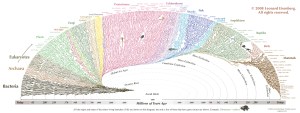
Noah had every single one of these animals on the ark with him. True story.

Noah had every single one of these animals on the ark with him. True story.

Every single one of us, then, is a sort of “Noah’s Ark” in our own right. In truth, we’re each made up of millions and millions of little Noah’s Arks.

Now, I don’t know that that was the author’s intent for the story of Noah’s Ark. I’m not offering any of this as anything but speculation on my part. Some, or most, or even all of what I’ve written here might be what these stories are really about, but I’m not dogmatic about any of it, because I just don’t know with any certainty. And despite claims to the contrary, I don’t believe anybody knows with any certainty.

What I do know is this: Jesus Christ rose from the dead. I can prove that, and I believe I have proven that, as much as anything can be proven. And that’s not because my debate skills are such that I have any unique ability to prove things like that; contrary to some of my critics, it’s not because I have any special Jedi mind tricks or extraordinary powers of persuasion up my sleeve. It’s because the nature of the Event itself is such that it lends itself to relatively simple confirmation for anyone willing to honestly look into it—to look into it without preconception, prejudice, or a pre-set agenda that depends upon it being either true or untrue. You don’t need “faith” or superstition or suspension of disbelief or any amount of childhood conditioning to believe the resurrection. These do more to obscure and confuse the truth than they ever do to illuminate it. All you need is a resolution to be honest and to follow the truth wherever it leads, and then God Himself will provide you with faith, once you’re confronted with the facts themselves and respond to them without reservation or qualification. It is through the facts, actually, that He provides faith—not the other way around.

I know the resurrection to be true. As a naked fact of history, I know it to be true. That’s my starting point.

Because of that, I trust that Jesus knew what he was talking about when he affirmed the truth of the Scripture.

I also know that the earth and the universe weren’t made in six literal 24-hour days, and that God didn’t personally and directly mold each and every individual species of animal life out of clay in its present form.

I also know that it isn’t the Bible that asks me to believe those things—just Christians. And Christians have been wrong en masse before.

Granted, believing the resurrection means believing in the miraculous—in a God who intervenes in history. And, believing in Jesus means believing what he believed, and he seemed to uphold the truth of the stories of Noah and Adam and the others we find in Scripture.

I can’t follow Jesus Christ, then, without also upholding the truth of those stories. But, in what way they’re true—and what way Jesus held them to be true—isn’t so clearly established. Unlike the resurrection, their truth doesn’t always depend on them being literal and historically factual in every respect. I’m completely open to the literal truth of Noah fitting at least two living specimens of every single form of animal life on earth into the ark, if someone can come up with a plausible explanation for how that happened, along with an explanation for there being absolutely no geological or sedimentary evidence for a worldwide flood. But—and, again, unlike the resurrection—I’m not sure any of that is the point.

There were more than a few early Church Fathers, for instance, who upheld the literal, factual, historical truth of the resurrection and miracles of Jesus, but who also taught that when the plain, ordinary meaning of a story can’t be accepted, for whatever reason, there must be some kind of allegorical truth God intends to be found. Origen, for instance, took the teachings of Jesus literally (probably inappropriately in this regard) and seriously enough to actually castrate himself, but was known for allegorizing many of the stories of the Old Testament.

My objection to Young Earth Creationism, though, is not that I have any trouble believing that God intervenes to do the miraculous, nor that I have any problems acknowledging the supernatural or the paranormal, per se. And, it wouldn’t be accurate to characterize my own interpretation of Genesis as allegory. For the most part, I find that when it’s read plainly and literally (but not superficially) on its own terms, yet recognizing the constraints of language—not just primitive, pre-scientific Bronze Age language, but all language—the general picture we get from Genesis, while not exactly identical, looks much, much, much more like what we can see through the lens of modern physics, cosmology, and evolutionary biology than it does the crude, cartoonish finger-painted picture given to us by six-day, Young Earth Creationism.

No, I believe God is more than capable of intervening at will, but—from what I read in Scripture—I don’t believe it’s His way to do that directly, except as the rarest of exceptions. Also, the strict distinction we often make between “natural” and “supernatural” isn’t entirely biblical. As I’d mentioned in my previous entry, that’s something that’s crept in from paganism and polytheism, not something indigenous to the Bible.

But, I’ll have to devote my next blog entry to explaining what I mean by that. For now, there remains one more glaring obstacle to reconciliation of the book of Genesis, and the rest of the Bible, with the scientific discoveries that have shaped the modern age.

In particular, one scientific discovery represents a significant dilemma to basic Christian teachings.

If the Theory of Evolution is true, then that means Adam, and every other form of life on earth, evolved through natural selection.

“Natural selection” is, of course, just a fancy, sciencey way of saying “death”—specifically, “death that precludes reproduction”: variation comes about by way of random genetic mutation, which cumulatively results in different traits emerging over successive generations, but if a new trait turns out to be a liability to survival rather than an advantage, its bearers tend to die before they can reproduce, so the trait doesn’t get passed on. By process of elimination through death, the mutations that turn out to be advantageous adaptations are naturally selected to survive and proliferate.

So, Adam’s existence would have come about only after uncounted millions of generations lived and died before him.

Yet, we read in Genesis, and in every commentary on it found in the New Testament, that death exists in the universe as a consequence of what Adam did.

Paul wrote, “Sin entered the world through one man, and death through sin, and in this way death came to all people, because all sinned…”

Not only that, but the Curse of the Fall brought about the persistence of entropy itself throughout the universe, because, we read, the Atonement and the Resurrection are God’s answer to and salvation from the Curse, not just for humanity, but for the entire universe:

“The creation waits in eager expectation for the sons of God to be revealed. For the creation was subjected to frustration, not by its own choice, but by the will of the one who subjected it, in hope that the creation itself will be liberated from its bondage to decay and brought into the glorious freedom of the children of God.”

The New Testament teaches that Christ took upon himself the curse wrought by Adam, and by descending—first into flesh and blood as a Member of the human race, and then into the grave—he fulfilled the requirement of death incurred by Adam upon the entire universe. Then, by rising again from death—first in a bodily resurrection, and then to the right hand of God—he took all of creation with him, in a sense, thereby redeeming the entire universe: a redemption to be consummated and completed when he returns at the end of history:

“For since death came through a man, the resurrection of the dead comes also through a man. For as in Adam all die, so in Christ all will be made alive. But each in turn: Christ, the firstfruits; then, when he comes, those who belong to him. Then the end will come, when he hands over the kingdom to God the Father after he has destroyed all dominion, authority and power. For he must reign until he has put all his enemies under his feet. The last enemy to be destroyed is death. For he ‘has put everything under his feet.’ Now when it says that ‘everything’ has been put under him, it is clear that this does not include God himself, who put everything under Christ. When he has done this, then the Son himself will be made subject to him who put everything under him, so that God may be all in all.”

But, if Adam evolved through natural selection, i.e., death, how then can Adam be culpable for the existence of death? How can death be a “curse” resulting from Adam’s sin if death was part of the process that brought about Adam’s existence in the first place? And if death isn’t, after all, a punishment upon Adam’s rebellion against God, then what meaning do Jesus’ death and resurrection have?

Again—I believe a person can accept the truth of the stories of Genesis without necessarily believing them in the literal and factual sense in every respect. But, I don’t see that the same option exists for the resurrection. Without the resurrection as a literal, historical fact, Christianity would be nothing but a hollow shell. If it didn’t really happen, all we’re left with is a nice story with no relevance to real life. It would still make for a great template for superhero movies and fantasy literature, but it would be utterly worthless as the basis for a philosophy of life.

For the resurrection to be real, the Atonement also has to have been real—Jesus’ death has to have held a transcendent, spiritual and cosmic meaning. That’s what the resurrection signifies: the One condemned by the powers of this fallen world has been vindicated by God and, through him, God has reversed the curse of death and redeemed humanity and the universe from its final and lasting grip. Without the Atonement, there might still be the social implications of the Son of God being condemned and crucified by the civil and religious elites of the day, but it doesn’t seem to me that God would go to such lengths or put His Son through so much for something as comparatively trivial as a political statement. Without the broader, cosmic meaning of the Atonement, Jesus’ crucifixion would be an absurd tragedy to be mourned, not a triumph to be celebrated and validated through the resurrection.

So, Young Earth Creationists and other Christians who reject the Theory of Evolution do have a point—there does at least seem to be a legitimate conflict between the Atonement and the idea of Natural Selection.

I happen to know for a fact that the resurrection actually happened, though. And, I happen to think that the science is pretty much conclusive on the Theory of Evolution.

And, for reasons to be explained more fully in my next entry, to not embrace the findings of modern science, and to choose willful ignorance over knowledge, to hide from new information, even out of—especially out of– commitment to the Bible is actually a betrayal of everything it teaches.

So, as unlikely as it might seem up front, there must some way to reconcile the two.

The Scripture doesn’t say in so many words what that way is, but there are clues.

First, Paul wrote, “God presented Christ as a sacrifice of atonement, through the shedding of his blood—to be received by faith. He did this to demonstrate his righteousness, because in his forbearance he had left the sins committed beforehand unpunished—he did it to demonstrate his righteousness at the present time, so as to be just and the one who justifies those who have faith in Jesus.”

This thought came right after Paul established that all alike have sinned, and none are justified by their own merits, by their own good deeds or character or nature:

“No one will be declared righteous in God’s sight by the works of the law; rather, through the law we become conscious of our sin. But now, apart from the law the righteousness of God has been made known, to which the Law and the Prophets testify. This righteousness is given through faith in Jesus Christ to all who believe. There is no difference between Jew and Gentile, for all have sinned and fall short of the glory of God, and all are justified freely by his grace through the redemption that came by Christ Jesus.”

In other words, it doesn’t matter what group you fall into—Jew or Gentile, Greek or barbarian, male or female, free or slave—because everybody’s under the same curse, living by the same fallen, corrupt nature, and is saved through the same faith, by the grace of the same God.

Paul goes on to explain, as he does in his other writings, that the patriarch Abraham was a prototype and example of the faith in Christ through which we are justified and saved.

Abraham, of course, lived about 2,000 years before Christ. We learn from Paul and other teachers, including Jesus himself, that there is no true righteousness or salvation apart from Jesus Christ, yet we read that Abraham—who lived and died two-millennia before Christ—exemplified the faith to which we’re called for salvation.

We’ve already discussed how both modern physics and ancient scripture teach that time is not as rigid and absolute as we perceive it to be. It’s elastic, subjective to physical parameters of mass and velocity and gravity.

Evidently, it isn’t as linear or one-directional as we perceive it to be, either. At least, not from God’s perspective, it isn’t.

According to the Scripture, Christ’s atonement was applied backwards in time to people who lived and died before his death and resurrection.

It’s a little bit beyond the scope of this discussion, but still worth pointing out as a preview to a future blog entry, but it reads elsewhere that the gospel of salvation through Christ was “a mystery kept hidden for ages and generations, but is now (in the 1st century) revealed to the saints.” Paul said it’s “the mystery hidden for long ages past, but now revealed and made known through the prophetic writings by the command of the eternal God.”

That means people in Abraham’s time didn’t know about it. Moses didn’t know about it. Adam and Eve, Enoch, Noah, Jethro of Midian, Naaman the Syrian, the widow of Zarephath, and countless others reckoned as “righteous” in the Scripture were in no position to know about the Messiah’s death and resurrection, nor about the resultant Atonement and Redemption.

Also, there are passages in the Old Testament in which the Second Person of the Trinity is seen acting in his High Priestly role on behalf of people who lived and died long before the Son of God was born on earth, yet we read that Jesus Christ was qualified for that role only because of what he did on earth.

So, all those people who lived and died before Christ was born still benefited from what Christ accomplished. It happened within time, at a certain point in history, but God applied the blessings accomplished by it throughout all time, and to people who were not and could not have been conscious of it, because God exists beyond space and time. When Jesus ascended to the right hand of the Father, he also ascended beyond space and time. So, there has never been a time in the history of the universe when the Man from Nazareth—the One with nail-scarred hands, born to the young bride of an impoverished Jewish carpenter in an obscure province of the Roman Empire—was not dwelling in the very heart of the Godhead, interceding with God on behalf of fallen humanity.

This raises questions and considerations long ignored—willfully, stubbornly, and disgracefully ignored by mainstream Christianity—about what it means to be “in Christ” and whether a person must be conscious of being “in Christ,” and on what terms. It raises questions about whether people like Socrates and Gandhi or that hypothetical pygmy in the deepest, darkest jungles of South America who’s never heard of Christianity could, in theory, be saved after all.

In other words, there is no question that Jesus is the Only Savior, the Only Way to be Saved. He is. However, in what way “Jesus is the only way” is another question entirely, and one that mainstream Christianity typically fails to explain in any biblically-thorough or morally-cognizant manner.

But, that might best be left to another blog entry.

The point I want to make in this entry is that if the blessings of the Atonement were applied across time, forward and backwards, future and past, then why wouldn’t the Curse have been applied on the same terms?

The Atonement, after all, is God’s answer to the Curse. The Atonement settles the karmic debt, so to speak, incurred in the Fall of Man. It balances mankind’s spiritual ledger before God, which was covered in red by the Curse, and as such, it’s the inverse and opposite of the Curse.

It is all but explicitly stated in Scripture that the blessings of the Atonement were applied across time in both directions. Implied in that is the suggestion that the Curse, as the karmic opposite of the Atonement, also applied equally to Adam’s future and his past.

As in, even though the Fall occurred at a specific point in time and (pre)history, the resultant Curse applied across time, all the way back to the beginning, when the process of cosmic entropy first began in the moments immediately following the Big Bang.

So, Natural Selection and the Atonement are not, as it turns out, mutually exclusive concepts. The Curse doesn’t have to have taken effect after the emergence of Man, any more than God had to wait until after the death and resurrection of the Messiah to apply the benefits of the Atonement. God exists outside of time, and so, therefore, do the consequences of our relationship to Him. Had Adam not rebelled, the Curse would not have introduced death into the universe, and natural selection would not have been the mechanism for the evolution of complex life. Something else would have been. Perhaps adaptation would not have been random, necessitating the elimination of unfit mutations? The universe would have functioned differently from the beginning, possibly without the Law of Entropy holding sway, and possibly with a completely different scheme for life on Earth.

And as unlikely as that might sound from the standpoint of practical, scientific reality—that the fundamental laws of the universe could have been influenced from the beginning by the choices made by a single specimen of animate dirt 13 billion-or-so years later, it’s not actually that far-fetched sounding when it’s considered alongside other ideas advanced by physicists themselves in their attempts to answer the Big Questions of existence.

The Participatory Anthropic Principle, for instance, proposes that the existence of the universe depends on observers—that it exists only because we’re here to experience it (that tree falling in the woods would not only not make a sound, but it wouldn’t be falling, wouldn’t be a tree, and there would be no woods within which to fall, without someone there to hear it…). The PAP is controversial, admittedly, but it doesn’t get people laughed out of academia for seriously discussing it, if some of Stephen Hawking’s writings and public addresses are any indication. It’s really just one variation of a more general “Anthropic Principle” to account for the existence of life in the universe, and it’s not even the craziest iteration. In trying to flesh out the Anthropic Principle, physicists have had to resort to serious discussion about the emergence of intelligent machines in the future, parallel universes, time-travel and other notions usually left to science fiction writers to explore.

The idea that the Fall of Man might have had practical effects on the fundamental laws of the universe isn’t actually that far out, then, and it isn’t, by comparison, so ridiculous to consider that if God exists and made Man as the privileged bearer of His Image, Natural Selection and Entropy might be the cosmic consequence of our rebellion against Him.

We read in Scripture that the Fall occurred after God “took the man and put him in the Garden of Eden.” Whether this was an actual, geographic location, a spiritual plane, a psychological state, or what has long been the subject of scholarly debate. I’m completely open to it being an actual, literal place on earth, or any of the above, really, but I don’t know that it must be either of these in particular for the truth… no—for the reality of the story to apply. Whatever the true nature of the Garden of Eden, the truth of the relationship between God and Man is real, and so are the consequences.

We read, though, that the Garden of Eden was this other (…location? …condition? …plane?) to which God took him and the woman, presumably removing him from somewhere else within the normal scheme of what his life would have been had God not relocated him. The Garden was a paradise beyond what would have been his normal habitat, where Man freely enjoyed the presence of God and His gifts to Man without fear or suffering or want or death. But, it was also a place where his loyalty and love and trust in God would be tested, and his relationship with God and with His creation would be defined by the outcome of that test.

Then, we read that a talking snake—which even Young Earth Creationists interpret non-literally to mean the Devil, or Satan, or “the Accuser” in Hebrew, or the Great Red Dragon and the Prince of the Power of the Air, as he’s called in the New Testament—entered the Garden to cast doubt on God’s goodness and intentions, in order to get Adam and Eve to fail their test and fall from grace.

The serpent succeeded, and God cursed all three of them: the serpent was condemned, among other indignities, to slither in the dust for the rest of time (How did it get around before it slithered? Did it have legs and feet and a different body type?); the woman was cursed to painful childbirth and resultant dependence upon her husband; and the man (and all that belonged to him) was cursed with mortality and condemned to a constant struggle to make his living from the earth that would be cursed now because of him, and he was banished from God’s presence.

Whatever the Garden of Eden was, Adam didn’t get to stay for long. Or maybe he did. We actually have no idea how much time he spent there, nor even if it was something within space and time that could be measured in terms of temporal duration. At any rate, he disqualified himself and his descendents from it, and now humanity is barred from the immortality represented by the Tree of Life by a deadly, lightsaber-wielding angelic gatekeeper—or something that could only best be described as such according to available Bronze Age-terms.

As time went on and Adam’s offspring proliferated on the earth and they descended into greater and greater depths of depravity, we read that God wiped out nearly the entire human race, sparing only a handful to repopulate the earth.

That’s what we read in Scripture.

We’ve learned from other sources, like geology and paleontology and other sciences, that dragons once ruled the earth, long before the rise of Man. Then, something happened—we don’t know exactly what, but some massive extinction event wiped them all out and fundamentally altered the ecology of this planet.dinosaurs-extinction-150-dpi Or, at least, most of them were wiped out. Enough survived to evolve and adapt to the new environment following the asteroid strike and climate change and other alterations that wiped out most of them. Some evolved into snakes that slither on the ground. Some evolved into birds, which now dominate the skies above us.
Long after this, mankind evolved and began to proliferate on the earth. Then, another extinction event wiped out all but a few of us.

Now, I couldn’t begin to guess what the extinction of the dinosaurs has to do, in a spiritual or in a scientific sense, with the fact that Satan, or the “Great Red Dragon,” or “the Prince of the Power of the Air,” as he’s also called, was cursed in the Garden of Eden for being the snake that deceived Adam and Eve.

But, there seems to be some kind of loose correlation there, as there are between other broad features of both Scripture and scientific discoveries about the history of the Earth. And that tells me that the Scripture is actually far more true than we typically imagine—more true than our childhood Sunday school literature ever would have led us to believe, but also true in ways we never could have imagined. It’s true in ways we couldn’t even guess that it’s true.

And my concern here, obviously, is not to resolve every single apparent discrepancy between the Bible and the findings of modern science, nor is it to solve every mystery or answer every question.

I simply don’t know, with any real certainty, what the Scripture means when it tells of a global flood, or of plant life emerging before sunlight ever reached the earth, or of the first woman being the result of a divine rib transplant. I don’t believe the evidence supports a strictly literal Noah’s ark and a global deluge, or the special creation of Eve, or plant life emerging and thriving in the absence of sunlight.

I do know that the Scriptures are divinely inspired, and so they are the medium for a body of profound, life-giving truths revealed by the very same Power who raised Jesus from the dead. And I don’t know this, even, because the Bible demonstrates such an uncanny prescience with regard to what we’re continually discovering about the universe through the scientific method. I don’t point out the correlation as an apologetic for Christianity to non-believers (the resurrection and the fulfillment of prophecy accomplish that already), but as an apologetic for modern science to Christians, who continue to perpetrate a pointless and counterproductive war with interests who should not be our natural enemies.

Contrary to the narrative typically invoked in western culture, and reinforced by Christian efforts to deny and suppress the Theory of Evolution and the Big Bang Theory and the rest, the scientific revolution was not the consequence of civilization shuffling off the supposed irrationality of Christianity, but of Christians shuffling off the irrationality of paganism and polytheism.

More on that next time…

Posted in Uncategorized | 4 Comments

Why I’m not a Young Earth Creationist… and Jesus isn’t either. (1/3)

UPDATE: I disavow much (not all) of this. My views on the Book of Genesis and its relationship to science have changed considerably since I wrote this many years ago, and if I’m being honest, I’m somewhat embarrassed by much of what I’ve written here. I feel like it would be dishonest of me to remove it, however, and also — as embarrassed as I am about how I used to think — keeping it up for posterity might be helpful and instructive, if only to convey that it’s Ok to change your views in light of new information, even if you have to eat a little crow along the way. 

Maybe I’ll get around someday soon to finally writing Part 3 of this, in which I’ll explain how and why my views have changed. For now, though, feel free to bask in my humiliation. 

This little tractate started out as a Facebook comment the other day by which I’d intended to explain why I so emphatically reject the notion that Jesus was a Six-Day, Young Earth Creationist. I got a little carried away, though, and the discussion moved on before I could finish this and post it. Since I find myself having this conversation so often anyway, though, and since I created this blog precisely so I could collect all of these mini-lectures I find myself inflicting upon people, I thought I may as well post it here, so when it comes up in conversation again I can just say, “I wrote a blog entry about that,” and spare the person a lengthy impromptu sermon, while still providing an option to read about it at their leisure at a later time.

Again, the discussion was about Christianity’s relationship to modern science, and why I’m so emphatic that Young Earth Creationism isn’t actually taught in the Bible, and that the Theory of Evolution is, not only a more-or-less indisputable and proven scientific fact, but the most biblically-correct model of biology on the market.

I should further qualify my use of the word “indisputable,” though. I use it, of course, as a relative term, because any and all scientific theories exist for the purpose of being disputed. That said, I know there are flaws, gaps, and as-yet unexplained inconsistencies within the Theory of Evolution, and the work of scientists is to either figure out how to reconcile those apparent discrepancies with the broader principle on which the theoretical model is built, or to come up with a better scientific (not philosopical, but scientific) model to account for them– a model that provides more consistent and accurate predictability with regard to the phenomena under study than the  current model.

It does no good, then, for YECs to point out apparent problems with the Theory of Evolution, any more than it would be worthwhile to point out that Isaac Newton’s Laws of Motion don’t apply to questions of electromagnetism, or that the Theory of General Relativity doesn’t agree with Quantum Mechanics. The real scientists already know all that, and that’s why the search for a single, comprehensive model of the universe has dominated the study of physics for the past 100 or so years.

In the field of biology, there is no significant controversy over the Theory of Evolution, because there is no other theory on the market to compete with it. Intelligent Design, while true, does not qualify, because it’s not a scientific theory. There is no way to make a testable hypothesis on the basis of Intelligent Design, because it can’t be used to make any kind of predictions whatsoever about what it purports to explain. It can’t be used to develop better drugs or preserve endangered species or anything else for which a sound theory of biology is used.

But, that’s all beside the point where Young Earth Creationists are concerned. I’ve heard plenty of people quote Phillip Johnson books, Darwin’s Black Box and other works of evangelical propaganda packaged as shrewd and sober scientific challenges to the prevailing model of biology, but it’s specious (and a bit pretentious) for Christians to claim that they dispute the Theory of Evolution on its scientific merits. Never mind the fact that most evolutionary skeptics aren’t even remotely qualified (any more than I am) to step foot in that arena, because if it weren’t for our religious commitment to uphold the Bible, most of us would never have any reason to question or comment upon the Theory’s scientific validity.

But… here’s the main issue at work here: a great many churchgoers spend the first few years of their lives being told by others what the Bible teaches, long before they’re in any position to read it for themselves with any meaningful comprehension. Their understanding of God and the universe and the origin of man is absorbed in early childhood and shaped in large part by cartoon depictions found in coloring books and children’s Sunday school literature. Having been told so often by well-meaning but thoroughly indoctrinated Sunday school teachers what the Bible supposedly teaches, the typical churchgoer is conditioned to hold a certain collection of preconceptions long before he or she ever learns to read. In general, they learn that God is an elderly Caucasian man with a flowing white beard who, about six-thousand years ago, rolled up the sleeves on His white robe before He reached into the mud with His two five-fingered hands to sculpt each individual species of animal life, two-by-two, in the precise form in which they exist today, as an add-on to a brief, week-long project of constructing the universe by much the same hands-on method. jesus_dinosaur  This nursery-inculcated worldview is packed with colorful ideas about talking animals as commonplace features of the original state of creation, biblical figures coexisting with dinosaurs, and prehistoric man believing and worshiping on much the same terms as a modern American evangelical.

So, when they’re old enough to then read the Bible for themselves, they wind up projecting many of these notions onto the text and feeding them back to themselves, convinced that what they’re walking away with afterward is “biblical teaching,” when it’s not.  (That is, if they actually do wind up reading it for themselves, because, let’s face it: most people filling church pews today—or even teaching Sunday school classes, for that matter—couldn’t answer basic questions about the wanderings of the Patriarchs, the Babylonian exile, or even basics about messianic prophecy, along with a host of other key concepts that collectively comprise “Christianity,” much less be able to answer questions about where the Bible came from and why it’s this particular book they uphold rather than others. None of that would be so bad, though, if we weren’t so insistent that everyone else run our shared public institutions according to our poorly-explored understanding of what constitutes Christianity. But, I digress…)

If we take the Scriptures on their own terms, though, without projecting our own ideas in-between the lines, they’re actually much more supportive—and, even, suggestive—of the Big Bang Theory, the relativity of space/time, and, even, progressive biological evolution.

I find it simultaneously exasperating and amusing when I encounter Christians who turn their noses up at the Big Bang Theory because they understand it only as an attack on the biblical teaching they purport to uphold. The physics community initially turned their noses up at it as well when George Lemaitre first proposed it, and for precisely the opposite reason: the notion of creatio ex nihilo (“creation out of nothing”) was, at the time, regarded as a purely theological idea– a superstition, really– so when this Catholic priest/physics professor became the first to propose it as the logical consequence of Einstein’s new General Theory of Relativity, commonly-held anti-religious snobbery led them to  assume he must have been advancing a religious agenda under a flimsy guise of scientific respectability (given some our aforementioned tendencies to dress religious indoctrination up in a nice tuxedo, it’s easy to understand why they’d think that, though).

Lemaitre hypothesized the idea of an expanding universe suddenly appearing from an infinitely hot, dense singularity (or a “primeval atom,” as he termed it) one-third the size of a proton, which emerged inexplicably out of the darkness and void before it exploded in an immense flash of light that resolved itself into the matter and energy that comprise the universe in its entirety. The “Big Bang” Theory (a label originally meant as a pejorative before it stuck) has since been confirmed to be true several times over, but at the time, they dismissed it as nothing but a mathematical apologia for the scriptural passage reading, “In the beginning God created the heavens and the earth… And God said, ‘Let there be light,’ and there was light. God saw that the light was good, and he separated the light from the darkness. God called the light ‘day,’ and the darkness he called ‘night.’ And there was evening, and there was morning—the first day.”

At the time, conventional wisdom among physicists had it that the universe was eternal and static, and the idea of a cosmic beginning was regarded as a quaint religious myth. A curious reversal has occurred in the intervening century in that what was once regarded as a superstition to be derided by the intellectual elite is now axiomatic to scientists’ understanding of the universe, and so is often derided instead by the religious elite.

Of course, the final verse quoted is often taken to mean all of this happened within the span of a literal, 24-hour day… which would be a plain and obvious, albeit superficial and mistaken reading.

If light = “day” and darkness = “night,” and this was the first such occurrence of day and night, then of course it’s a literal 24-day, right?

Except, light and darkness on planet Earth are the consequence of rotating in and out of the illumination of the sun—something that wasn’t possible until the Fourth Day, when God set the sun, the moon, and the stars in the skyward view of the Earth. And, we read, He didn’t do it just to provide light, but to “serve as signs to mark times and days and years.” It reads that “God set them in the vault of the sky to give light on the earth, to govern the day and the night, and to separate light from darkness.”

Yet, God had already separated light from darkness before, thereby creating the day and night that marked the First Day. Two more days then elapsed according to the standard of time established on the First Day. But, it wasn’t until the Fourth Day that He “separated light from darkness” on earth, thereby creating the night and day that mark a “day” as we experience them.

So, whatever else the passage means, that original, primeval scale of time established on the First Day could not have been a literal 24-hour day as we experience them, but a different measurement of time entirely. It was the broader, cosmic framework of time by which the general stages of creation progressed, but not a “day” as we know them, and the Creation account was written in such a manner as to make that distinction explicit.

Of course, when it’s read under a universally-held assumption that “a day” is just a day, and can only mean a day—because time is known to be static and linear and absolute and non-negotiable—the error is understandable. It ignores an explicit distinction within the text, but it’s still an understandable error, given the limits of our common perception of time. In the age after Einstein, though, we know better, and so, evidently, did the author of the Creation account. We know now that time is relative to the observer’s frame of reference, and that variables like mass and gravity and the curvature of space will affect the rate at which time flows, just like a boulder in a river will affect the flow of water around it. A person standing inside something as massive as the Great Pyramid of Giza will be subject to time at a slightly slower pace than a person standing in the open, but much faster than someone who might be standing on the surface of a planet the size of, say, Jupiter (I know, I know—Jupiter doesn’t have a surface, but use your imagination). If a person were unfortunate enough to be caught at the event horizon of a black hole, observers in the distance would see the cascade of events play out practically instantaneously, but to the person himself, the episode would take hundreds of years to play out, and it would appear to the person that he was frozen in place at the black hole’s edge, because time itself would slow to a crawl in the midst of its immense gravity.

What we needed Albert Einstein and Stephen Hawking and others to teach us about time, other biblical writers were able to figure out on their own somehow: time is relative to the observer’s frame of reference, so an observer from, say, God’s frame of reference could experience a day to be as long as a thousand years, or a thousand years to go by as quickly as one day. God created time, and so He stands outside of it, beyond it, so millions of years to Him are as brief as the moments between the tick of a clock, and the moments between a clock tick are as long as the age of a universe. We don’t know exactly how long, from our frame of reference, the Six Days of Creation were (nor is that the point), but a plain comparison of Genesis 1:17,18  with vs. 3-5 should tell us that it’s not a literal 24-hour day in view when the six stages of creation are referred to as “days.”

The days of creation, then, couldn’t have been the brief, comparatively instantaneous episodes we understand them to have been from our childhood indoctrination, but would have been cosmic epochs in which the progress of creation gradually came into place.

And I say “came into place” because, we read (contrary to the depictions of our childhood), at no stage of creation did God ever directly intervene. Rather, He expressed His will, and creation carried it out. He said, “Let there be…” and then it was. He commanded, and creation obeyed. He issued the command, the law, the principle, the pattern, by which the universe would operate, and He issued it in a specific orderly, progressive manner.

Nowhere is this more pronounced than on the Sixth Day, when He created animal life; or, rather, when He commanded that the earth create animal life:

“And God said, ‘Let the land produce living creatures according to their kinds: the livestock, the creatures that move along the ground, and the wild animals, each according to its kind.’ And it was so.”

According to the Scripture itself, God did not reach into the mud and shape each species with His own two five-fingered hands. Rather, He merely commanded, and the earth brought it forth, of itself, according to His will, according to natural laws dictated by God. The earth—which previously was not “alive” in any biological sense—produced life of itself, and it emerged from the planet “according to its kind.”

So, if life emerged from the earth according to the natural processes set in place by the Creator, it stands to reason (and fossil record observation) that it was more like the material already present in the earth when it started out, so it emerged in a simple, basic form, then reproduced with degrees of variation and complexity in successive generations “according to its kind,” i.e., its taxonomy, eventually separating into phyla, classes, orders, families, genii, species, subspecies, etc.

Eventually, near the conclusion of the epoch known as “the Sixth Day,” a completely unique and unprecedented species of life arose—a species unlike any previous “kind”—a species made uniquely “in the Image of God.” It was a species with a power like that of God: the power to speak—to think and communicate in symbolic terms, and to thereby create with that speech.

Clearly, Man could not create ex nihilo as could God, but he could create systems of symbols by which God’s creation could be organized, understood, and subdued: Man’s first work was to name the animals, and so he participated, in a fashion, in God’s process of creation (Genesis 2:19, 20).

Of course, an obvious objection to this line of reasoning is that the Scripture reads, “God formed man from the dust of the earth,” so (some reason), Man could not have evolved as “just another animal,” but was specially created by God.

Specially created we were, for sure, but there is no elaboration in Scripture of the specific process by which God made us. The only specific mention is of the material used: the dust of the earth, which is the same material of which the rest of the animal world is composed, having been “brought forth from the earth” on the Sixth Day. The Scripture says nothing about how many degrees of removal Adam was from the earth, nor the specific process by which his physical material was transformed from mere dust into the cells of his body.

There is a strong suggestion of the general process, though: Mankind emerged at the end of the Sixth Day, which began with God’s command that the earth bring forth living creatures. The creation of man began with the emergence of that first single-celled, self-replicating organism, which fed on the nutrients of the earth and reproduced itself over trillions of generations for millions of years, gradually transforming through mutation and natural selection, taking on new powers of movement and awareness and communication, and the ability to manipulate its environment to its advantage.

The eventual result was the vast complexity of life we see around us today—something the earth produced of itself,  according to natural laws of chemistry and physics decreed by God, as we read in scripture.

Of course, it doesn’t say that in so many words. It reads only that “God said, ‘Let there be…’ …and it was.” It isn’t much of a leap, though, to read it to mean that, implied in the command “Let there be…” were the instructions “Let the natural laws of chemistry and physics be such that this outcome occurs.” In fact, there is no material difference between these two wordings—they are different ways of saying the exact same thing.

Naturally, though, such an explicit description would have been lost on a Bronze Age readership, as would an explicit description of creatio ex nihilo.

After all, it never reads “creation out of nothing” in so many words either. In fact, the only explicit mention in scripture of God creating the universe “out of nothing” is found in the Apocrypha (2 Maccabees 7:28), written centuries after the Genesis account.

That concept might have been a bit advanced and alien for its time as well—as alien as describing the development of life in terms of the laws of thermodynamics, genetic variation, and natural selection. The number zero wouldn’t be invented for another few centuries, and most cultures at the time believed that the gods had fashioned the world out of some pre-existent material (usually the carcass of a giant dragon or sea monster, or on the back of a giant tortoise, which stood on the back of another, larger giant tortoise standing on the back of a stiller larger tortoise, ad infinitum). The account in Genesis seems to play to that expectation, even as it undercuts it: “Now the earth was formless and empty, darkness was over the surface of the deep, and the Spirit of God was hovering over the waters.”

All language is based on symbols, and symbols have to be recognizable– they have to be based on objects and experiences common enough to be easily referenced and recalled by the people who share the language; otherwise they’re just gibberish. And, Bronze Age Hebrews had a much less varied range of common experiences to reference than modern English speakers. Consequently, there are fewer than 9,000 unique words in the Old Testament, which speaks to an ancient Hebrew vocabulary that was much more limited than the more than one million words we have in the English language today.

Yet, the writer of Genesis had to somehow describe something that happened beyond and prior to any human experience– something for which no human being had ever had to come up with language to describe before, using only the limited range of shared experience represented in those 9,000 words. 

All things considered, one can only admire the unrivaled genius at work in the economy of language found in the book of Genesis, as well as the prescience in describing realities we take for granted today, yet were inconceivable to anyone living at the time.

They had no concept at the time, and therefore no words– no direct symbols for “zero” or “nothing” or for the vacuum of space. So, the sea—with its dark, unknowable depths and unpredictable, turbulent motions—was typically employed as a descriptor in pagan creation mythology for the primeval chaos of the universe prior to the formation of the earth. Genesis seems to use that expectation as its starting point, but qualifies it by describing the earth as being, in Hebrew, tohu—without form or shape, and bohu—without substance or content, and covered in darkness—the absence of light or appearance. In a culture with no number zero and no concept of “nothing,” this was as close as the writer, in near eastern Bronze Age terms, could get to saying, “there was nothing prior to creation.” But, the writer of 2 Maccabees and others at the time seemed to catch on, and creatio ex nihilo became the standard interpretation of Genesis 1:1-5, long before there was any scientific justification to believe the universe had a beginning in time, prior to which there was nothing.

Likewise, it doesn’t read in so many words that God created life by saying, “Let the laws of chemistry and physics and biology be such that complex animal life emerges from the planet,” but I think we can safely infer that from what is written. That reading, at least, depends far less upon our preconceptions than the cartoonish, anthropomorphized version offered by children’s Sunday school literature.

As life proliferated and adapted and struggled and took on new powers and forms, the evolutionary Great Leap Forward finally happened late in the epoch referred to in scripture as the Sixth Day: a single specimen of primate was born, which appeared in all respects to be like every other member of its species. It was mostly hairless, could walk erect, had opposable thumbs—just like all the others of its kind. But, it understood things in a way others couldn’t, and tried to communicate what it understood, but to no avail: it was isolated in its understanding, for it alone carried the mutation that made the crucial difference between anatomically modern humans and behaviorally modern humans. It had inherited its large cranium from its forebears, which they developed by having learned the magic of fire, which enabled them to cook and digest meat in order to fulfill the massive requirements of protein demanded by their larger brains. But, this new specimen could do much more than conjure fire with dry wood or with flint and brush. It could develop a vast array of symbols in the form of sounds, which it could use to try to communicate with others of his kind… if only there were any others of its kind.

This capacity for symbolic thought and communication amounted to the capacity to think in abstract terms, beyond just the grunts and gestures that meant “danger” or “food” or “let’s mate.” This capacity for abstract thought gave it the capacity—gave him the capacity, rather, to understand the existence of his Creator, and to worship Him.

Adam was made from the dust of the earth, but not directly—not by God’s direct contact with the dirt. He was made from the dust of the earth in the same way we all are: we’re conceived in our mothers’ wombs and then we grow from the material provided through the food they eat, which is made of nutrients from the earth, delivered by way of plants, or by the meat of animals that ate the plants. Adam was born of a mother and a father, but he was born with a particular mutation that made him unique in all the world: he was the first of his kind, made in the image of God.

This would explain, of course, where Cain got his wife, and it explains who all those people were of whom Cain was so terrified when God banished him to Nod: humanity—or, at least, proto-humanity—existed prior to the arrival of Adam. The writer of Genesis seemed to take it for granted that the human race existed in some capacity prior to God’s creation of Adam and Eve, and seemed to expect readers to understand that as well. No explanation was offered for who these people were who populated the city built by Cain, nor who it was that posed a threat to him in his banishment. Yet, every time a descendent of Adam was conceived and born, the writer was explicit about his origins: “Cain went in to his wife and she became pregnant…,” etc.

These earlier specimens of humanity were superficially and anatomically identical to Adam and his descendents, but they lacked the mutation gained in the Great Leap Forward—a mutation that gave them the power of abstract, symbolic thought by which they created systems of zoology and morality through which they were able to assign qualitative value to animals and objects and relationships and people. They were able to recognize beauty and truth and goodness beyond mere sensory input and gratification of appetite, which is how they, and they alone in all the world, were able to relate to their Creator, and to experience guilt and shame over immorality and betrayal.

The ancients understood the significance of this distinction. The relationship between speech and creation and it’s centrality in the condition of man as the unique bearer of God’s image was a major avenue of exploration in Jewish mysticism, long before evolutionary biologists and anthropologists came up with terms like “Great Leap Forward” and “behavioral modernity” to explain the same truth. Kabbalists expressed it through mantras like Abracadabra, which is Aramaic for “As I speak, I create.”

They, and the Greek philosophers with whom they exchanged ideas, understood humanity’s symbol-based rationality to be of the same quality as the Divine Mind that created the universe. The quality was the same, but the degree was but a miniscule fraction of the infinite Supreme Consciousness.

This basic understanding—that human rationality is of the same kind of Intelligence as the Divine Mind—laid the foundation for what would become the scientific revolution.

Of course, this cuts sharply against the narrative we typically invoke in Western society, which has it that the Age of Reason represented a shuffling off of the supernaturalism and superstition imposed on civilization by the forces of Christianity: we learned that bad weather and illness aren’t the result, necessarily, of witchcraft or demons or the wrath of God, but low-pressure fronts and germs. If someone falls prey to illness or natural disaster, we don’t consult an oracle or a priest to find out how to expiate their sin, we consult a medical doctor or a meteorologist.

But, that kind of supernaturalism and irrationality wasn’t actually indigenous to Judeo-Christian tradition. It was something that crept in from the paganism of our ancestors.

I might be getting ahead of myself, though. By now, I expect that there are some pretty loud objections to what I’ve written so far. There are, after all, more than a few problems with my effort to reconcile the teachings of Scripture with those of modern science.

They’re not insurmountable problems, but they do require the scope of another blog entry. So… to be continued.

Posted in Uncategorized | 1 Comment

This.

Posted in Uncategorized | Leave a comment

Fortune Cookies and Altars of Hewn Stone

I went to church this morning. It was the first time in a long time because, well…

Well, I don’t really want to get into that.

Or, I do, but getting into that is the broader purpose of this blog, and the “because” should be obvious enough soon enough if it’s not already from other entries.

Anyway, I’d made up my mind not to be critical or judgy, but to just go, take in what I could, benefit from what I could, see if I could find a place for myself there, and remember that none of these people should care what I think of their church service, because nobody needs to clear it with me before they play a worship song or preach a sermon. Clearly.

That, and being critical and disapproving is just plain exhausting.

I find that when I do it, it’s because—as a follower of Jesus Christ, I feel somewhat responsible for how he’s represented, for the work done in his Name, for the messages spoken in his Name, the causes undertaken in his Name, etc. As a Christian, the things said, done, condoned or condemned in his Name are, in a sense, being done in my name, and that of anyone and everyone else who identifies with Jesus Christ. I don’t have more claim on the name of Christ than anyone else, but to do have some claim, and I have an obligation to try to set the record straight when he’s being misrepresented.

And, there’s that whole “Great Commission”-thing: as a follower of Christ, I’m commanded to go out and tell people about him, to the effect of making disciples. So, you can’t be a Christian without taking some responsibility for how Christ is known and perceived in the world.

But, it’s not like God is my own personal intellectual property. I have no licensing rights, no authority to go from church-to-church as the Theological Police. Nor do I want to. Like I said—it’s exhausting, and it doesn’t make me very popular when I find myself doing it.

So, I went into this with the best of intentions. Or the laziest of intentions. Whatever. In either case, I didn’t want to be critical. I wanted to be nice and friendly and likeable and be able to sincerely tell the people I met there how much I enjoyed the service and how much I looked forward to coming back and how much I’d love to take them up on their offer for lunch, etc. I really just wanted to rejoin the human race by being a part of a community of like-minded people. I wanted to be part of a church again.

Anyone still reading this has probably gathered by now that my intentions didn’t quite play out…

My sense of alienation started with the worship service, but that’s pretty routine anyway. When I see lyrics projected on the screen about “giving my everything for Your kingdom cause” and about how we’re “set free through the blood of Christ” and how we’re supposed to be “people of selfless faith,” etc., I can’t help but wonder, “Are we all really singing about the same thing?” What does that mean to these people—that we’re set free through the blood of Christ? If you ask some Christians, it means we don’t have to eat kosher or be circumcised anymore… something that never would have applied to us or our predominantly European ancestors anyway. Some will say it means we’re “set free from sin,” but in what sense are we “free from sin”? Some think it just means we can do whatever we want and presume on God’s forgiveness and a trouble-free afterlife… “Is that what everybody’s so excited about this morning?”

But, that’s a tangent. Those are the considerations that come to mind in any worship service at any church I’m visiting for the first (or second, third, or hundredth) time, based on past experience and common observations about denominational differences and doctrinal divisions. The ambiguity makes it hard to take the collective emotion seriously, so I find myself fighting an increasing feeling of silliness about so much enthusiasm attached to so many vague abstractions and potentially misguided theology.

I fully realize how weird, and how cripplingly dysfunctional it is to let myself become so morbidly preoccupied with these considerations during worship service. I mean, the point of doing it together, in a group, is that we’re all on the same page—that it should be fellowship as well as worship, and that only really works if there is a common foundation to our collective enthusiasm, so we can feed off of and reinforce each other in our common faith.

But, there’s only so much I can control, and having some worship and fellowship is better than none at all, so I try to bury all these distractions and just go with it.

Then came the sermon.

The text was the Book of Esther, and the message was about how “God can take something ordinary and use it for something extraordinary” (never mind that Esther would have had to have been extraordinarily hot to get noticed in the first place, and never mind that the preacher apparently thought it was the Persians, not the Babylonians, who carried the Jews into captivity, but that’s just quibbling on my part).

The point to which the sermon led was that the congregation needs to give extraordinarily to pay for the ongoing church building project.

That wasn’t the only point, though. It was just an example to illustrate the general message that, even though you might just be an ordinary (insert occupation here… schoolteacher, construction worker, office drone, corporate manager, etc.), God can still use you for something extraordinary, because that’s what He did with Esther.

A couple of people shouted “Amen, brother!”

Then there was an altar-call, in case anyone had been so moved by the sermon that they wanted to publicly commit or recommit their lives to Jesus.

Now, I don’t dispute that God can use ordinary people or objects to extraordinary effect, or that that’s what He did with Esther.

I also don’t dispute that churches need money for building projects and payrolls and utility bills and other operating expenses, and so people need to tithe, and if there are legitimate but extraordinary expenses, they need to give extraordinarily… if they want those expenses met.

And my point isn’t just to criticize the sermon for not being very good or original.

Because, let’s face it—we’ve all heard this sermon a hundred times. Not exactly this one, but something along those lines: “Look what God did with this loser in biblical times! Even hookers and slaves got to be used by God. Think of what He can do in your life!”

But, again—the quality of the sermon, or lack thereof, is not my point.

As a journalist, I know what it’s like to put something out there for public consumption and criticism, and I know that every article I write isn’t a Pulitzer-prize winning work (to date, none of them have been). Heck, I know a lot of it isn’t even very good by my own meager standards, and so I’m wide-open to criticism.

But, if I didn’t know the difference between writing news and writing my own opinions or speculations, I’d get fired pretty quickly, and rightly so.

Likewise, a school teacher who doesn’t know the difference between educating children and indoctrinating them should not be employed as a teacher.

A police officer who doesn’t know the difference between using force to uphold the law and using force to get his own way should not be employed as a police officer, and should probably be in jail.

In the case of preachers…

As I was sitting in church this morning and wrestling with my reasons for being so put off by this sermon, a certain law from the Old Testament kept coming to mind: there were recurring prohibitions in the Law of Moses against idolatry, but along with them were some peculiar and seemingly arbitrary instructions about the construction of altars.

“The Lord said to Moses, ‘Tell the Israelites this: “You have seen for yourselves that I have spoken to you from heaven: Do not make any gods to be alongside Me; do not make for yourselves gods of silver or gods of gold.

Make an altar of earth for Me and sacrifice on it your burnt offerings and fellowship offerings, your sheep and goats and your cattle. Wherever I cause My Name to be honored, I will come to you and bless you. If you make an altar of stones for me, do not build it with dressed stones, for you will defile it if you use a tool on it.’”

When they made an altar, it was to be made of, well… it was just supposed to be a pile of dirt, basically. Or, if they wanted something more substantial and sturdy, they could use a pile of rocks, but they weren’t supposed to be anything special—no fancy, hewn rocks, because any use of a tool on the stones would defile them.

That didn’t apply, of course, to the altars in the Temple—the Altar of Incense and the Altar of Burnt Offering. They had horns and were made of precisely-measured wood and decorated with bronze and gold, so they had to use tools for that.

But, they were made according to a strict, God-given pattern by specifically-chosen, Spirit-filled people.

The point was that God didn’t want any kind of human creativity to enter into the equation. He didn’t want to be worshiped on an altar fashioned through human skill or imagination.

Even if it was a particularly gifted human who was completely and genuinely devoted to God, who just wanted to please God by using his or her talents to His glory, it was nonetheless forbidden.

The reason for that, I believe, was that if they were going to worship God, He wanted them to worship God.

If an altar was adorned with man-made artistry, that pattern of artistry would have been associated with the worship of God, then eventually institutionalized as a part of that worship, and it would only be a matter of time before that pattern came to represent God—if only for the group of people who used that style of altar.

But, God can’t be represented by any image or pattern of human design: “You saw no form of any kind the day the Lord spoke to you at Horeb out of the fire. Therefore watch yourselves very carefully, so that you do not become corrupt and make for yourselves an idol, an image of any shape, whether formed like a man or a woman, or like any animal on earth or any bird that flies in the air…do not be enticed into bowing down to them and worshiping things the Lord your God has apportioned to all the nations under heaven.”

The destruction caused by idolatry is twofold: first, and worst of all, it confines “God” within human understanding. He is infinitely more than we can ever imagine Him to be, but we effectively cut ourselves off from Him when we cling to a man-made concept of God instead of God Himself.

Therefore, all theological systems should be merely provisional—they should always be open to revision and growth. A great many churchgoers cling dogmatically to certain doctrinal positions like security blankets, refusing to relinquish them, even in the face of clear, compelling evidence that they’re wrong. They think they’re being faithful to God by doing so, but they’re all too often only being faithful to a particular concept of God, because it’s the one in which they’ve invested their reputations and identity, and on which they’ve settled.

Secondly, it limits us by raising up natural forces and concepts as gods, setting them above ourselves.

For instance, most ancient people in the West and in the Near East worshipped the goddess Ishtar, or Easter (Ashtoreth or Asherah in the Old Testament),  or Aphrodite/Venus as she was known to the Greeks and Romans.

Ishtar was the personification of female sexuality. Worship of her was usually coupled with worship of her consort Baal, the storm god, through temple prostitution.

The thinking behind this system was that when it rained, that was supposedly Baal having sex with Ishtar, the earth-goddess. Baal was worshipped as a means to an end: to bring the rain to water the crops. So, in order to bring this about, Baal and Ishtar had to be aroused by ritual sex acts in their temple.

Now, contrary to a few long-standing Christian traditions, the Bible doesn’t teach that sex is in any way bad. It’s good. God invented it. Our sexuality is a part of our humanity—it’s an aspect of having been created in God’s Image, even.

However, it has to be controlled. Christian or not, for just plain old social and legal reasons, we all have to learn to control our sexual impulses, to some degree. Like all of our other appetites, once mastered, it becomes an indispensable servant. But, it must be mastered.

In fact, mastery of our appetites is an essential aspect of our salvation. Our salvation consists in our “participation in the divine nature” and “escaping the corruption of the world caused by human appetite,” or “epithumia,” as it reads in the original Greek. Salvation amounts to being given the New Nature, but to participate in our New Nature, we have to become greater than our appetites.

When our sexuality is exalted to the status of godhood, though, it becomes the master. The belief system arising out of idolatry tells us that our sexuality is a god to be worshiped and obeyed. Mastering it is out of the question, and appeasing it is a religious obligation, no matter the cost. Sacrifices must be made in service to it.

Archeologists have discovered innumerable artifacts from that religious system in Israel: mass infant graves where the aborted fetuses and murdered newborns of temple prostitutes were disposed of.

Ishtar/Aphrodite worship gave them an outlet to let their sexuality master them, and routine horrors followed.

Or, if a personification of female sexuality didn’t put them in a worshipful mood, there were male prostitutes at the temple of Apollo.

And then there was Mars, the god of war, to whom all sacrifices were justified, by virtue of his divinity.

But, there were also more domestic and mundane gods and goddesses: Hestia, goddess of the hearth and home; Minerva, goddess of learning and of commerce; etc.

All aspects of nature, civilization, and human experience were personified and deified and worshiped. According to this thinking, none of these forces were subject to man, but mankind was subject to them all. They weren’t just institutions that had been set in place by natural forces now understandable through psychology and sociology: they were gods and goddesses. Social structures were set in stone, so to speak, because they had been set in place by the gods. If you were born a slave, it was because the gods wanted it that way, and to oppose the institution of slavery was to oppose the divine order. The status quo was validated and protected as the will of the gods, and anyone who questioned it was likely to be tried and executed as a corrupting influence. And if you had impulses for sex and violence, those could be denied no more than an impulse for music and poetry and justice. These were all gods to be worshiped, and their whims were to be obeyed.

The sin in that was that it made man subject to what God had apportioned to all the nations under heaven. Contrary to a great many ideas entertained by fundamentalist religion, it has always been God’s plan that humanity learn to conquer and control nature. We were meant to walk on the moon, understand natural processes of meteorology and biology, and even split the atom. Idolatrous worship held us back from that, and it took the advent of Christianity put us on that track by inspiring the innovations of God-seeking men like Isaac Newton and Gregor Mendel and others whose devotion to God and understanding of monotheistic cosmology taught them that the universe must be naturally-ordered and subject to intelligent observation and prediction.

It was also sin—again, because it equated natural forces and human appetites with Ultimate Reality, thereby exalting the status quo as the Divine Plan.

In contrast, the prophets and apostles taught that this world is fallen and corrupt, but God has promised to fix it—to redeem and transform it—through the Messiah. Following the Messiah, then, means joining his cause to redeem the world. We don’t just sit back and wait for it, though—we work to bring it about. That’s what the Great Commission is about. That’s what the Church is for. We are God’s instrument and agency for bringing about the Messianic Age.

I’ve written at length in other entries about how to do that, and how what we’re calling “evangelism” and “discipleship” aren’t really, so I won’t rehash all that here, except to say that, at the very least, it means we have to be willing to relinquish the safety of existing institutions and beliefs. “Whoever tries to save his life will lose it, whoever loses his life for my sake will find it,” the Lord said.

So, when I hear a sermon about how “God can take something ordinary and use it for something extraordinary,” with no actual reference to how Esther fit into God’s larger redemptive plan, and no practical instruction for how that applies to us (other than to tithe more), I can’t help but be critical, despite intentions otherwise.

And I’m not being critical because it wasn’t a very good sermon. I’m being critical because it was idolatrous.

If that “extraordinariness” to which he called us was in any way related to the overall message of the gospel, or even a clumsy admonition to seek the face of God, I wouldn’t have been moved to write this. But, it wasn’t. It was nothing but a validation of the status quo: “You’re fine being an ordinary (insert occupation here), because God will use you for something extraordinary. It’s all a part of his plan. You don’t have to do anything differently. Just accept the warm, gooey, sugary sentiment we’re feeding you, and you’ll go to heaven. Oh, and give us money.”

Sure, he made reference to Scripture, but was that really the message of Scripture? Or was that just something he projected onto it to give an appearance of being “scriptural”?

Jesus called people to leave everything to follow him, and said that if we love our families more than we love him, we can’t really follow him.

With that in view… does anyone really think God’s purpose for the Book of Esther was to tell us to be content with our day jobs?

Maybe God wants us to be content in our day jobs, but you can’t really get that from the Book of Esther, and you can get the opposite message from plenty of other passages, if you want to.

The fact is, it didn’t really matter what the Book of Esther actually teaches, because that preacher just wanted to dial-in a sermon that told everyone they were Ok, and that they should feel good about themselves and where they are in life, because that’s where God wants them.

I get that he and the countless other preachers who routinely do the same thing are trying to be “relevant” and all that.  But, the Bible is already relevant, if they’d just let it speak for itself.

Instead, they’re projecting their own ideas onto it and feeding them back to themselves, repackaged in biblical rhetoric. And you can make the Bible say whatever you want when you do that.

But, that reduces the Bible to a fortune cookie, or a daily horoscope. It reduces the gospel to a gooey, sentimental affirmation of the status quo, and it offers a “word of God” completely devoid of God.

Using it that way is the equivalent of worshiping God on an altar of over-decorated stones, and then worshiping our own artistry as God, and then using that worship as a validation of whatever else we want to chisel upon the altar.

That’s why there are a million different little versions of “Christianity” out there who can’t agree on what the Bible actually teaches, apart from a few broad, toothless generalities.

And that, my friends, is why I always feel like such an alien in church, and why I hate going. I just don’t see the point. I feel like I’d be better off getting some fortune cookies, and hanging out in a bar.

Posted in Uncategorized | 4 Comments

The Untold Story of the Resurrection Revealed! What REALLY happened 2,000 years ago… finally unearthed!

Ok, not really.

Well, kinda.’

Promises of shocking revelations and untold stories of well-known events get people to buy books and read gossip magazines, so if you’re reading this, the same trick got you to read my blog and feed my constant need for attention… So, mission accomplished.

But, it’s not entirely a trick… just a slight exaggeration.

Anyway, let me explain—

I didn’t have a home church to go to last year on Easter and I didn’t feel like trying out a new church amid the crowded influx of nominal Christians making their yearly check-in, so I stayed home to reflect on the resurrection on my own by reading through each of the Gospel accounts, flipping back-and-forth between them in an attempt to get the full picture.

I just so happened to have recently been reading John Shelby Spong’s abominable work of liberal theological propaganda Resurrection: Myth or Reality?, in which, among other lines of argument, he accounts for the supposedly irreconcilable differences and discrepancies between the four accounts (well… five, if we count Paul’s account from 1 Corinthians 15) by reiterating the standard position of modern biblical higher criticism, which is that that the New Testament accounts of Jesus, particularly of his resurrection, represent various stages of legendary tradition layered over a few small kernels of truth in the form of scant authentic memories of the actual Jesus of history.

My reasons for rejecting that argument and for accepting the New Testament accounts as reliable accounts of history were explained at length in my last three entries, but it still gave me a hankering (yes, I had a hankering) to see a single “official” version of events, without the apparent discrepancies between the four Gospels. I wanted to know what really happened—not just several witnesses’ separate versions of what happened.

Just to clarify—Spong and his fellows have a few valid points…

For instance, Matthew, Mark, and John all mention a trip to Galilee, where they saw the risen Jesus, yet Luke has Jesus explicitly telling them to stay in Jerusalem until the events of Pentecost. That at least seems to be a pretty major contradiction.

Also, one version has the women seeing a single angel outside the tomb after an earthquake, another has the angel inside the tomb with no mention of an earthquake, another has it as two angels, and another has no angels—just an empty, unguarded tomb discovered by Mary Magdalene before she runs to the disciples. That version has her encountering the risen Jesus later by herself, while another version has him appearing first to all of the women as a group. Paul said Peter alone was the first witness to the risen Jesus, yet the Gospel accounts seemingly have Peter seeing Jesus alive again for the first time with most of the other apostles with him.

And so on and so forth….

If we already know it’s all just legend and magical nonsense from the get-go, there’s no great mystery here: they just made up different stories about the resurrection. Case closed.

Except… (as discussed in my last few entries) that explanation just doesn’t account for the known and incontrovertible facts about the origins of Christianity.

There is every possible indication that the original Christians thought of the resurrection as an actual event of history. And not just an actual event in history, but an event they experienced.

They didn’t have our “progressive,” postmodern understanding of religion as a man-made convention made up of interchangeable, subjective narratives (at least, not as it related to their own religion). Deliberately making stuff up about God just wasn’t, well… kosher. We think of religion today almost as a form of art—as a form of collective, cultural self-expression. Whatever validity there may or may not be to that understanding, that isn’t how the apostles and early Christians, as Jews (or Gentile converts), understood their own religion. They saw it more as a rigid science, and its laws and traditions were immutable, authoritative, and non-negotiable—you just didn’t mess around with what God commanded. In fact, one of Jesus’ biggest problems with the religious leaders of his day was that they tended to mistake their own traditions for God’s. So, when the first Christians offered their different accounts of the resurrection, they weren’t offering “their own interpretation of an emerging tradition,” but their own remembered experiences, or in the case of Luke, other people’s remembered experiences:

Many have undertaken to draw up an account of the things that have been fulfilled among us, just as they were handed down to us by those who from the first were eyewitnesses and servants of the word. With this in mind, since I myself have carefully investigated everything from the beginning, I too decided to write an orderly account for you, most excellent Beloved of God, so that you may know the certainty of the things you have been taught.”

The fact that there are differences and, even, discrepancies between the four Gospels doesn’t in any way undermine their credibility as historical witnesses. If anything, that bolsters their credibility—it shows that they didn’t conspire together to get their stories straight. Remembering events differently just means they were remembering, not fabricating.

Obviously, there are nuances to this beyond what I’ve addressed here, and I don’t want to get too far into a critique of modern biblical higher criticism, rehash what I’ve written about it in previous entries, or get into another lengthy apologetic treatment of the resurrection. I only bring it up to say that I had some of these considerations in mind last Easter as I began to read the Gospel accounts, and it made me want to resolve them into a single, comprehensive account.

So, being the reclusive nerd that I am—and not knowing at the time that somebody else already beat me to the punch a couple thousand years ago, I commenced to spend the rest of the day combining the different resurrection accounts into a single narrative, arranged according to the general chronology provided by Paul.

And I have to say, despite unknowingly reinventing the wheel, it was a pretty worthwhile and edifying exercise.

For one thing, I resolved (to my own satisfaction, at least) most of the seeming contradictions… at least, those that could be resolved. The discrepancies that couldn’t be resolved, though, don’t really matter. Granted, they frustrate modern conventional ideas of “biblical inerrancy,” but apart from that consideration, they’re inconsequential, and from an historical standpoint, they actually strengthen the Gospels’ credibility as authentic memories.

More importantly, though, it cast the resurrection in a new light for me.

Not to say that the individual accounts are inadequate or lacking in themselves, but (to me, at least) that single combined narrative is of greater value than the mere sum of its parts. Each individual account is like a different number in a coordinate, and combining them offers a more textured and nuanced, multi-dimensional picture of what happened and of the people involved.

If you’ve seen the movie Contact, a good analogy (perhaps ironically) for what I’m getting at would be when they finally figured out to look at the blueprints for the alien construct as a single three-dimensional diagram instead of as individual two-dimensional images. Themes and conflicts emerged that I hadn’t seen before, and the reality of it sank-in in ways it hadn’t quite previously.

I don’t want to ruin it by getting into specifics, in case people want to read it for themselves. It’s just been sitting on my computer all year since then, and since Easter is coming up, and since I just finished explaining why I believe the resurrection to be a knowable, provable fact of history, it seemed appropriate to put this out there for anyone inclined to read it.

I would have just pasted it directly into a blog template, but I color-coded the text to show the seams between its constituent parts and their respective source. I thought it was important to preserve that, but I couldn’t figure out how to do that within the blog template, so I’ve just attached it as a Word document here.

Resurrection SINGLE NARRATIVE

Posted in Uncategorized | 2 Comments