
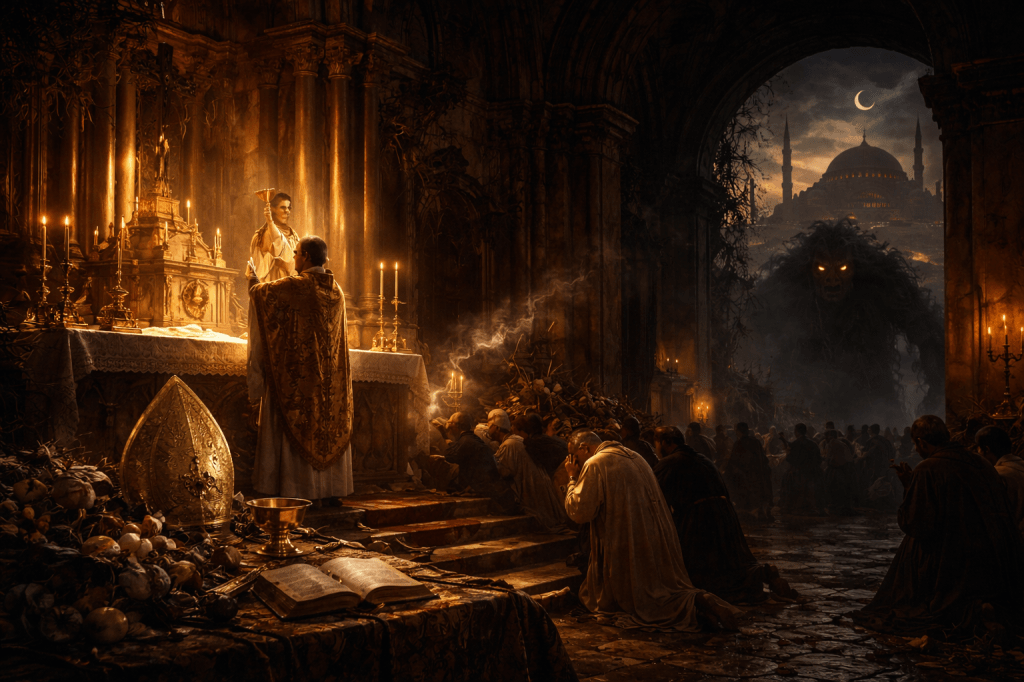
A brief history of the Church and the monster that we made
Fully three quarters of the Christian world that existed in the time of Muhammad has been conquered and consumed by Islam.
When Muhammad died in the year 632, Islam existed only on the Arabian Peninsula.
Egypt and the rest of North Africa, the Levant and most of the Middle East, Anatolia (modern-day Turkey), and even some portions of India were major Christian population centers at the time. Today, they are Muslim strongholds and have been for so long that it often comes as a surprise to casual observers of history that they were ever otherwise. Christians still exist in some of those places, but as marginalized minorities – dhimmis: second-class citizens whose freedom to openly live out their faith is subject entirely to local Muslim tolerance, which is typically in short supply, per the directives of Sharia.
Christianity is the largest religion in the world today, but if it hadn’t been for New World colonization – if the Islamic conquest of Constantinople (among other encroachments) hadn’t driven Christendom to the desperation that fueled the Age of Exploration – it’s debatable if Christianity would still exist today at all.
And, by all indications from recent and ongoing demographic trends, it is entirely possible, if not likely, that Islam will overtake Christianity as the dominant religion in the world within a generation or two, as major cities in the West become increasingly Islamized through mass-migration and Christianity continues its downward slide.
The Scourge of God?
I bring all this up because, whenever I raise the issue of the Church’s collective, functional apostasy and observe the very conspicuous derailments in previous centuries that brought us to this state, Christians can be counted upon to recoil in pious offense.
“What?! You don’t think God is in charge? You don’t think Jesus guides his Church by the Holy Spirit and protects us from error and harm?”
But if it’s that simple, why did God allow the majority of the ancient and medieval Church to be wiped out by a rival, hostile religion? Why did He allow the humiliation, brutalizing, mass-murder and near extinction of His people at the hands of marauding hordes claiming to act on His behalf?
I have yet to encounter a Christian who is offended by my observations about the state of the Church who can reconcile the plain facts of history with the assumptions undergirding that offense.
It is commonly taken for granted as a matter of dogma – even by Protestants, for some reason they can never quite explain – that God simply will not allow the Church to fall into serious error, so that whatever Christians have been doing for X-amount of time must be what God wants us to have been doing.
Of course, Christians will acknowledge the errors of other denominations and traditions – Protestants will freely condemn, for instance, the pagan idolatry to which worship of Mary and prayer to “saints” amounts, and the unbiblical authoritarianism exhibited by the existence of the Papacy and Catholic priesthood. But, like everyone else, when it comes to their own traditions and dogmas, they assume that God has been a doting helicopter parent setting up guardrails along the way to prevent their own institution’s lapse into serious error.
While it is undeniably true that the Bible indeed teaches that God is sovereign, Jesus Christ rules at the right hand of the Father, and the Holy Spirit dwells within Christ’s followers to “lead into all truth,” Christians tend to vastly oversimplify all of this, gloss over the all-important conditions of such promises and assurances, and completely ignore all of the frequent and emphatic warnings against deception, complacency and error:
The gate is wide and the road is broad that leads to destruction, and many enter through it; but small is the gate and narrow is the road that leads to life, and few find it, Jesus warned.
So, anyone looking for safety in numbers and security within institutional consensus is simply ignoring our Lord’s explicit guidance.
“Watch out for false prophets,” he said in the very next breath. Such people come in pious, non-threatening disguises, but are vicious beasts underneath their costumes, the Lord said.
Such deceivers will come in the very name of Jesus, and they will be numerous, he also warned.
The apostle Peter repeated this warning, adding that such false teachers will “make a business” (Greek: “emporeusantai”) out of believers using “plastic words” (“logoi plastois”) – church will be big business, exploiting the elasticity of language and the gullibility of the public to enrich and empower themselves at the expense of Christians who fail to be vigilant and discerning, he foretold.
When Paul left Ephesus for the last time, he met with the elders of the church and wept as he warned them, “I know that after I leave, savage wolves will come in among you and will not spare the flock. Even from your own number men will arise and distort the truth in order to draw away disciples after them. So be on your guard!”
Conspicuous by their absence are any assurances anywhere in the Bible that God Himself will guide the Church to actively prevent error and apostasy.
Many will cite Jesus’ declaration to Peter that “on this rock I will build my Church, and the gates of Hell will not overcome it” as such an assurance, to argue that the Church, on principle, can never fail, never fall into error and apostasy.
But that’s just not what he said. Gates are defensive. The illustration Jesus made was of the Church laying siege to the Enemy’s fortress and tearing down its defensive walls to conquer the territory within. It is an assurance that, if the Church is faithful and on-mission, we will be unstoppable. Anyone who reads that as a blanket, unconditional assurance that the Church is simply immune to attack and deception only gets that meaning because they want so desperately to find it, and they have to ignore the overwhelming proliferation of other passages warning against exactly that kind of complacency. He said the Enemy’s walls would crumble, if we attack. He never said our own walls are impervious, so we need not keep watch.
Quite the contrary: the warnings are so prevalent and so insistent that – but for constant vigilance and strict discipline – it should be our default expectation that error and apostasy will have infiltrated and deceived the Church.
Can anyone sincerely claim to believe that constant vigilance and strict discipline has characterized the Church at any point in our history?
And, this would be consistent with the thoroughly established pattern of God’s people.
After returning from exile and confronting the Israelites with the sin that led to it, the Levites recounted the Israelites’ history in a prayer of repentance:
“But they were disobedient and rebelled against You; they turned their backs on Your law. They killed Your prophets, who had warned them in order to turn them back to You; they committed awful blasphemies. So You delivered them into the hands of their enemies, who oppressed them. But when they were oppressed they cried out to You. From heaven You heard them, and in Your great compassion You gave them deliverers, who rescued them from the hand of their enemies. But as soon as they were at rest, they again did what was evil in Your sight. Then You abandoned them to the hand of their enemies so that they ruled over them. And when they cried out to You again, You heard from heaven, and in Your compassion You delivered them time after time.” (Nehemiah 9:26-28)
“These things happened to them as examples and were written down as warnings for us, on whom the fulfillment of the ages has come,” wrote Paul to the Christians in Corinth.
As in, Christians should not look to the Old Testament and think the pattern of apostasy, punishment and restoration was unique to Israel and the Jews, and something to which the Church is immune or protected. The Church is vulnerable to the same patterns, and history has borne this out.
But, of course, as it turns out – God has indeed guided the Church by the Holy Spirit to protect against error and lead us into all truth, because He has provided the Bible, so that we are never so deep into error that we are beyond recovery. It is by reference to the Bible that we should see plainly how dire our need for that recovery is, as we’ve seen so far and as we’ll explore in what follows.
The War of Two Kingdoms
When Jesus was tempted in the wilderness, the Devil took him to a high place and showed him all the kingdoms of the world and told him, “I will give you all of their authority and glory; it has been surrendered to me, and I can give it to anyone I choose. If you worship me, it will be yours.”
This episode provides a glimpse into what has come to be known in recent years as “the Divine Council worldview,” according to which, God delegates authority to lesser, created “gods,” who now rule this world.
Originally, God gave authority over creation to Man, but by his disobedience in the Garden, Man effectively ceded that authority to the Serpent – the divine being later referred to as “Satan” or the “Devil”: the very one who tempted Jesus.
Also, when humanity collectively rebelled again at the Tower of Babel, God gave them over to the rule of the gods who now preside within the Divine Council.
In passages like Job 1, we see how the Devil exercises that authority: he brings an accusation of sin and disloyalty against Job and God allows him to prosecute. Our sin gives the Devil authority. And because we are collectively fallen, this gives the Devil and his cohort authority over the entire earth and all nations of the world.
This is how the Devil was able to offer up the kingdoms of the world to Jesus as his own possession – because he is the “god of this age” and “the prince of this world.” His authority over this world is real, according to the Bible.
I don’t believe that the temptation was for Jesus to render a mere token gesture of deference, such as bending the knee or bowing before him. The temptation to “worship” was in adopting the Devil’s methods, as every ruler under the Devil’s authority had before: taking up the sword and imposing authority by force, through conquest. The temptation was to become the popularly expected version of the Messiah awaited by the Jews at the time: King David riding in on a white horse to overthrow the Roman Empire through a military uprising to establish a Jewish empire in its place, with himself as a Jewish Caesar/God-emperor, ruling from Zion.
By taking up the sword to impose his rule by force, Jesus would have been putting himself under the Devil’s authority, which would have saved no one. It would have merely replaced one blood-soaked empire with another, leaving humanity in no better position.
The world could not be saved through violence. Instead, he had to accept the violence of the world upon himself, exercised on the Devil’s behalf, in order to pay the penalty for humanity’s sin, thereby denying the Devil the authority of his accusations.
Having died for the sins of the world and being raised again in glory, Jesus won humanity out from under the Devil’s authority, and that is why he was able to tell his followers before his ascension and enthronement:
“All authority in heaven and on earth has been given to me. Therefore go and make disciples of all nations, baptizing them in the name of the Father and of the Son and of the Holy Spirit, and teaching them to obey everything I have commanded you.”
So, Jesus has all authority there is – he has defeated the Devil and the corrupt gods of the Divine Council. All of those kingdoms of the world and their splendor that were offered by the Devil are now rightfully his, on his terms and God’s terms, because he purchased them with his own blood instead of taking them by force.
He has all authority over the nations, but he does not have the obedience of the nations, quite plainly.
Eventually, he will return to exercise that authority visibly on earth, ruling the nations from the throne of David, but his kingdom is only for those who willingly, voluntarily and enthusiastically obey him, out of faith. Those who reject his rule in favor of the Devil’s will meet with the same fate as the Devil, which is death and eternal exclusion from God’s Presence.
So, it is the mission of the Church to extend his offer and to persuade the nations of the world to voluntarily enter into covenant with God through him (i.e., baptism), to obey Him willingly (discipleship), and thereby be reconciled to God and freed from the Devil’s power.
The New Testament writers were clear and consistent that this salvation is by grace, through faith, not by the works of the law, i.e., coercion by threat of violence.
That salvation consists of God’s own Spirit descending to dwell within us – as individuals and collectively as the Church, both to regenerate us into the likeness of Christ himself, as well as to empower us as the new temple and priesthood: God’s very Presence on earth. The Church, for all intents and purposes, is the Messiah, the Body of Christ.
“I tell you the truth, whatever you bind on earth will be bound in heaven, and whatever you loose on earth will be loosed in heaven,” Jesus told the very first members of the Church. “Again, I tell you the truth that if two of you on earth agree about anything they ask for, it will be done for them by my Father in heaven. For where two or three gather in my name, there am I with them.”
Because of Christ’s sacrifice and his dwelling within us by the Spirit of God, the Church acts in the world with the very power and authority of Christ himself.
And, we can see this in the early days of the Church, when the apostles and other early Christians performed miraculous healings and commanded spirits and persuaded vast multitudes to renounce their worship of demons to worship the true God.
In this way, the kingdom of God advanced in the world, becoming a major world religion in a single generation, and continuing in power for generations after.
The Church faced violent opposition from our fellow man but could not be stopped, because – while humans were free to resist, the spiritual forces of darkness that ruled over those humans were impotent before the power of God dwelling within the Church. Death had no power over the Church, because Christians had no fear of death. It was a hated enemy, but a defeated one through Christ’s resurrection, and so the blood of martyrs only made the Church grow more powerful.
The Betrayal
Late in the year 312 AD, on the eve of a battle that would decide the entire future of humanity, the young Emperor Constantine reportedly looked to the sky in search of guidance and assurance from his god, Sol Invictus, the “Unconquered Sun.” And divine guidance he received, but not from whom he expected. Superimposed against the sun, he saw the Chi Rho – the sigil of the God worshiped by the Christians, accompanied by words written in light, “In hoc signo vinces.”: “In this sign, conquer.”
On his orders, his men painted the sign on their shields, and after their against-all-odds victory over the rival Emperor Maxentius at Milvian Bridge outside Rome, Constantine credited his triumph to the One whose sign it was, and so became a Christian.
That, at least, is the version of events we get from Constantine’s biographer and pro bono panegyrist, Eusebius of Caesarea, who also wrote the first surviving history of the Church after the Book of Acts.
If there were skeptics of this story at the time, they were few and far between and their words would have fallen on deaf ears, because the historically uncontestable outcome of this battle was so surrealistically too-good-to-be true for Christians that any religious embellishment would have been superfluous: this was divine deliverance, as far as they were concerned, with or without a supernatural vision.
A few months after his victory, Constantine issued the Edict of Milan, which legalized Christianity. His predecessor Diocletian had presided over the longest and most brutal, empire-wide, systematic persecution of Christians in history. And now, Christians received news that – not only was the persecution finally at an end, but that Christianity was, at long last, officially protected by law. And not only that, but – miracle of miracles – one of their own now sat upon the throne of imperial power.
To Christians who had just survived that brutal preceding decade of persecution, this was a miracle that could have been exceeded by nothing short of the second coming of Christ himself.
So, their lack of discernment in what followed is understandable on its own.
But, when considered alongside the centuries of gradual doctrinal drift discussed in the preceding article, it was virtually inevitable. Christians had already lost the plot, and so now they couldn’t recognize the Villain of the story when he was standing right in front of them.
Constantine is often blamed/credited with making Christianity the official religion of the Roman Empire. Technically, that wouldn’t happen for another several decades when Emperor Theodosius issued the Edict of Thessalonica in the year 380. But Constantine set the stage.
Exile, property confiscation and other social restrictions for dissenters from Christian orthodoxy already had precedent under Constantine and his immediate successors, but soon after Theodosius’ edict, imprisonment, tortures and capital punishments would be prescribed by law for heretics and pagans.
The first person executed for heresy was Priscillian, bishop of Avila, in the year 385, under Emperor Magnus Maximus.
This provoked sharp criticism from many Christian leaders, but it was largely a matter of jurisdictional concern – they were outraged that a secular civil court would issue such a ruling on what they regarded to be an ecclesiastical matter. Many of those critics thought a line had been crossed by the use of capital punishment, but there was no real controversy over the use of state coercion to enforce religious compliance as a matter of general principle.
But Christians would soon become acclimated to the full use of coercive violence by the state to enforce compliance with Catholic Orthodoxy. Imprisonment, torture and execution would become systematized and institutionalized tools of the Church for the next thousand years and beyond.
When Christianity began, Death was a hated, bitter enemy, but it was defeated by the divine weapon of the apostolic testimony of Christ’s resurrection. The enemy threatened death upon Christians, but to no avail, because Death holds no fear for immortals – the children of God imbued with His very Nature unto eternal life.
As the centuries went on and the attention of the Church drifted from the original gospel of Jewish Christianity about God’s ongoing and eventual renewal of this creation, turning instead to Platonic and pagan metaphysics about soul migration to a “spiritual” afterlife beyond this world, the lines began to blur about what the objectives of the Church’s war even are, and who the true enemy is.
After the Church merged with the Roman state through the reigns of Constantine and Theodosius, it took Death as a welcome ally, using it as a weapon to ensure conformity.
The content of the Christian religion had already changed in those preceding centuries, but now the very nature of “faith” was mutilated beyond recognition. Previously – and even with the doctrinal errors that had infected the Church – “faith” was a personal trust in God through Jesus Christ, grounded in the foundation of having been rationally persuaded of the truth of the resurrection.
But after Theodosius, what they called “faith” was just a matter of having been born into a society ruled by clergy, who might execute you if you don’t accept their institutional conventions. You weren’t free to investigate whether Christianity is true in order to even become persuaded on rational, objective terms, because it wasn’t open for debate. Christian doctrine now existed in a totally different category of thought, protected from any rational challenge.
And this perversion and hollowing-out of biblical faith served to undermine the individual Christian. Biblically, that individual, rationally-grounded faith is the catalyst for the transformation into Christ-likeness that was taken for granted as the rule for the normative Christian life. But with “faith” reduced to mere civic conformity in avoidance of punishment, that catalyst wasn’t there, nor was the objective of transformation even consciously present. The objective was to get into heaven, not to be the advance force of heaven’s arrival here on earth.
That isn’t to say that genuine Christianity was completely dead and absent from the world, but insofar as it still existed, it was an outlier, pursued in monasteries and other alternatives to the normal institutional routine. The default “Christianity” was a matter of skin-deep cultural and civic compliance. The institutional Church had become an obstacle and hindrance to true Christian spiritual life, not the means to it.
And this should be obvious to us by the fact that, in the New Testament, all Christians are, by definition, “saints” – holy ones. But in the traditional institutionalized Church, a “saint” is a special, exalted, super-Christian – defined by being the exception to the normal and expected Christian life.
The Devil’s Due
Where Christ rejected the Devil’s temptation to take power through violence and state coercion, the Church bent the knee.
Just like in the Garden, just like Israel’s fall into Baal worship and other infidelities, just like the Jewish religious leaders’ worship of institutional power rather than their Messiah – the Church took the enemy for a welcome ally and betrayed our God.
And this gave the Devil a rightful claim of authority in the world.
He can’t make an absolute claim over the Church. We are bought by the blood of Jesus, and the Devil can never undo that or snatch us from the palm of God’s hand.
But that doesn’t mean our sin has no consequence and the Devil is totally impotent against us.
We were warned quite persistently of the contrary.
And we are not passive infants, incapable of action, that God bypasses our wills and moves us unwittingly or protects us against our own choices. We are responsible agents and our actions have consequences. God created us for such agency, and our salvation consists of being restored to it, and it matters how we exercise it. Our choices have real and meaningful stakes.
And our choice to take up the Roman sword had dire, devastating consequences that plague us to this day.
If we take into consideration all of those passages in the Bible that depict the Divine Council in operation, we can envision something like the scene that must have played out in heaven after the Church succumbed to the Roman state’s unholy marriage proposal:
“Your Covenant People belong to You, but they have taken up my methods,” the Devil taunted Christ.
“Your claim is greater than mine, but I still have a claim. What they have loosed on earth … have they not also loosed in heaven? And what they have loosed in heaven, should it not bear fruit on earth? The measure they use – should it not also be measured to them? Have they not, in Your Name, given me the right to act accordingly against them? But if I cannot touch them, because they belong to You, do I not have the right to a substitute? Do I not have the right to raise up a church of my own?”
And our Lord, by all evidence of history, granted his claim as legitimate.
So, because of our submission to his temptation, the Devil was allowed to create an Anti-Church – a church that is the mirror-opposite to everything the True Church is supposed to be, just as the Anti-Christ is the antithesis to and counterfeit of Christ himself.
Whereas the Church is supposed to teach us to master and subjugate our flesh and animal appetites – to conquer our sexual lusts and violent aggressions and avarice for wealth and ambitions for power, the Anti-Church teaches its followers to embrace these and provides a religious legitimacy to them. They are motivations and virtues to cultivate, not sins. The True Church is supposed to teach us to love our enemies and bless those who persecute us and use rational persuasion to win them to God. But in the Anti-Church, “God” is best served through violent conquest. Taking sex slaves and plunder, and terrorizing, humiliating and slaughtering all who refuse to submit are holy sacraments within the Anti-Church. The surest guarantee of “God’s” favor is to die through the course of murdering enemies, not loving them.
The True Church took up the sword and merged with the state to use coercion as a betrayal of our mission and identity in Christ. The Anti-Church embraces coercion by threat of violence as its very essence and identity.
The True Church is tasked with teaching people to pursue holiness by mortifying the lower, bestial nature in order to live instead by the Holy Spirit. The Anti-Church turns men into vicious beasts and calls it “holy.”
Islam is the bastard child of that unholy union between the Church and the Roman imperium, adopted and raised by the Devil himself in order to bring out the worst qualities of both. Islam is the “Grendel” to our “King Hrothgar” (if we go by the movie version of “Beowulf,” that is) – it is the offspring of our infidelity, returned to punish us for siring it.
It is our own bastard child, and therefore our responsibility.
That is to say – Muslims are the true victims, and only we can save them.
This is true of all nations who are alienated from God and under the Devil’s rule, but it is even more true of Muslims. Through no fault of their own, they were born into a darkness more pervasive and destructive than any other false religion, because it is a darkness borne of our sin as the Church.
No One is Coming to Save Us
Through the Protestant Reformation and the American Revolution and the example of our Constitution and Bill of Rights, the Church has largely – albeit bumblingly and incompletely and almost despite itself – repented of the particular sin that conceived Islam. It came at great cost and through centuries of struggle, but we have rid Christendom of outright religious coercion by state violence.
At this point, though … Big deal. We still have Islam. And we haven’t fully reckoned with that sin, nor addressed all of the many shortcomings of the Church that led to it, which we have inherited. We haven’t restored that genuine, transformative faith grounded in reason, but still rely predominantly on indoctrination and social conditioning to inculcate Christian identity, and so as the Church, we are still weak and still vulnerable to temptation and shortcuts.
And, as I might have mentioned already – the Church is dying. It’s great that we stopped torturing out confessions from heretics and burning them at the stake, but lately, that’s more because we lack the option than from actual repentance and conviction against it on principle.
And, as Islam continues to menace the West and Christians flirt with so-called “Christian Nationalism” as the proposed solution to that and other growing social problems, my fear is that we’re on the path to repeating all of those past mistakes.
But this time, there is no New World to provide a path of escape. The world is full, and our enemies are at gate.
We know that Christianity will never ultimately be extinguished in the world and that Christ will eventually triumph over all of his enemies. God’s purposes will be fulfilled, inevitably.
But that doesn’t mean there aren’t serious, devastating consequences to losing today.
“This gospel of the kingdom must be preached to all nations, and then the end will come,” said Jesus.
“Preaching the gospel” isn’t just speaking a message and seeing what sticks and who responds. It’s the Great Commission: It’s making disciples of the nations and teaching them to willingly obey.
The Church itself barely has any concept of what “discipleship” means, much less are we winning the nations over to obedience to Christ. We are losing ground daily. Mosques are popping up everywhere by the thousands while church buildings are being abandoned for disuse by the tens of thousands.
Victory doesn’t happen until the job is done, and it’s the Church’s job to do it, and if the Church doesn’t do it, no one will.
God has all the time there is. Whether ultimate victory comes in 10,000 years, after we’ve finally broken our pattern of apostasy and risen to our mission as the Church, or if it happens in our lifetimes – it’s up to us. God has put it into our hands, and He won’t do it for us.
As in, He’s not coming to save us.
But, He doesn’t need to. The Savior already came, and so he’s already here – in us. For those of us who truly belong to him, we already have all the power we need to save the Church, and then the world.


 The Third Helix
Pingback: The Endurance of the Church: History, Apostolic Continuity, and the Myth of Christian Collapse – Be Prepared To Give a Defense